
When an AC device is tested only under a fixed and stable utility supply, important performance problems can remain hidden.
Motors, compressors, industrial controllers, power electronics, transformers, pumps, and other AC equipment may operate differently when input voltage, frequency, load, or power quality changes. A product that performs well at nominal conditions may show excessive current, overheating, vibration, unstable control, reduced efficiency, or unexpected faults when operating outside those conditions.
This is why a Variable Frequency Power Supply is increasingly important for AC equipment testing.
Instead of relying entirely on the local utility grid, engineers can use a controlled AC power source to reproduce different operating conditions, evaluate equipment behavior, and identify problems before field deployment.
For R&D teams, test laboratories, equipment manufacturers, and system integrators, controlled frequency testing provides a more repeatable way to validate AC equipment performance.
ⅠIndustry Pain Points: Why Fixed-Frequency Testing Is Not Always Enough
Most commercial power grids provide relatively stable voltage and frequency. This is convenient for normal operation but can be a limitation during engineering testing.
1. Equipment may operate under different frequency conditions
AC equipment can be designed for different electrical environments, such as 50 Hz, 60 Hz, or application-specific frequencies.
A motor designed for one frequency may experience changes in speed, current, torque, heating, and efficiency when operated at another frequency.
For example, for an induction motor, synchronous speed is related to supply frequency:
Ns = 120 × f / P
where:
· Ns = synchronous speed in rpm
· f = supply frequency in Hz
· P = number of poles
Changing the frequency therefore changes a fundamental operating parameter of the motor.
2. Grid conditions cannot always reproduce test requirements
A factory or laboratory may need to test equipment at frequencies that are not available from the local utility.
Using the grid as the only test source makes it difficult to systematically reproduce different operating conditions.
A programmable frequency power supply can solve this problem by allowing engineers to establish controlled test points.
3. Intermittent faults can be difficult to reproduce
Some failures occur only under specific combinations of voltage, frequency, and load.
Without a controllable AC source, engineers may have difficulty determining whether the problem comes from:
· Equipment design
· Frequency sensitivity
· Input voltage variation
· Control-system behavior
· Thermal stress
· Power-quality conditions
· Interaction between the equipment and its power source
Repeatable power conditions make troubleshooting much more systematic.
4. Testing failures can become expensive
Finding a problem after installation can involve equipment removal, engineering rework, field service, and schedule delays.
Testing different input conditions during R&D and pre-production can reduce these risks by identifying abnormal behavior earlier.
Ⅱ Working Principle: How a Variable Frequency Power Supply Works
A Variable Frequency Power Supply converts an available electrical input into a controlled AC output with adjustable electrical parameters.
A simplified architecture can be represented as:
AC Input → Power Conversion → Regulation & Control → AC Output → Test Equipment
Depending on the system architecture, the power supply may regulate parameters such as:
· Output voltage
· Output frequency
· Output current
· Output power
· Phase configuration
· Voltage/frequency relationship
· Protection limits
The control system allows engineers to establish defined test conditions and repeat them as required.
For example, an AC motor can be tested sequentially at different frequencies while engineers monitor current, speed, temperature, vibration, and output performance.
This creates a controlled relationship between the input electrical condition and the equipment response.
Why frequency control matters
Frequency is not simply another adjustable number.
For many AC loads, frequency directly influences electrical and mechanical behavior. A controlled frequency source can therefore be used to investigate:
· Motor speed response
· Starting characteristics
· Current changes
· Thermal behavior
· Control-system stability
· Efficiency
· Abnormal operating conditions
· Frequency-dependent faults
This makes frequency control particularly valuable during product development and qualification testing.
Ⅲ Selection Guide: How to Choose a Frequency Power Supply for AC Testing
The correct power supply should be selected according to the equipment under test rather than simply choosing the highest available power rating.
| Selection Parameter | What Engineers Should Check | Why It Matters |
| Output power | VA / kVA / kW requirement | Determines whether the source can support the load |
| Output voltage | Required AC voltage range | Must match the equipment test specification |
| Frequency range | Required Hz range | Determines available test conditions |
| Phase | Single-phase or three-phase | Must match the equipment architecture |
| Voltage regulation | Stability under changing load | Helps maintain repeatable test conditions |
| Frequency accuracy | Frequency deviation | Important for controlled testing |
| Load type | Motor, electronics, transformer, heater, etc. | Different loads have different requirements |
| Peak/inrush current | Starting or transient current | Important for motors and capacitive loads |
| Protection | Overcurrent, overvoltage, overtemperature, etc. | Protects both source and test equipment |
| Control interface | Local, analog, RS485, Ethernet, etc. | Supports automated testing and integration |
Ⅳ Technical Solution: Building a Better AC Equipment Test System
For industrial testing, the frequency power supply should be considered part of the complete test system.
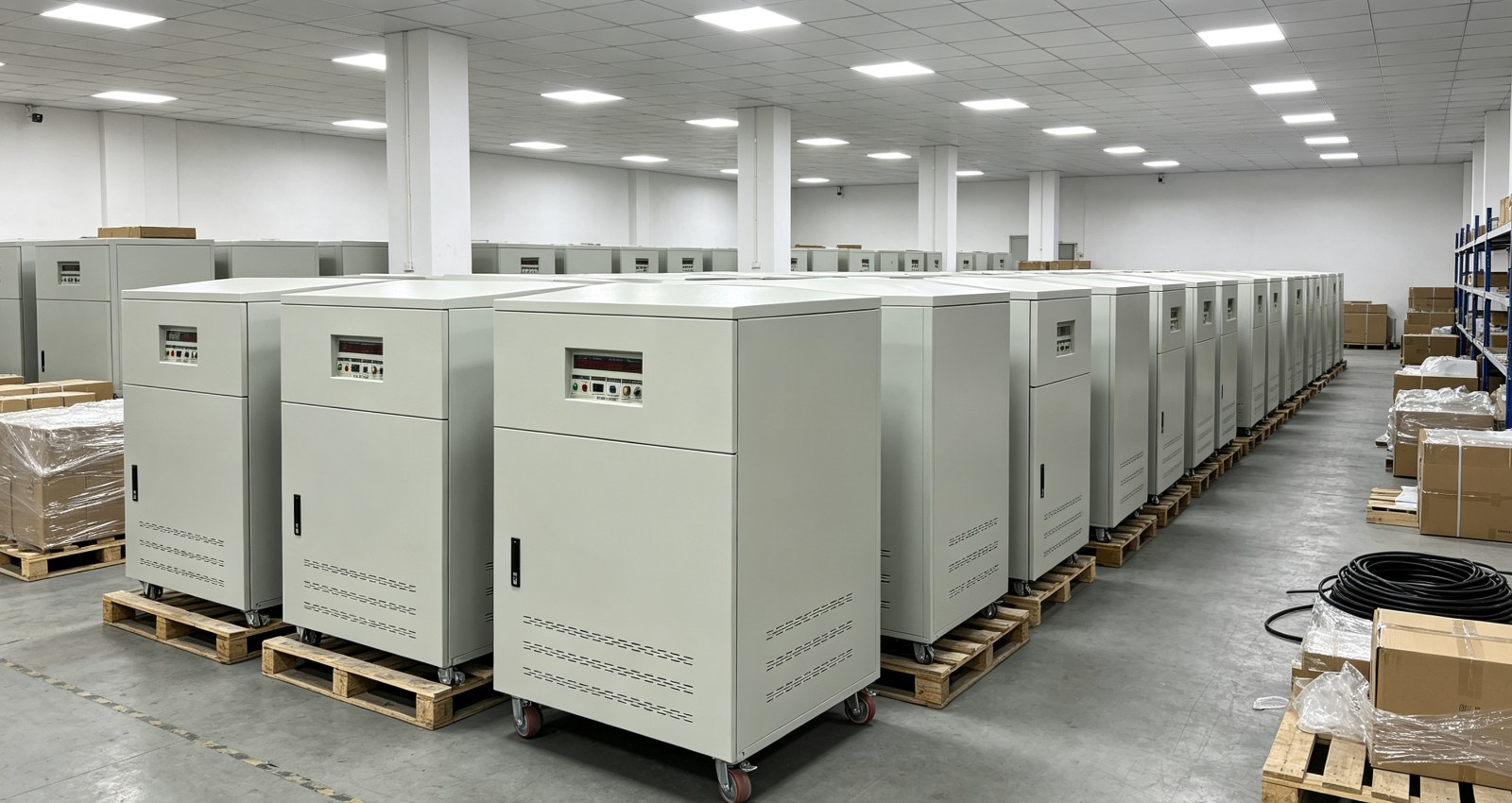
IDEALPLUSING can support AC power requirements according to the equipment’s electrical specifications, test conditions, and application environment.
Depending on project requirements, the solution can be evaluated around:
Adjustable Electrical Parameters
The required voltage, frequency, phase configuration, and power level can be matched to the application.
For specialized testing, engineers can also evaluate wider adjustment ranges or application-specific operating points.
Application-Oriented Configuration
A motor test system has different requirements from an electronic power supply test, transformer test, or industrial control-system test.
The power source should therefore be selected according to:
Load characteristics + nominal rating + transient behavior + required test conditions.
Protection and Monitoring
For laboratory and industrial applications, protection functions are important because abnormal load conditions can occur during testing.
Typical considerations include:
· Overcurrent protection
· Overvoltage protection
· Overtemperature protection
· Short-circuit protection
· Output monitoring
· Fault indication
Customized Integration
Some customers require more than a standalone AC source.
Depending on project requirements, a customized solution may include:
· Specific input/output configurations
· Different voltage and frequency ranges
· Communication interfaces
· Remote control
· Monitoring functions
· Rack or cabinet integration
· Integration with automated test equipment
CTA 1 — Talk to an Engineer
If you are testing motors, industrial AC equipment, or other frequency-sensitive loads, contact our engineering team with your voltage, frequency, power, phase, and load requirements. We can help identify the appropriate frequency power supply configuration.
Ⅴ Application Case: Motor and Industrial Equipment Testing
Consider a typical engineering test scenario in which an industrial motor needs to be evaluated under multiple frequency conditions.
Instead of testing only at the local 50 Hz or 60 Hz grid frequency, engineers can establish several controlled operating points.
A simplified test sequence could be:
Step 1: Test at nominal voltage and frequency
Step 2: Change frequency to evaluate speed response
Step 3: Monitor input current and temperature
Step 4: Evaluate efficiency and mechanical output
Step 5: Repeat the test under different load conditions
Step 6: Record abnormal behavior and compare results
The important engineering benefit is repeatability.
For example, if a motor shows abnormal temperature rise at a particular frequency, engineers can reproduce that condition and investigate the relationship between frequency, current, load, and thermal behavior.
This type of controlled testing can help identify design problems before equipment reaches field installation.
Engineering note: Actual test limits, frequency ranges, voltage levels, and acceptance criteria should always be defined according to the equipment specification and applicable test standard. The example above is an engineering methodology, not a guaranteed performance result.
CTA 2 — Download Technical Information
Need help defining the correct voltage, frequency, power, and phase requirements? Request our Frequency Power Supply Selection Guide / Technical Datasheet to compare suitable configurations before specifying equipment.
Ⅵ From R&D to Production Testing
The value of a variable frequency source is not limited to laboratory development.
It can support multiple stages of the equipment lifecycle:
R&D → Prototype Testing → Design Verification → Production Testing → System Integration → Troubleshooting
During R&D, engineers may use it to investigate operating characteristics.
During design verification, the same concept can help reproduce defined electrical conditions.
During production testing, a controlled AC source can provide a repeatable input environment for functional verification.
For system integrators, it can also help verify whether equipment behaves correctly under the electrical conditions expected at the installation site.
This makes a programmable AC power source a useful engineering tool rather than simply another piece of laboratory equipment.
CTA 3 — Request a Customized Solution
If your application requires a specific AC voltage, frequency range, power rating, phase configuration, communication interface, or mechanical integration, send us your technical requirements for a customized power solution and quotation.
FAQ
1. What is a variable frequency power supply?
A variable frequency power supply is an AC power source that allows engineers to control the output frequency, and typically other parameters such as voltage, for testing or operating electrical equipment.
2. Why is variable frequency power supply important for AC equipment testing?
It allows engineers to reproduce different electrical operating conditions in a controlled and repeatable environment rather than relying only on the local utility grid.
3. Can a frequency power supply be used for motor testing?
Yes. It can be used to evaluate motor behavior under different frequency and voltage conditions, including current, speed, thermal response, and efficiency-related characteristics.
4. What is the difference between a frequency converter and a variable frequency power supply?
The terminology can vary by application. A frequency converter may focus on converting an input frequency to another frequency, while a programmable frequency power supply is typically designed to provide controlled electrical output conditions for equipment operation or testing.
5. What frequency range should I choose?
The required range depends on the equipment specification and test procedure. Engineers should first identify the nominal frequency and the minimum and maximum frequencies required for testing.
6. Can a variable frequency power supply simulate different grid conditions?
It can reproduce defined voltage and frequency conditions within its specified operating range. However, the exact ability to simulate power-quality events depends on the power supply’s architecture and available functions.
Conclusion
AC equipment cannot always be fully validated under a single fixed grid condition.
A Variable Frequency Power Supply provides engineers with a controlled way to adjust frequency and other electrical parameters, making it easier to investigate motor behavior, equipment stability, efficiency, thermal performance, and frequency-related faults.
For R&D laboratories, industrial equipment manufacturers, testing organizations, and system integrators, the main value is repeatable electrical testing.
The right solution should be selected according to the actual load, voltage, frequency, power, phase, transient behavior, control requirements, and test methodology.
If you are developing or testing AC equipment, start with the application requirements rather than the power supply model. Share your input voltage, required frequency range, power rating, phase, load type, and testing objective with IDEALPLUSING to evaluate a suitable frequency power solution.