
Aircraft parked inside hangars do not automatically power down all onboard electronic hardware. During aircraft maintenance, avionics testing, electrical system inspections and fault diagnostics, many onboard systems still rely on stable external power from ground power units. Beyond delivering energy, ground power forms an integral component of the overall maintenance-and-test operating environment.
A critical question arises: will voltage swings, undervoltage, overvoltage, frequency drift, harmonic distortion, voltage sags or transient overvoltages originating from ground power sources inflict harm on aircraft-borne electronics? There is no straightforward yes-or-no answer. Minor, short-lived power deviations may trigger built-in equipment protection mechanisms, initiate component reboot or abort ongoing test sequences. Yet severe deviations of sufficient magnitude or duration that exceed hardware-specified input thresholds can raise electrical stress on internal power modules and semiconductor components. Under extreme scenarios, permanent hardware impairment may follow.
For aircraft maintenance crews, a more practical concern emerges: how do sub-standard power conditions skew equipment behaviour, distort test readouts and mislead technical judgements made during troubleshooting?
I. Aircraft Maintenance Risks Extend Beyond Direct Hardware Failure
Within Maintenance, Repair and Overhaul (MRO) facilities, power-related issues seldom manifest as immediate, visible component burnout. Most complications surface by disrupting scheduled maintenance workflows.
1. Abrupt power loss amid active testing
During avionics validation cycles, sudden voltage sags from external power supplies can force aircraft hardware or connected test instruments into protective shutdown states, terminating test runs mid-execution. After power restoration, technicians must reconfirm equipment status, cross-check configurable parameters and rerun segments of previously-interrupted test routines.
The causal chain unfolds as: power quality anomaly → test abortion → parameter re-configuration → repeated test execution → extended maintenance turnaround time. For operations prioritising minimum aircraft ground time, such unplanned overhead directly degrades workshop throughput.
2. False fault indications driven by supply irregularities
This represents one of the most insidious failure modes encountered in hangar operations. When avionics generate fault alerts during testing, technicians normally start diagnostics by examining physical hardware, wiring looms and connector interfaces. Where root causes stem instead from unstable incoming power, diagnostic efforts get diverted toward incorrect failure sources.
Sequence example: ground power abnormality → altered equipment operating status → system fault alarms → misdirected troubleshooting workflows. Outcomes include redundant diagnostic cycles, unnecessary component disassembly-reassembly work, and even replacement of fully functional parts diagnosed erroneously as defective. Reliable ground power therefore serves not merely for hardware safeguarding, but also for curbing wasted effort stemming from misleading fault diagnoses.
3. Inconsistent test outputs for identical units
Repeatability constitutes a core requirement for maintenance-oriented verification procedures. When running identical test scripts against one piece of hardware yields divergent outputs across separate test sessions, technicians must isolate whether variance originates within the unit-under-test, or stems from shifts in ambient test conditions. Input voltage fluctuations during test execution introduce power supply itself as an uncontrolled experimental variable.
Consistent ground-fed power enhances:
· Repeatability of test measurements
· Diagnostic efficiency for fault isolation
· Credibility of captured test datasets
· Completeness and traceability of maintenance documentation
II. Categories of Power-Quality Disturbances Impacting Aircraft Electronics
Different classes of power disturbance generate distinct failure pathways. Risk assessment cannot rely purely on disturbance classification alone. Three interacting variables must always be weighed: disturbance magnitude, disturbance duration, and hardware input tolerance limits.
Take voltage sag events for illustration: brief, low-magnitude deviations may only activate on-board power management routines. Prolonged severe undervoltage outside hardware tolerance windows, by contrast, triggers system resets and forced protective shutdowns.
The table below outlines prevalent power-quality anomalies, underlying physical stress mechanisms, direct consequences observed at test benches, and desirable performance attributes for ground power hardware to mitigate these risks.
Table 1
Type of power-quality anomaly | Typical observable symptoms | Potential hardware impacts | Direct impacts on maintenance and testing | Recommended power-unit performance features |
Overvoltage / transient surge voltages | Supply levels exceed rated limits; short-duration high-amplitude voltage spikes | Elevated electrical stress on input circuits, power conversion stages and protective components; permanent component damage under severe conditions | Overvoltage protection activation; forced equipment shutdown; catastrophic hardware failure in worst-case scenarios | Tight output-voltage accuracy, over-voltage-protection (OVP), robust transient-suppression performance |
Undervoltage / voltage sag | Supply falls below permissible thresholds; sharp short-term voltage drop-offs | Insufficient input voltage for internal power-conversion circuits, potentially disrupting normal operation | System resets, alarm signalling, communication dropout, premature test termination | Stabilised output delivery, fast dynamic load-response characteristics, well-calibrated undervoltage protection |
Voltage Fluctuation / Transient Deviation | Brief output-voltage offsets triggered by load transitions or grid-side supply variations | Increased regulation burden placed on internal power conversion and stabilisation circuits; degraded operational stability | Scattered test-data variance, poor measurement repeatability, higher complexity for fault-source identification | High output stability, fast transient recovery, precision closed-loop voltage regulation |
Frequency deviation / harmonic waveform distortion | AC operating frequency drifts outside specifications; significant waveform distortion | Increased losses in magnetic and filter components, with potential electromagnetic interference | Malfunction of frequency-sensitive avionics hardware; interference contaminating test environments | Tightly-regulated output frequency, low total harmonic distortion (THD), built-in EMI suppression measures |
Momentary supply interruption | Complete short-term loss of AC or DC input power | Loss of nominal operating power; hardware enters power-fail protection states | Test-sequence termination, full equipment re-initialisation, increased man-hour overhead | Continuous power delivery capability, anomaly monitoring, alarm event logging, data-communication interfaces |
As summarised in this table, power-quality defects exert multi-faceted influences. Maintenance practitioners must distinguish conditions confined purely to test-level disruptions versus scenarios progressing to irreversible component damage.
III. Functional Disturbance, Test Anomaly or Permanent Hardware Degradation?
Power-supply irregularities do not equate automatically to broken hardware. For aircraft avionics, power-quality issues progress through successive stages: functional disruption, measurement inconsistency, gradual reliability degradation, and only in extreme circumstances permanent hardware damage.
Two threshold values need explicit differentiation: operational disturbance thresholds and hardware-damage thresholds. Equipment can exhibit alarms, reboots or test-failure events long before stress levels reach the point of permanent component failure.
1. Functional disruption: the first observable symptoms
Short-duration, low-amplitude voltage deviations activate native protective logic. Manifestations include:
· System warning alerts
· Intermittent communication loss
· Autonomous unit reboot
· Hardware-initiated protective shutdown
· Suspended test procedures
At this stage, the observed symptoms do not necessarily indicate permanent hardware damage.
2. Test-result anomalies: compromised diagnostic decision-making Sustained supply volatility can generate inconsistent measurement outputs even while hardware remains nominally operational. Where repeat test cycles deliver conflicting results for identical hardware under test, technicians must evaluate whether faults lie within the unit or originate from shifting supply conditions. This may spawn false fault reports, redundant testing and inflated maintenance labour costs.
3. Cumulative stress: progressive reliability risks
Extended operation outside acceptable supply boundaries subjects power modules, protective components and semiconductors to sustained electrical and thermal loading. Degradation may not surface immediately, yet long-term hardware stability can become compromised.
4. Severe excursions: onset of irreversible hardware damage
Major overvoltage, high-energy transient surges or other excursions vastly exceeding rated input limits impose stress surpassing component design margins. This may cause protective-component burnout, power-module breakdown and other permanent hardware faults.
Actual risk levels therefore hinge jointly on disturbance amplitude, exposure duration and each unit’s input tolerance envelope. Voltage fluctuations do not guarantee immediate hardware failure.This is explained below using a two-dimensional conduction model.
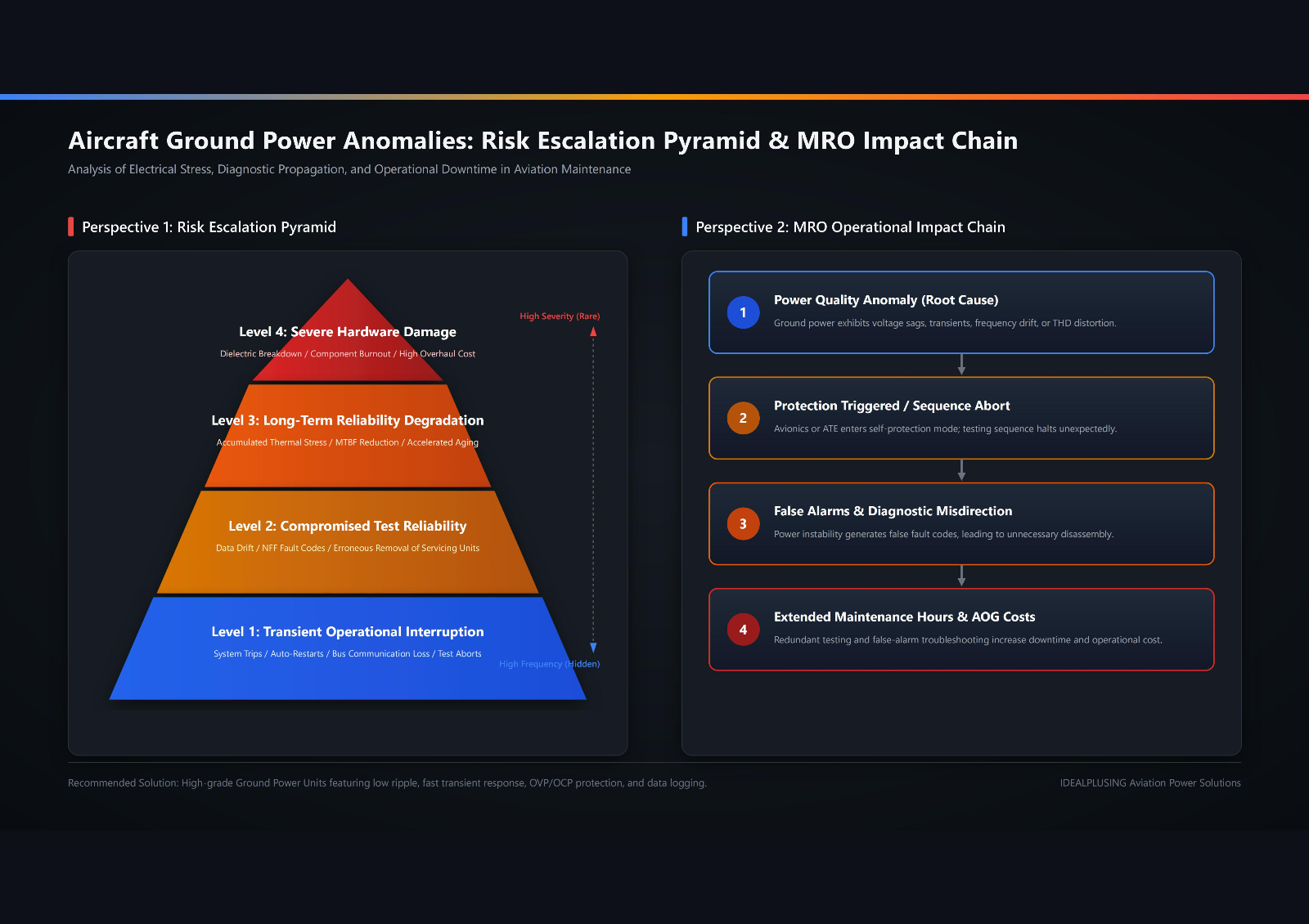
The dual-axis cause-effect model visualises how sub-par ground power propagates: beginning with operational disturbances and unreliable test outputs, driving higher maintenance labour expenditure, and only under extreme conditions culminating in irreversible component damage. Poor ground power seldom creates instant hardware failure; instead it frequently generates subtle, recurrent test disruptions and misdiagnoses, with hardware breakdown representing the severe end-point outcome.
IV. Why Aviation-Maintenance Environments Exhibit Heightened Sensitivity Toward Power-Quality Variability
1. Hangar-based maintenance relies heavily on dependable external power
Aircraft undergoing scheduled inspections, avionics troubleshooting and electrical system overhauls remain partially powered even when stationed on-ground. Ground-power malfunctions therefore have system-wide consequences extending well beyond individual hardware units to impact complete maintenance-test workflows.
2. Avionics testing demands minimisation of uncontrolled external variables
Test setups are designed such that hardware-under-test constitutes the primary variable for observation. Unstable ground power introduces an unwanted confounding factor. When tests fail, technicians must evaluate multiple root-cause hypotheses:
· Is the aircraft unit itself defective?
· Are test instruments faulty?
· Do wiring-interface defects exist?
· Has ground-power performance drifted?
Stabilised supply conditions reduce diagnostic ambiguity.
3. Line-maintenance workflows prioritise fast turnaround
On-ramp fault resolution requires rapid inspection and troubleshooting cycles. Supply-driven interruptions trigger cascading overhead: supply anomaly → aborted test → fault re-verification → repeated test execution. Extended test durations directly interfere with aircraft scheduling and fleet rotation plans.
V. Diagnostic Workflow: Identifying Power-Induced Test Failures
This critical step is frequently overlooked within aircraft-maintenance practice. When avionics units fail verification tests without concurrent logging of supply-side operating conditions, technicians lose vital evidence supporting root-cause analysis.
Traditional diagnostic sequence prioritises aircraft hardware, wiring infrastructure and test instruments before examining external ground-power sources. Modern ground-power hardware with real-time logging of output voltage, current, power draw and alarm events delivers contextual test-condition metadata. Technicians can compare historical datasets for recurring fault scenarios rather than depending purely on experiential judgement.
For automated maintenance-test frameworks, communication and event-recording capabilities facilitate comprehensive audit trails for test runs. Aviation ground power units can provide more than basic power delivery; they can also support control, real-time monitoring and historical traceability.
VI. How Can MRO Teams Choose the Right Aircraft Ground Power for Maintenance and Testing?
Comparing rated output power alone provides insufficient criteria for equipment procurement.
1. Output-voltage accuracy
Deviation between actual delivered voltage versus set-point values must satisfy requirements specific to hardware and test objectives. Precision-demanding verification tasks depend heavily on accurate voltage set-point control.
2. Output stability
Equipment performance under changing load conditions determines whether outputs hold steady as connected avionics or test instruments activate and de-activate. Stable delivery minimises load-transition-driven disturbances affecting units-under-test.
3. Transient-response performance
Rapid load changes trigger temporary output-voltage offsets. Fast transient-recovery enables swift return toward target set-points, which carries particular importance for test cycles simulating diverse operational load profiles.
4. Ripple and noise levels
Assess ripple and noise performance against hardware-under-test specifications for avionics validation workflows. Low ripple and noise reduce interference contaminating test environments.
5. Built-in protective features
Essential capabilities include:
· Overvoltage protection
· Overcurrent protection
· Over-power protection
· Overtemperature protection
· Short-circuit protection
Comprehensive protection functions contain fault propagation once anomalies occur.
6. Monitoring and communication capabilities
Automated-test deployments benefit further from:
· Real-time parameter visualisation
· Remote control interfaces
· Serial-bus communication
· Ethernet connectivity
· Alarm-status read-back
· Remote parameter configuration
· Event-and-parameter logging
These features integrate ground power units as controllable nodes within automated test ecosystems.
7. Why High-Quality Ground Power Is Necessary Despite Built-In Aircraft Equipment Protection
Aircraft avionics typically incorporate input protection and power regulation functions as part of their design. These features help limit the effects of abnormal voltage, overcurrent, and other power disturbances. However, built-in protection does not eliminate the need for a high-quality external ground power supply.
Built-in equipment protection and high-quality ground power address risk at two complementary levels. Onboard protection primarily helps limit potential damage once a power abnormality occurs. In contrast, high-quality ground power helps reduce the likelihood and magnitude of power anomalies at the source, minimize the impact of external power disturbances on equipment operation, and maintain stable and consistent conditions for aircraft maintenance and functional testing.
If the ground power supply experiences frequent voltage fluctuations, transient disturbances, or unstable output, the protection mechanisms of aircraft equipment may be triggered repeatedly. This can result in system alarms, equipment resets, communication interruptions, or aborted test procedures. For MRO operations, such disruptions can increase troubleshooting time and lead to repeated test cycles, reducing overall maintenance efficiency.
Accordingly, onboard equipment protection and high-quality ground power are not substitutes for one another. They are complementary layers of risk control:
Stable ground power → Reduces the likelihood of power anomalies
Built-in equipment protection → Limits potential damage when anomalies occur
In simple terms, onboard protection serves as a final line of defense against abnormal electrical conditions, while reliable ground power provides proactive upstream risk control. When selecting an aviation ground power unit, MRO teams should therefore evaluate not only protection functions but also key performance characteristics such as output accuracy, voltage stability, transient response, and monitoring capabilities. These factors help establish stable and reliable power conditions for aircraft maintenance, troubleshooting, and functional testing.
VII. Establishing Robust Power-Supply Workflows for Aircraft-Maintenance Operations
High-quality hardware delivers limited value without standardised operational procedures.
Step 1: Pre-test validation of supply conditions
Inspect input utility power, configured output voltage, maximum current limits, rated power capacity and operational health status prior to initiating maintenance work.
Step 2: Parameter confirmation prior to physical connection
Configure output voltage thresholds, current limits and protection set-points according to maintenance-task requirements. Programmable power units allow pre-saved parameter profiles mapped to distinct test scenarios.
Step 3: Continuous monitoring during test execution
Keep track of output voltage, current, power consumption and alarm flags throughout test runs. When anomalies emerge, cross-reference logged supply metadata to assist root-cause isolation.
Step 4: Preserve records upon test completion
Document test-setup conditions, power-unit parameter configurations, logged anomaly events and test-outcome observations. Historical records support comparative analysis when similar faults recur later.
VIII. How to Select Aircraft Ground Power for Different Maintenance Tasks?
Different maintenance and verification tasks impose divergent demands on ground-power equipment. Beyond nominal power ratings, procurement should factor output stability, control precision, protective-feature completeness and monitoring functionality.
Table 2
Application scenario | Priority performance characteristics |
Avionics maintenance | Output stability, low ripple and noise |
Electrical-system verification | Precise voltage and current regulation |
Automated test workflows | Programmable outputs, remote-control support, communication interfaces |
Extended-duration maintenance | Steady continuous operation, comprehensive protective mechanisms |
Fault-diagnosis activities | Real-time status monitoring, visible alarm indicators |
Test-data management workflows | Communication interfaces, event-logging functionality |
Multi-aircraft / multi-hardware-type workshops | Wide adjustable-output range, flexible parameter-configuration capacity |
Hangar and apron-based routine maintenance | Continuous-duty performance, field-adapted mechanical-electrical design |
Four core capability dimensions define suitable maintenance-grade aviation ground power: steady power delivery, precise controllability, anomaly-protection coverage and operational-state observability. Select hardware matching test-task requirements for output voltage, current, power rating and communication options. IDEALPLUSING develops application-specific power-supply solutions for aircraft maintenance, avionics validation and electrical-system testing, matching output specifications, control modalities and monitoring functions against real-world operational requirements.
IX. Why Aircraft Ground Power Is More Than a Power Source?
Within aircraft-maintenance contexts, aviation ground power units function not as isolated standalone devices. They form part of an interconnected chain: Ground power unit → aircraft electrical distribution system → avionics hardware → test-bench instruments → captured test datasets.
Deficiencies anywhere within this sequence can distort diagnostic conclusions. Equipment selection therefore needs to go beyond checking power-rating adequacy, posing the following practical evaluation questions:
· Does output remain stable amid load transitions?
· Can the unit maintain target operating points under dynamic-load conditions?
· Are protective responses reliably activated under fault scenarios?
· Can operational states be tracked during test execution?
· Is historical event data available for post-fault trace-back?
These considerations carry greater practical relevance than simple comparisons of nominal power ratings.
Concluding Remarks: Protecting More Than Physical Aircraft Hardware
Sub-standard ground power does not inevitably produce immediate avionics hardware damage. Within maintenance-and-test environments, supply-quality defects first create this causal sequence: power-supply irregularity → altered hardware operating behaviour → corrupted test measurements → expanded diagnostic workload → prolonged maintenance turnaround.
Major, sustained excursions outside rated input boundaries further elevate electrical-thermal stress upon power-conversion modules and semiconductors, potentially leading to irreversible hardware damage.
Reliable aviation ground power does not merely deliver electricity. It establishes well-defined, precise, protected and traceable supply environments for maintenance and validation cycles. For hangar work, avionics troubleshooting, electrical-system inspection, fault diagnostics and apron-based maintenance, properly-matched power-supply solutions eliminate uncertainty originating from supply-side variability. They enhance test-measurement repeatability and minimise unplanned workflow interruptions.
Reliable ground power protects not only aircraft hardware, but also test-data integrity, maintenance efficiency and aircraft turnaround time.