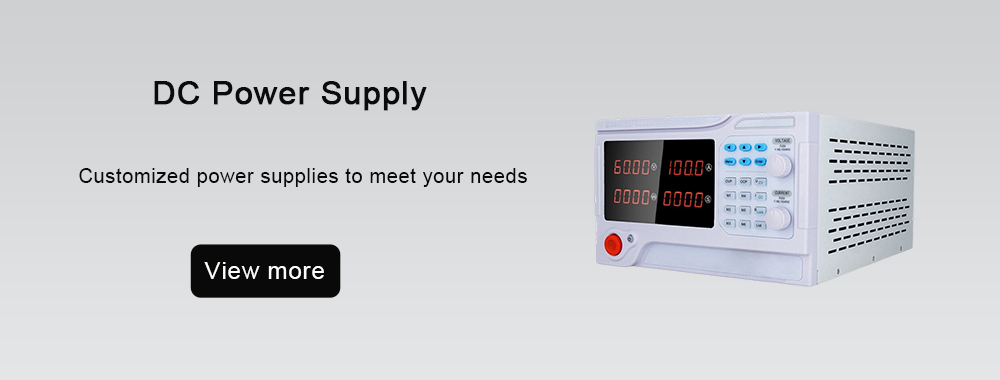
In industrial testing, laboratory research and development, and electronic equipment manufacturing, programmable DC power supplies have become indispensable core equipment due to their flexible adjustment capabilities and precise output characteristics. Understanding their core technical specifications not only helps users select the right equipment but also allows them to fully utilize the device's performance, avoiding test errors or equipment damage caused by mismatched parameters. Below, we will break down the key technical specifications of programmable DC power supplies and explain them in the context of practical application scenarios.
Output Voltage and Current
Output voltage and current are the most basic technical parameters of a programmable DC power supply, directly determining the load range the device can handle. High-quality programmable DC power supplies offer a wide adjustment range, meeting both the microampere-level power supply needs of small electronic components and the high-current output requirements of high-power equipment. In scenarios such as new energy vehicle electronic control testing and photovoltaic module simulation, the wide voltage and current adjustment capabilities of programmable DC power supplies can accurately reproduce the power supply environment under different working conditions, ensuring the authenticity of test data.
Accuracy and Stability
Accuracy and long-term stability are the core competitive advantages of programmable DC power supplies. Accuracy is usually reflected in the deviation between the output value and the set value, including sub-indicators such as load regulation and voltage regulation; while stability concerns the consistency of the device's output during long-term operation. In scenarios with stringent power supply requirements, such as precision electronic instrument calibration and semiconductor chip testing, the high accuracy and high stability of programmable DC power supplies can effectively avoid test deviations caused by voltage and current fluctuations. Brands like IDEALPLUSING have built a good reputation in these types of scenarios.
Ripple and Noise Control
Ripple and noise are important indicators for measuring the output quality of programmable DC power supplies, referring to the AC interference signals superimposed on the output voltage. Even weak ripple noise can affect the normal operation of sensitive electronic equipment and even lead to distorted test data. In scenarios such as communication equipment development and sensor testing, low-ripple noise programmable DC power supplies can provide a clean power supply environment, ensuring that equipment performance is not affected, and guaranteeing the smooth progress of research and development and testing work.
Programming and Control Functions
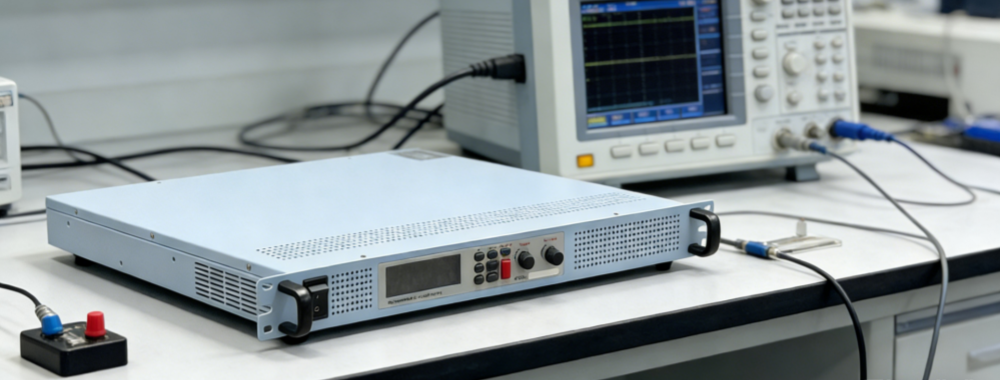
Programmable functionality is a core advantage of these power supplies, supporting remote control and automated programming through interfaces such as PC software, RS485, and LAN. Users can preset voltage and current change curves to achieve complex power supply modes such as timed switching and stepped output, significantly improving testing efficiency. In scenarios such as automated production lines and mass product testing, the flexible programming capabilities of programmable DC power supplies allow for seamless integration with testing systems, enabling unmanned automatic testing and reducing labor costs.
Protection Mechanisms
Comprehensive protection mechanisms are an important guarantee for the safe operation of programmable DC power supplies. Common functions include overvoltage protection, overcurrent protection, overtemperature protection, short-circuit protection, etc. These protection functions can respond quickly when the equipment is abnormal, cutting off the output or limiting current and voltage, so as to avoid damage to the power supply itself or the load equipment due to overload, short circuit and other problems. In industrial production and laboratory operations, reliable protection mechanisms can effectively reduce safety risks and protect the safety of personnel and equipment.
IDEALPLUISNG Power Expert:
We focus on the research and development, sales and services in the fields of DC-DC power modules, AC-DC rectifier modules, DC-AC inverters, AC power supplies, DC power supplies, LED power supplies, chargers, rectifier systems, etc., providing personalized, efficient, reliable and cost-effective power solutions for all walks of life.
Thank you for considering our services.