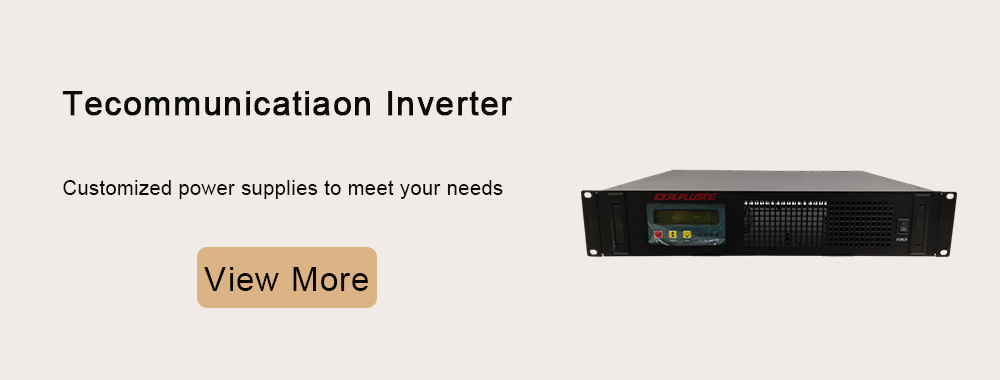
Communication inverters, as critical power supply equipment for communication base stations, data centers, and other scenarios, have their stable operation directly related to the continuity of communication systems. Many users experience equipment failures due to neglecting details during use, even affecting the entire communication link. Below, we share key precautions for using communication inverters, based on practical application scenarios.
Installation: Building a Solid Foundation for Communication Inverter Operation
The installation of communication inverters must be performed by professional personnel. Before installation, carefully check whether the equipment appearance is damaged during transportation. The installation location should be away from humid, corrosive or flammable and explosive environments, and a heat dissipation space of more than 150mm should be reserved to avoid heat accumulation in sealed environments. During wiring, strictly match the voltage parameters, the DC input must comply with the equipment's nominal range, the terminals should be tightened to prevent heat generation due to loose connections. The connection line between the battery and the inverter is recommended to be controlled within 3 meters, and thicker wire diameters should be used for long distances to reduce losses.
Operation: Avoiding Risks in Communication Inverter Use
Before starting the communication inverter, it is necessary to ensure that the total load power reserves 20%-30% redundancy to avoid accelerated component aging due to full-load operation. In daily use, the load should be controlled at 60%-80% of the rated capacity, neither overloading nor underloading, to prevent deep battery discharge. The AC output terminal can only be connected to specified loads, and it is strictly prohibited to connect to commercial power or other power sources. After shutdown, wait for 10 minutes before performing internal operations to avoid high-voltage electric shock risks. Brands that pay attention to details like IDEALPLUSING, their communication inverters are more in line with actual usage needs in terms of operation prompt design.

Environmental Adaptation: Extending Communication Inverter Lifespan
The working environment of the communication inverter should be controlled between -10℃ and 40℃, with an ideal temperature of 10℃-25℃, and the humidity should not exceed 90% without condensation. For outdoor use, sun protection and rainproof measures should be taken. For coastal or desert areas, models with higher protection levels should be selected to avoid salt spray and sand erosion. When the altitude exceeds 1000 meters, the capacity should be reduced as required to ensure that the communication inverter can still output stably in complex environments.
Maintenance: Ensuring the continuous and reliable operation of communication inverters
Regularly clean the surface and filters of the communication inverter, and check the indicator lights, output voltage, and wiring tightness monthly. If a fault alarm occurs, first troubleshoot the cause using the device's built-in monitoring function; do not disassemble the casing without authorization. It is recommended to perform a discharge test quarterly to activate the battery. When performing maintenance, wear insulated tools and prevent metal objects from falling into the equipment. For complex faults, contact professional technical personnel.
IDEALPLUISNG Power Expert:
We focus on the research and development, sales and services in the fields of DC-DC power modules, AC-DC rectifier modules, DC-AC inverters, AC power supplies, DC power supplies, LED power supplies, chargers, rectifier systems, etc., providing personalized, efficient, reliable and cost-effective power solutions for all walks of life.
Thank you for considering our services.