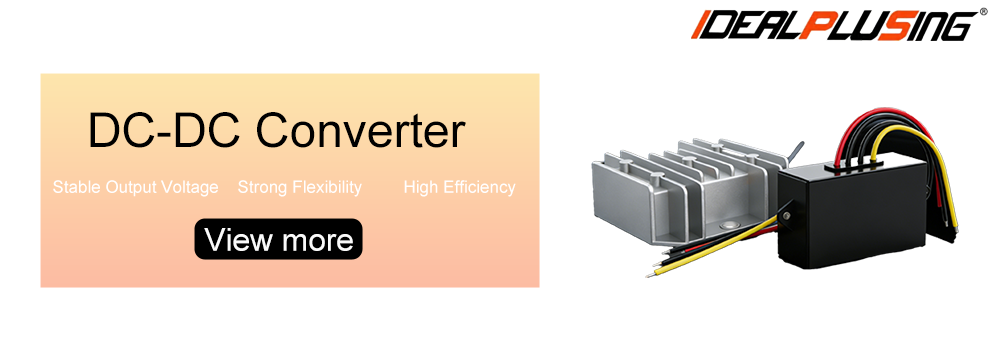
In consumer electronics, portable devices, and precision industrial control, the trend of miniaturization of electronic devices is significant. Small-sized DC-DC converters, as core power supply components, face the inherent conflict between increased power and optimized heat dissipation. Device miniaturization requires converters to reduce their size, while downstream functional upgrades demand increased power and power density. Increased power inevitably exacerbates heat generation, and in small-sized scenarios, the limited heat dissipation space makes it difficult to dissipate heat. Failure to balance these two factors can lead to reduced converter efficiency, component aging, and even malfunctions. Therefore, achieving a balance between power and heat dissipation under small-size constraints is a core issue in their design optimization.
I. Analysis of the Core Conflict: The Intrinsic Conflict Between Power and Heat Dissipation in Small-SSized Scenarios
The conflict between power and heat dissipation in small-sized DC-DC converters is essentially the opposition between increased energy density and insufficient heat dissipation space. First, volume compression limits heat dissipation paths; heat from converters integrated into dense PCB boards is difficult to dissipate, easily leading to localized high temperatures. Second, higher power density leads to greater electrical energy conversion losses, and the surge in heat further increases the heat dissipation pressure. Third, small-sized designs often sacrifice heat dissipation structures and are mostly used in portable devices lacking active cooling, creating a vicious cycle of "higher power – more difficult heat dissipation."
II. Topology Optimization: Reducing Power Loss and Heat Generation at the Source
The core of balancing power and heat dissipation is "controlling the source and reducing heat," and optimizing the topology structure is key. Traditional hard-switching topologies have high losses and significant heat generation; small-sized, high-power scenarios require prioritizing soft-switching topologies such as LLC resonant and synchronous rectification. LLC resonant topology achieves zero-voltage switching and zero-current turn-off for switching devices, reducing losses by 30% to 50%, and its high-frequency characteristics allow for smaller component sizes; synchronous rectification topology uses low-on-resistance MOSFETs to replace diodes, reducing conduction losses, and its compact structure is suitable for small-sized designs. Combined with topology parameter optimization, it can achieve a balance between power and loss.
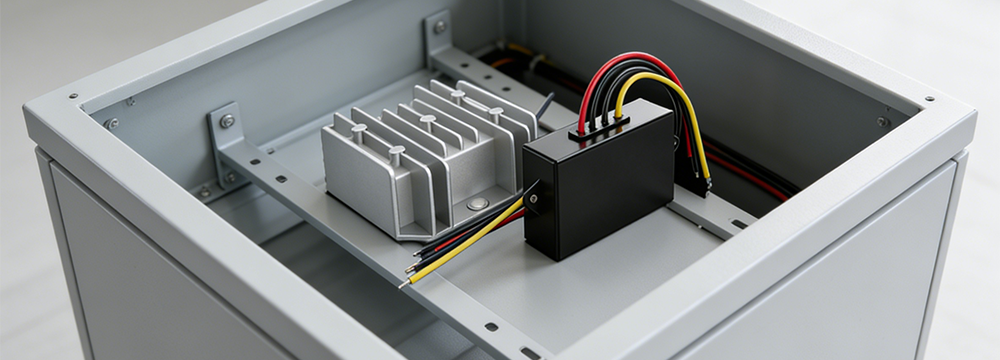
III. Component Selection Upgrade: Precisely Matching Small-Size Requirements, Balancing High Power and Low Heat Generation
Component selection needs to overcome the dual limitations of size and performance, focusing on three major categories: power devices, magnetic components, and thermal management components. Power devices prioritize GaN and SiC wide-bandgap semiconductor devices, reducing heat generation by more than 40% and size by 30% to 50% at the same power level, meeting the demands of small size and high power; magnetic components utilize low-loss materials such as nanocrystalline and high-frequency ferrite, employing a flat, integrated design to reduce volume and heat generation; thermal conductive auxiliary devices use 0.1-0.5mm thin, high-thermal conductivity materials to improve heat transfer efficiency without occupying excessive space.
IV. Structure and Layout Optimization: Maximizing Limited Space for Efficient Heat Dissipation
Small-volume scenarios require refined design to improve heat dissipation efficiency. Structurally, a compact, integrated design is adopted, with a thin, high-thermal conductivity metal casing and added micro- fins on the surface to increase the heat dissipation area; the PCB layout follows the principle of "shortest power loop and dispersed heat-generating components," shortening wiring, increasing heat dissipation copper foil, placing high-heat components near the heat dissipation area, and using layered layout to reduce thermal interaction, maximizing heat dissipation in limited space.
V. Auxiliary Cooling and Intelligent Control: Addressing the Cooling Shortcomings in Small-Volume Scenarios
Ultra-high power-density converters typically rely on auxiliary cooling and intelligent control. For passive cooling, micro‑fin structures or thermally conductive potting materials can be embedded. Active cooling uses miniature fans and thermoelectric cooling modules, working with intelligent temperature control to run only when needed. A power‑temperature linkage control strategy is also applied: output power is properly reduced at high temperatures, and automatically restored to rated level after cooling, maintaining a dynamic balance between stable operation and thermal safety.
Achieving a power and heat dissipation balance in compact DC-DC converters demands multi-dimensional synergy across topology optimization, component selection, structural layout, auxiliary cooling and intelligent control. Topology and component optimization cut down heat generation at the source, structural layout enhances heat dissipation efficiency, and auxiliary cooling paired with intelligent control makes up for inherent thermal deficiencies. Future development efforts will need to integrate emerging technologies to break through technical bottlenecks, and realize the development goal of compact size, high power, low heat generation and high reliability, thus providing robust support for the upgrading of miniaturized electronic devices.
We at IDEALPLUSING not only provide products, but also strive to provide customers with suitable power supply solutions and quotations.
Our core competitiveness lies in carefully selecting a variety of power supply options to help customers evaluate and choose the most suitable power supply solution.
We can offer AC DC power supply, DC AC inverter, AC AC power source(single phase or 3 phases),AC DC Ground Power Unit...