
Across industrial manufacturing, precision measurement, and new energy R&D, the demand for high‑quality power in industrial equipment has grown increasingly strict. Nowhere is stable, clean and adjustable power more critical than for precision machine tools, electronic testing equipment, new energy battery test systems and inverter aging platforms.
Yet voltage fluctuations, frequency drift and harmonic interference plague conventional grid power. These disturbances can easily trigger equipment malfunctions, invalidate test data, damage key components or lead to unplanned shutdowns.
Only high-precision, steady and controllable power sources can overcome such grid limitations. Through precise energy conversion and regulation, variable frequency power supplies do exactly that, delivering dependable power for a full range of industrial equipment.How do variable frequency power supplies produce such stable and clean power?
I. Precise frequency & voltage control — eliminating grid fluctuations
Standard grid power has unstable voltage and frequency. Industrial equipment, especially precision instruments, is highly sensitive to these changes; even small deviations can disrupt normal operation.
The key strength of variable frequency power supplies is their ability to accurately adjust output frequency and voltage, fully isolating equipment from grid instability.
First converting grid AC power into DC power, then inverting the DC power into AC power with freely adjustable frequency and voltage. Equipped with high-precision detection and feedback control modules, variable frequency power supply effectively suppress grid voltage fluctuations and frequency drift. It collects grid input parameters and equipment load requirements in real time, automatically adjusting the output frequency and voltage, controlling frequency accuracy within ±0.01% and voltage accuracy within ±1%, ensuring that the output power frequency and voltage remain stable within the rated range required by the equipment, preventing unstable operation and shutdowns due to grid fluctuations.
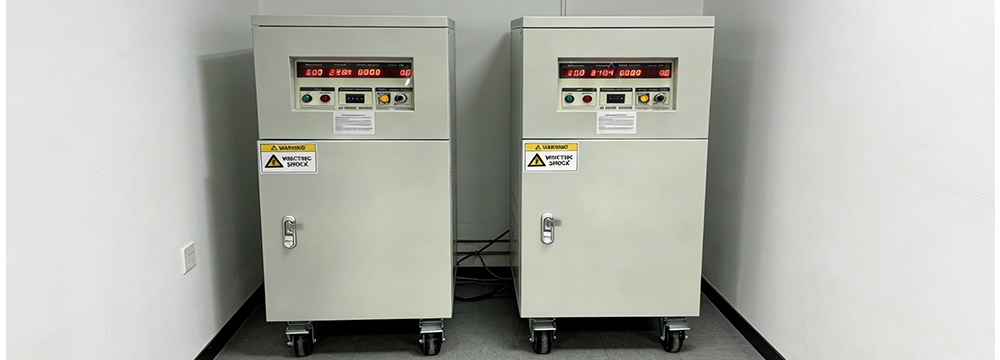
II. Harmonic Suppression and Filtering: Purifying Power Quality and Reducing Interference Losses
Industrial sites contain numerous nonlinear devices such as frequency converters, relays, and welding machines. These devices inject harmonics into the power grid, causing waveform distortion and harmonic interference. Harmonics not only increase power loss but also interfere with the control circuits of precision equipment, leading to malfunctions, test data deviations, and in severe cases, damage to core components. Variable frequency power supplies purify power quality at its source through built-in high-efficiency filtering and harmonic suppression circuits, providing clean sinusoidal power to equipment.
On one hand,Variable frequency power supplies incorporate an EMI filter module on the input side to suppress harmonics and noise from the power grid from entering the power supply, preventing interference with the power conversion process. On the other hand, a low-pass filter circuit on the output side filters out high-frequency harmonics generated during inverter output, ensuring the sinusoidal nature of the output waveform. Total Harmonic Distortion (THD) is kept below 5%, with certain high‑precision models achieving levels lower than 2%. At the same time, variable frequency drives come with built‑in power factor correction, which can raise the power factor to over 0.98. This reduces reactive power loss, further improves power quality, and supplies clean, stable power with minimal interference to precision instruments and sensitive loads.
III. Load Adaptive Adjustment: Adapting to Complex Working Conditions for Stable Power Output
In industrial scenarios, loads often change dynamically. If the power supply fails to respond rapidly, output voltage and current will fluctuate, directly undermining the stability of equipment operation. Variable frequency drives feature strong load adaptive performance, enabling real‑time response to load changes and maintaining consistent power output.
Whenever the load rises or falls abruptly, the feedback control system of the variable frequency power supply reacts within milliseconds. It automatically adjusts the output power to keep voltage and current stable, avoiding interruptions or voltage sags caused by sudden load shifts. In addition, Variable frequency power supplies support constant‑voltage, constant‑current, and constant‑power operating modes, allowing flexible adaptation to diverse working conditions based on the power demands of different industrial devices. Therefore, they are highly suitable for industrial applications with complex loads and variable operating states.
It integrates multiple protection mechanisms, including overcurrent, overvoltage, undervoltage, overheating, short circuit, phase loss, and overload protection. It monitors input and output parameters and power supply operating status in real time. In the event of an anomaly (such as overload, excessive voltage, or excessive temperature), it quickly triggers a protection response, protecting the frequency converter power supply itself and downstream industrial equipment through current limiting, voltage reduction, and shutdown. This guards against equipment burnout and fault escalation triggered by abnormal power input,thereby strengthening both the stability and safety of the entire power supply system.
In summary, only variable frequency power supplies can effectively resolve the pain points caused by grid instability.Through precise regulation of frequency and voltage, they eliminate fluctuations.By harmonic suppression and filtering, they refine power quality to an excellent level.Via adaptive load control, they fit a wide variety of working conditions.And with comprehensive protection mechanisms, they provide reliable safety for the whole power supply process. These multi-dimensional collaborative efforts provide a stable, clean, and reliable power supply for industrial equipment.
As industrial equipment transforms towards precision, intelligence, and high-end applications, the requirements for power quality will continue to increase. As a core device for stable and clean power supply, variable frequency power supplies will be widely used in more industrial scenarios. They not only ensure stable equipment operation and improve production efficiency and testing accuracy but also reduce energy loss and extend equipment lifespan, providing strong support for high-quality industrial development.