
Nowhere are product testing and aging more vital than in electronics manufacturing, power supply production, home appliance testing, and motor R&D. These steps determine product reliability, stability, quality, and efficiency.
Conventional testing relies on fixed-frequency, fixed-voltage grid power, which struggles to replicate complex working conditions. With poor adjustability and low precision, it often leads to lengthy cycles, inaccurate data, and low efficiency.
Only variable frequency power supply offer wide adjustability, clean power, fast response, and full operating condition simulation. They greatly enhance testing and aging efficiency in procedure, data accuracy, scenario coverage, and compatibility, making them indispensable for modern inspection and aging lines.
I. Flexible Frequency and Voltage Adjustment to Meet Full-Scenario Simulation Testing
Many products Exhibit significant performance differences under different voltages and frequencies. For example, exported electrical appliances need to be compatible with different 50Hz/60Hz power grids, power modules need to verify wide voltage range adaptability, and motors need to be tested for operating status at different speeds. Traditional power supplies cannot be freely adjusted and can only be used with additional equipment to step down or up the frequency, resulting in cumbersome processes and large errors.
The variable frequency power supply can continuously adjust the output voltage and frequency, with a common range of 0-300V and 40-70Hz, or even higher frequencies. One-button switching can simulate different global power grid environments, high and low voltage fluctuations, and extreme power supply conditions. No wiring changes or additional modifications are required, enabling parallel testing of multiple specifications and standards of products, significantly reducing debugging time and making the testing process more efficient.
II. Pure and Stable Output, Ensuring Accurate and Reliable
Test Data Testing and aging require extremely high stability of the power supply waveform and voltage. Harmonics, surges, and voltage drops in the power grid can lead to data distortion, misjudgments, and repeated testing. The variable frequency power supply adopts an AC-DC-AC conversion structure with built-in multi-stage filtering and closed-loop control, outputting a pure sine wave with low total harmonic distortion, high voltage and frequency accuracy, and is unaffected by external power grid fluctuations.
Stable power supply allows sensors, instruments, and products under test to operate in ideal conditions, resulting in strong consistency and high reliability of test data, significantly reducing the number of retests and supplementary tests, fundamentally improving test pass rates and overall work efficiency.
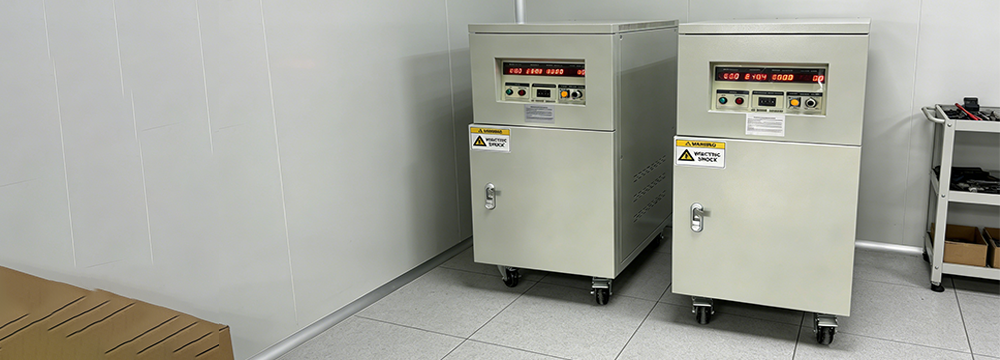
III. Rapid Dynamic Response, Shortening Aging and Loading Time
In aging tests, products often undergo various operating conditions, including no-load, load, sudden changes, and cycles. Traditional power supplies are slow to respond and lag in adjustment, unable to quickly switch states, resulting in prolonged aging cycles.
Variable frequency power supplies possess millisecond-level dynamic response capabilities, quickly following load changes and achieving smooth voltage and power switching. They support continuous cyclic aging modes, completing product extreme condition and lifespan verification in a short time. This rapid response not only shortens the aging time for individual products but also improves the overall throughput of the aging line, increasing production capacity.
IV. Simplified Wiring and Control, Improving Automated Testing Efficiency
Modern production lines are increasingly automated. Variable frequency power supplies support remote communication control and can be linked with PLCs, industrial computers, and testing systems to achieve programmed automated testing. After preset voltage, frequency, time, and cycle logic, the power supply can automatically execute the entire test process without manual intervention or adjustment.
Compared to traditional fixed power supplies that require manual wiring, equipment replacement, and repeated debugging, variable frequency power supplies significantly reduce labor costs, minimize operational errors, and enable 24-hour continuous stable testing, greatly improving overall production line efficiency.
V. Compatibility with Multiple Load Types, Enhancing Equipment Utilization
Testing and aging scenarios involve complex load types, including resistive, inductive, capacitive, and nonlinear loads. Ordinary power supplies are prone to waveform distortion, overload protection issues, and unstable output when handling complex loads.
Variable frequency power supplies have strong load-carrying capacity and wide adaptability. A single device can meet the testing and aging needs of various products such as power supplies, home appliances, motors, PCBs, and electronic components, reducing equipment investment, improving space utilization and overall efficiency, truly achieving multi-purpose and highly efficient reuse.
The core reason why variable frequency power supplies can significantly improve testing and aging efficiency lies in their adjustable power supply, high-precision output, high-speed response, full coverage of operating conditions, and automated control. It not only shortens the testing cycle, reduces repetitive labor, and improves data reliability, but also enhances the automation level of the production line and the product qualification rate.