
As the "energy backbone" for aircraft ground operations, aviation ground power supplies (GPUs) must deliver stable performance not only in standard airport settings but also stand up to extreme conditions like high altitudes, frigid regions, and deserts.Neither frigid temperatures of tens of degrees below zero nor scorching heat of 70°C are kind to ordinary power supplies—they often fail to start in cold weather, produce unstable output after startup, or suffer a sharp efficiency drop (even complete malfunction) in extreme heat. Yet, the stability demands for power supplies during aircraft avionics and engine startup can never be compromised.
In essence, extreme temperatures—whether high or low—disrupt the normal operation of a GPU’s internal components. Low temperatures can "freeze" components, slowing their response; high temperatures cause overheating and accelerate aging. To ensure the power supply remains reliable in such harsh conditions, maintaining its startup capability and output efficiency, the core lies in integrating "cold-resistant, heat-resistant, and stable-output" protection. Only through practical technical measures can we mitigate the adverse effects of temperature fluctuations.
I. Choosing the Right Durable Core Components to Withstand Extreme Temperatures From the Source
The stability of a power supply depends first and foremost on the temperature resistance of its internal components. Unlike ordinary power supplies that use civilian or industrial-grade components, ground-based aviation power supplies use components that can withstand a wide temperature range, unaffected by either cold or heat.
For instance, core power devices have been upgraded to heat‑tolerant, low‑loss variants, ensuring no overheating or efficiency decay even under prolonged high‑temperature operation. Wide‑temperature‑rated capacitors, relays and other temperature‑sensitive components further prevent freezing or malfunction at low temperatures, as well as bulging or damage at high temperatures. Only in this way can the power supply maintain stable operation across extreme temperatures and guarantee reliable startup and output.
II. Intelligent Temperature Control for Adaptive Thermal Management
Component endurance alone is not enough to withstand extreme temperatures. Equally important is an intelligent thermal management system that provides preheating in cold conditions and efficient cooling in hot environments.
In frigid conditions, the unit automatically enables preheating before startup, warming critical internal components to their optimal operating temperature. This eliminates cold‑start failures and ensures rapid, reliable energization even at deeply subzero temperatures. A sealed, insulated enclosure minimizes heat loss after preheating, sustaining stable operation after startup.
In extreme heat, the cooling system automatically boosts its output. Leveraging a high‑efficiency thermal structure, it rapidly exhausts internal heat to avoid performance degradation. The cooling intensity adjusts dynamically with ambient temperature: the hotter the environment, the stronger the heat dissipation. This allows full‑load operation at high temperatures without noticeable efficiency loss.
III. Intelligent Regulation to Offset Temperature Effects
Extreme temperatures do more than stress components — they also alter load characteristics and circuit behavior. Even with fully functional parts, output instability and reduced efficiency may still occur. Only with intelligent adaptive adjustment can the power supply compensate for real‑time temperature changes.
Equipped with advanced control logic, the aircraft ground power supply continuously monitors ambient temperature and output status, automatically tuning parameters to offset temperature‑induced deviations. At low temperatures, it optimizes the startup sequence to avoid high‑current surges that could damage components. At high temperatures, it adjusts operating frequency to lower losses and maintain steady output. Even under rapid temperature swings, it adapts quickly, preserving accuracy and efficiency to support aircraft startup and avionics systems.
IV. Reinforced Structural Protection Against Harsh Environments
Beyond extreme temperatures, outdoor conditions often include wind, sand, rain, snow and salt spray — all of which threaten long‑term performance. That is why the ground power unit features a heavily reinforced protective structure.
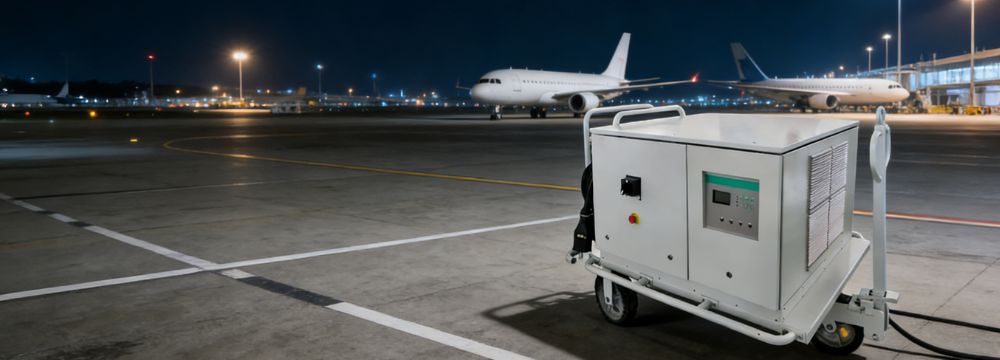
The entire system is fully sealed to block dust, rainwater and salt spray, preventing intrusion of sand and moisture that could lead to short circuits from icing or high humidity. The chassis uses specially treated, corrosion‑resistant and vibration‑damped materials, built to withstand the harsh outdoor conditions of airports. This robust enclosure shields internal components from external harm and further ensures stable operation across extreme temperature cycles.
In summary,the ability of ground-based aviation power supplies to maintain their starting performance and output efficiency under extreme high and low temperatures doesn't rely on complex principles. The core principle is a combination of internal and external strengths: internally, high-temperature resistant components are used, coupled with intelligent temperature control and adaptive adjustment to mitigate the core challenges posed by temperature; externally, a reinforced structural protection isolates the system from the harsh environment, ensuring the normal operation of internal components.
For aviation ground support, reliability in extreme environments is the greatest guarantee of safety. Only such durable and intelligent ground-based aviation power supplies can reliably support aircraft startup and avionics operation under any climatic conditions, safeguarding aviation operations.
Should you have any inquiries or demands, we welcome you to contact us at any time!
Thank you for your continued support and trust in us.