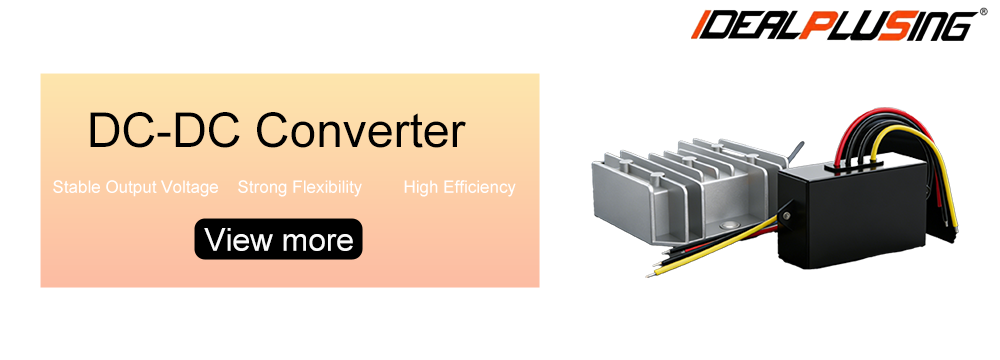
DC-DC converters serve as core power regulation components in many fields such as industrial automation, portable electronics and new energy energy storage. Many engineering practitioners often face problems like inappropriate topology selection, low efficiency and poor working condition adaptability when building circuit solutions. In fact, the topology selection of DC-DC converters follows clear rules. As long as we focus on three core parameters including input voltage, output voltage and rated power, we can quickly lock the matching structure and balance circuit stability, energy consumption performance and manufacturing cost. From the perspective of practical application, this paper analyzes the topology selection logic of DC-DC converters and provides practical references for circuit design.
Preliminary Selection of DC-DC Converter Topology Based on Input and Output Voltage
Voltage matching is the primary premise for DC-DC converter topology selection. Different voltage rise and fall logics correspond to dedicated topologies, which can be initially screened without complex calculation.
When the output voltage is always lower than the input voltage, the step-down DC-DC converter topology is the best choice. It features simple structure, straightforward component layout and controllable switching loss. It is suitable for conventional low-voltage power supply scenarios such as secondary power supply of circuit boards and battery regulated output, which can steadily convert high-voltage direct current into low-voltage direct current suitable for equipment.
If the output voltage needs to be higher than the input voltage, the step-up DC-DC converter topology should be adopted. This topology can boost voltage by virtue of inductance energy storage and release principle. It is suitable for small photovoltaic power supply and low-voltage battery expanded power supply, and has a high popularity in the application of small and medium-power DC-DC converters.
If the input voltage fluctuates greatly during operation, sometimes higher and sometimes lower than the output voltage, the ordinary step-up and step-down structure cannot meet the demand. At this time, the integrated buck-boost DC-DC converter topology is required. Without modifying the hardware circuit, it can adapt to two-way voltage regulation and is suitable for scenarios with unstable voltage conditions such as vehicle power supply and outdoor energy storage. In addition, for scenarios requiring electrical isolation, the isolated DC-DC converter topology with transformer should be prioritized to avoid mutual interference between high and low voltage loops.
Refine DC-DC Converter Topology Scheme Combined with Power Level
After determining the voltage adaptation direction, the power will further restrict the topological details and device configuration of DC-DC converters, and the selection logic varies greatly in different power ranges.
Under low-power working conditions, DC-DC converters within hundreds of watts can adopt simple single-switch topology with few peripheral circuit devices, low debugging difficulty and obvious cost advantages. It is suitable for low-power products such as smart home accessories and small sensing equipment, without complex heat dissipation and redundant design.
In the medium power range of several hundred watts to several kilowatts, DC-DC converters are suitable for synchronous rectification topology. Compared with traditional asynchronous structures, this kind of DC-DC converter can greatly reduce conduction loss and improve overall conversion efficiency. It is suitable for industrial control modules and small and medium-sized energy storage power supplies, balancing performance and economy.
In high-power application scenarios, DC-DC converters above kilowatts cannot bear the load with a single topology, and mostly adopt multi-phase parallel, full-bridge or half-bridge isolated topologies. Multiple power loops share the load to disperse heat generation pressure and improve the stability of current output, which is commonly used in new energy charging piles and large industrial DC power supply systems. A number of DC-DC converter products launched by IDEALPLUSING in the industry also adapt to the differentiated power supply needs of multiple industries relying on the refined design of topologies for different power levels.
Working Condition Adaptation Optimization: Make DC-DC Converter Topology Fit Practical Application
After selecting the basic topology corresponding to voltage and power, fine adjustment according to actual application scenarios is required to make the DC-DC converter perform optimally. For portable equipment with limited space, integrated chip topology is prioritized to reduce the occupied area of peripheral components; for precision instruments sensitive to electromagnetic interference, topologies with large switching noise should be avoided, and DC-DC converter topologies with filter structures should be matched; for industrial scenarios with long-term continuous operation, topologies with low loss and friendly heat dissipation should be prioritized to extend the service life of DC-DC converters.
Conclusion
The core of DC-DC converter topology selection is to determine the direction by input and output voltage, specify the specification by power level, and optimize the details combined with working conditions. Mastering this logic can get rid of the misunderstanding of blind selection, enable DC-DC converters to operate efficiently and stably in various power supply scenarios, effectively reduce the cost of circuit design rework, and adapt to the research and development needs of more industrial and civil electronic equipment.
FAQ:
1. What is a DC-DC converter?
A DC-DC converter is a power electronic device that converts one DC voltage level to another. It is widely used in telecommunications, industrial automation, electric vehicles, AGVs, forklifts, and renewable energy systems.
2. How do I choose the right DC-DC converter topology?
The selection depends on input voltage, output voltage, isolation requirements, and power level. Buck converters are suitable for step-down applications, Boost converters are used for step-up applications, while isolated topologies provide electrical isolation and enhanced safety.
3. What is the difference between Buck and Boost converters?
A Buck converter decreases the input voltage to a lower output voltage, while a Boost converter increases the input voltage to a higher output voltage. The choice depends on the voltage requirements of the application.
4. When should an isolated DC-DC converter be used?
An isolated DC-DC converter is recommended when electrical isolation is required for safety, noise reduction, or compliance with industry standards. Common applications include telecommunications, railway systems, medical equipment, and industrial control systems.
5. How do I determine the required power rating for a DC-DC converter?
The power rating should be selected according to the output voltage and current requirements of the load. It is generally recommended to reserve 20%–30% additional power capacity to ensure stable operation and future expansion.
6. Can DC-DC converters be used in AGV and forklift systems?
Yes. DC-DC converters are widely used in AGV, forklift, and electric vehicle systems to provide stable voltage conversion for control systems, sensors, communication equipment, and auxiliary devices.
7. What DC-DC converter is suitable for 48V battery systems?
For 48V battery systems, the converter specification depends on the required output voltage. Common configurations include 48V to 24V, 48V to 12V, and isolated 48V DC-DC converters for industrial applications.
Typical Applications of DC-DC Converters
AGV Systems
DC-DC converters provide stable power for AGV controllers, sensors, communication modules, and navigation systems.
Forklift Systems
Used to convert battery voltage to suitable levels for auxiliary equipment and electronic control units.
Telecom Equipment
Ensures stable DC voltage for communication devices and network infrastructure.
Railway and Industrial Automation
Provides isolated power conversion for control systems and safety-critical equipment.
Why Choose IDEALPLUSING DC-DC Converters
More than 13 years of manufacturing experience
Custom voltage and power solutions
High efficiency design
Industrial-grade reliability
OEM & ODM support
Global technical support