1. Introduction: How Does Semiconductor Material Shape High-Voltage Power Supply Design?
In high-voltage power supply development, power devices do not function as standalone components. They directly govern switching frequency, conversion efficiency, thermal management schemes, dimensions of magnetic parts, as well as the overall system footprint and long-term reliability.
This raises a critical question for design engineers: What impact does semiconductor material exert on high-voltage power supply architecture?
As high-voltage power supplies evolve toward superior efficiency, elevated power density and compact mechanical layouts, designers prioritize the following performance metrics:
· Higher conversion efficiency
· Elevated switching frequency
· Greater power density
· Reduced switching losses
· Improved thermal performance
· Enhanced long-term operational reliability
Conventional silicon power devices have been widely deployed across power electronics systems, backed by well-established fabrication workflows and robust supply chains. Nevertheless, silicon hits performance limits in high-voltage, high-frequency applications and compact designs, where silicon carbide (SiC) power devices deliver distinct engineering benefits.
As a wide-bandgap semiconductor, SiC features superior voltage withstand capability, elevated temperature endurance and fast switching characteristics, addressing design tradeoffs that traditional silicon devices struggle to resolve simultaneously.
For high-voltage power supply development, the core decision is not simply whether SiC outperforms silicon. Instead, engineers must weigh voltage class, switching frequency target, power density requirement, total system cost and thermal boundary conditions before final component selection.
2. Core Differences Between Silicon and SiC
2.1 Silicon Power Devices
Silicon remains one of the most prevalent semiconductor materials used in modern power electronics.
Decades of technical advancement have yielded mature device topologies, standardized manufacturing processes and extensive field application know-how. For systems operating at moderate switching frequencies with standard power density targets, silicon devices retain strong practical value.
Key characteristics of silicon power devices include:
· Fully validated technology ecosystem
· Competitive component pricing
· Broad product availability
· Mature mass-production workflows
· Abundant real-world engineering references
· Optimal performance for conventional switching frequency ranges
Silicon components remain a pragmatic choice for cost-sensitive projects, low-to-medium switching frequency requirements, or upgraded designs built upon proven silicon-based power supply architectures.
2.2 Silicon Carbide Power Devices
Silicon carbide falls under the wide-bandgap semiconductor category. Compared with silicon, its broader bandgap and higher breakdown electric field make it better suited for select high-voltage, high-frequency and high power-density scenarios.
During power conversion cycles, SiC devices enable faster switching transitions and cut energy dissipation generated during switching events. Their ability to sustain elevated operating temperatures also unlocks additional design flexibility for high power-density hardware.
To summarize, the primary strengths of SiC include:
· Intrinsic wide-bandgap material properties
· Higher breakdown electric field
· Lower switching losses
· Higher junction-temperature capability
· Support for elevated switching frequencies
· Improved power density potential
That said, SiC is not a universal upgrade for all high-voltage power supplies. Design teams must also evaluate device packaging costs, gate drive circuitry, printed circuit board layout constraints and electromagnetic interference risks.
3. SiC vs Silicon: Key Performance Comparison
Table 1
Parameter | Silicon | Silicon Carbide |
Bandgap | ~1.12 eV | ~3.26 eV |
Breakdown Electric Field | Lower | Higher |
Switching Speed | Moderate | Higher |
Switching Losses | Relatively high | Relatively low |
Junction Temperature Capability | Limited | Superior |
Power Density Potential | Moderate | Higher |
Supported Switching Frequency | Moderate | Higher |
Thermal Performance | Acceptable | Improved |
Component Cost | Lower | Higher |
Technical Maturity | Fully mature | Under rapid advancement |
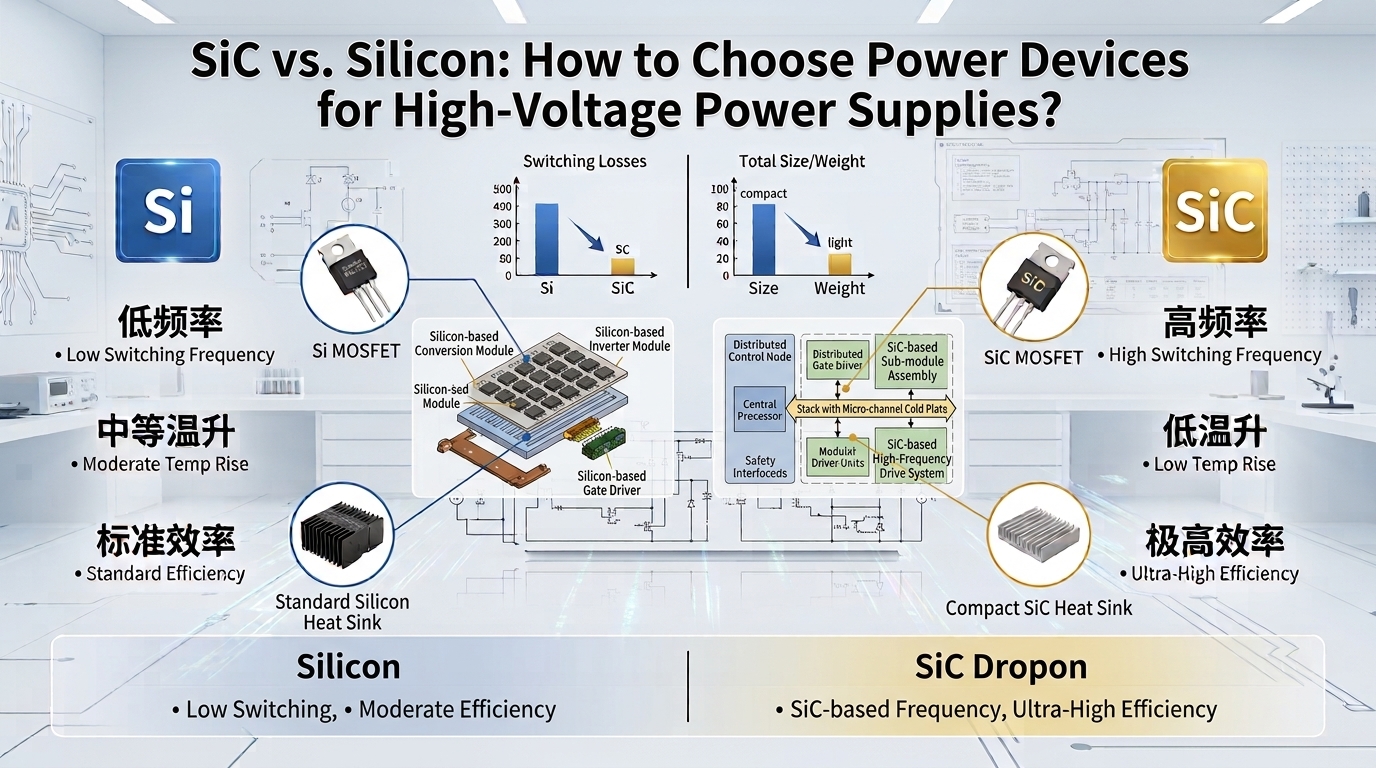 Why do these parameters carry special weight for high-voltage power supplies? First, high-voltage hardware sustains substantial electrical stress across power switches. Excessive switching losses convert directly into heat, imposing heavier burdens on thermal subsystems.
Second, raising switching frequency allows engineers to downsize transformers, inductors and filter assemblies. However, higher frequencies amplify switching losses and become a dominant limiting factor for overall system efficiency.
High-voltage power supply design is fundamentally an optimization exercise balancing voltage rating, operating frequency, power losses, thermal rise and mechanical enclosure size. SiC expands the feasible design envelope for these tradeoffs. It is critical to note that real-world device performance depends heavily on component model selection, converter topology, gate drive configuration and operating conditions; material classification alone cannot determine final conversion efficiency.
4. Why SiC Benefits High-Voltage Power Supply Systems
4.1 Support for Higher Switching Frequencies
Increased switching frequency creates opportunities to miniaturize magnetic components.
Transformers, inductors and passive filters often occupy the largest portion of space inside high-voltage power supplies. When switching frequency rises appropriately, engineers can reduce the physical footprint of these assemblies while satisfying core loss, insulation and thermal specifications.
The core design relationship can be simplified as: Elevated switching frequency → Reduced magnetic component dimensions → Improved power density
SiC enables targeted optimization for:
· Transformer mechanical size
· Inductor footprint
· Filter assembly dimensions
· Overall power supply enclosure volume
Still, higher switching frequency does not always equal better system performance. Faster switching edges amplify the impacts of circuit parasitic elements, complicate PCB layout and raise electromagnetic interference risks.
4.2 Reduced Switching Losses
Minimized switching losses constitute one of SiC’s most impactful advantages for power conversion hardware.
Every turn-on and turn-off event dissipates finite energy within power switches. As operating frequency climbs, cumulative switching losses increasingly dictate total system efficiency.
Under matched operating conditions, SiC devices suppress energy dissipation during switching transitions, which helps reduce:
· Energy waste during turn-on and turn-off cycles
· Excess heat generated by switching events
· Efficiency degradation under high-frequency operation
This explains why SiC is frequently evaluated for high-voltage, high-frequency converter topologies. Design teams must calculate exact loss figures using device datasheet parameters and targeted operating points; integrating SiC hardware does not guarantee efficiency gains without proper system tuning.
4.3 Superior High-Temperature Operation
High-voltage, high-power power supplies commonly face strict thermal design limits.
All power losses convert into thermal energy. When internal enclosure space is constrained, trapped heat drives up component temperatures and threatens system stability and service life.
SiC withstands higher junction temperatures, delivering additional thermal design margin for compact high power-density systems when paired with proper cooling infrastructure.
One important caveat applies: Adopting SiC does not eliminate thermal design requirements. Heat sinks, thermal interface materials, forced air cooling paths and temperature monitoring circuits remain essential for reliable high-voltage power supply operation.
4.4 Enhanced Power Density Capability
Combining the above advantages yields a clear design benefit: Higher switching frequency + lower switching losses + improved thermal endurance = Greater power density potential
This benefit delivers tangible value for laboratory power sources, industrial high-voltage equipment, high-voltage test instruments and other hardware with strict dimensional constraints.
5. How SiC Reshapes High-Voltage Power Supply Design Workflows
SiC adoption affects not only discrete power switches, but the entire power supply development methodology.
5.1 Switching Frequency and Gate Drive Optimization
SiC’s fast switching capability demands refined gate drive implementation.
During rapid switching transitions, parasitic inductance and capacitance exert far more pronounced effects. Design engineers must focus on:
· Gate drive circuit tuning
· Printed circuit board layout planning
· Control of dv/dt and di/dt rates
· Electromagnetic compatibility management
Poor layout practices can trigger voltage spikes and ringing during fast switching, increasing electrical stress across semiconductor components.
After switching to SiC hardware, design priorities shift away from blindly boosting switching frequency. The goal becomes seamless coordination among power devices, gate drive circuits and PCB layout.
5.2 Thermal Management
While SiC cuts overall heat generation, thermal management remains indispensable for high-voltage power supplies.
Design teams typically evaluate multiple thermal solutions in parallel:
· Heat sink sizing and specification
· Thermal interface material selection
· Forced or natural air cooling architecture
· Mechanical device mounting structure
· Real-time temperature monitoring
For high-power equipment, localized hot spot temperatures deserve closer attention than average bulk temperature readings.
5.3 Electromagnetic Interference and PCB Layout
Fast SiC switching introduces another key consideration: stricter electromagnetic compatibility requirements.
The simplified causal chain reads: Faster switching edges → Higher dv/dt and di/dt values → More stringent EMI mitigation needs
Engineers must tune switching speed deliberately and minimize the area of high-current power loops, refine gate drive routing and optimize interconnections between components.
This represents a frequently overlooked challenge of SiC implementation: performance upgrades from new semiconductor materials must be matched with improved circuit design discipline.
6. SiC vs Silicon: Decision Framework for Component Selection
No single power device suits every high-voltage power supply application.
6.1 Scenarios Where Silicon Remains Preferred
Silicon devices deserve priority evaluation for projects with the following characteristics:
· Cost control stands as the primary design objective
· Target switching frequency stays relatively low
· Power density requirements are moderate
· Existing products rely on validated silicon architectures
· Ultra-fast switching performance is unnecessary
For legacy product upgrades, if existing silicon hardware meets efficiency, temperature rise and reliability targets, switching semiconductor materials may fail to deliver sufficient overall return on investment.
6.2 Scenarios Worthy of SiC Evaluation
System requirements below justify detailed SiC performance and cost assessment:
· High operating voltage classes
· Demand for elevated switching frequencies
· Strict overall efficiency targets
· Compact power density specifications
· Limited available cooling capacity
· Requirements to reduce equipment size and weight
SiC’s advantages become most apparent for high-voltage, high-power systems with tight spatial constraints.
Final component selection relies on full system-level analysis, including power loss modeling, gate drive complexity, cooling hardware costs, component pricing and long-term system reliability testing.
7. Typical High-Voltage Power Supply Applications and Product Selection
SiC power devices can provide significant advantages in high-voltage, high-frequency and high-power conversion systems. However, the optimal power supply solution still depends on the specific application, including required voltage, current, power level, output type, switching frequency, regulation accuracy and control method.
Different applications therefore require different power supply architectures. High-voltage DC power supplies may be preferred for electrostatic processing, X-ray systems and electroplating, while high-voltage AC power supplies are commonly considered for dielectric testing, insulation testing and other AC withstand applications. Programmable and high-power DC supplies are also widely used in semiconductor testing, scientific research and energy storage applications.
The following table provides a practical reference for matching common high-voltage applications with suitable power supply types:
Table 2
Application | Key Requirements | Recommended Power Supply |
High-Voltage Testing | High voltage, stable and precise output | High-Voltage DC / AC Power Supply |
Insulation & Withstand Testing | High-voltage AC/DC, reliable protection | High-Voltage AC/DC Power Supply |
Electroplating | High current, stable DC output | High-Current DC Power Supply |
Electrostatic Processing | High voltage, low current, high stability | High-Voltage DC Power Supply |
Plasma Processing | High voltage, high-frequency operation | High-Voltage DC / AC Power Supply |
X-Ray & Radiation Equipment | High voltage, precise and stable output | High-Voltage DC Power Supply |
Semiconductor Testing | High precision, programmable control | Programmable DC Power Supply |
Scientific Research | Wide voltage range, precise voltage/current control | Adjustable / Programmable DC Power Supply |
Energy Storage Testing | High power, programmable output | High-Power DC Power Supply |
AC Dielectric Testing | High AC voltage, stable frequency | High-Voltage AC Power Supply |
The table highlights an important point: power supply selection should be based on application requirements rather than semiconductor material alone. Even when SiC is selected as the preferred power device technology, the final power supply architecture must still be matched to the required output characteristics, operating conditions and system-level performance targets.
For customers looking for a suitable high-voltage power supply, IDEALPLUSING offers a broad range of power supply solutions covering high-voltage AC/DC, adjustable, programmable and high-power applications. By comparing voltage range, current capacity, power rating, output characteristics and control requirements, customers can identify a product configuration that better fits their specific application.
Whether the requirement is a high-voltage DC source for industrial processing, a high-voltage AC supply for dielectric testing, a programmable power supply for laboratory and semiconductor testing, or a high-power solution for energy storage applications, IDEALPLUSING provides multiple product options for different engineering requirements.
For applications with customized voltage, current, power or control requirements, customers can also work with the IDEALPLUSING technical team to evaluate the appropriate power supply configuration and select a solution based on actual operating conditions.
8. Ongoing Development Trends for SiC in High-Voltage Power Supplies
Future high-voltage power supply development continues along defined technical trajectories:
· Higher sustainable switching frequencies
· Increased power density
· Improved end-to-end conversion efficiency
· Reduced overall system dimensions
· Advanced integrated thermal management
· High-resolution digital control schemes
· Intelligent real-time health monitoring
· Higher voltage-rated SiC power devices
In recent years, SiC adoption has expanded from conventional high-power conversion into numerous high-voltage, high-frequency power conversion scenarios. Parallel advancements continue across device packaging, gate drive technology and thermal design methodologies.
From an engineering perspective, SiC will not fully replace silicon. Silicon retains advantages of maturity and cost-effectiveness for cost-sensitive, low-frequency systems with relaxed power density targets. SiC, by contrast, unlocks new design possibilities for high-voltage, high-frequency, high-efficiency and compact power conversion hardware.
Power device selection for high-voltage power supplies should never focus solely on material comparisons. Instead, design teams conduct holistic evaluations covering voltage rating, switching frequency, power losses, cooling infrastructure, mechanical size, total cost and reliability.
For high-voltage power supply manufacturers, genuine engineering value does not come from adopting newer semiconductor materials indiscriminately. It lies in identifying the optimal balance between device performance and full-system design constraints for each unique application.