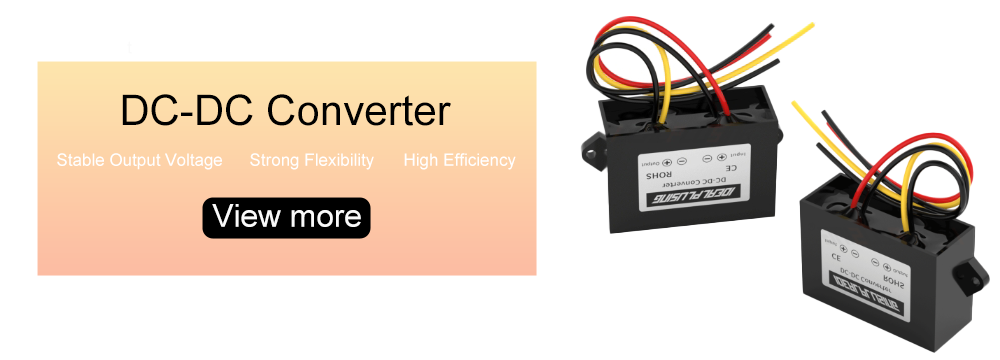
Today solar power is a part of how we make energy for our homes, businesses and big energy systems. We use panels to turn sunlight into electricity.Solar panels are not enough on their own to make this work well. We also need helpers called DC-DC converter to make sure the energy is used properly. These converters are very important for making sure the energy from the sun is changed into electricity that we can use. Solar power systems are not possible without high-performance DC-DC converters. They are essential, for power to work the way it should.
I. Photovoltaic Output Characteristics: Unstable Voltage, Requiring Dynamic Adjustment
Solar panels are really sensitive to a things. The amount of light they get how hot or cold it is and if something is blocking the light all make a difference in how much power they can make. For instance a solar panel that is supposed to make 30 volts of power might only make 18 volts on a day.. When the sun is shining really strong and it is very hot that same solar panel can make more than 36 volts of power. Solar panels can be a bit unpredictable like that because of these factors, like intensity and temperature that affect the output voltage and current of solar panels.
The solar panel output is not always the same it goes up and down. If you connect this output to a battery or an inverter it will not work well and it might even hurt the equipment that is connected to it.
DC-DC converters, the ones that have MPPT can change how much power they take in so the solar panel always works at its Maximum Power Point, which means it gets the most energy possible from the sun. This way the solar panel can capture the amount of energy.
The main thing about these systems is that they have a role. They use algorithms called MPPT and things like Boost and Buck-Boost to make them work better. This means they can follow the sunlight in a way. Because of this the systems can make a lot power. The power generation goes up by ten percent to thirty percent. This is all because of the MPPT algorithms and the DC-DC topologies, like Boost and Buck-Boost.
II. Matching Different Voltage Platforms: The "Bridge" for System Integration
A typical solar power system has a lot of voltage levels. This means that the solar power system uses voltage levels to work properly. The solar power system includes these voltage levels, for a reason. The solar power system is made up of parts that use these multiple voltage levels.
Photovoltaic array: May output 30V, 48V, or even 600V (high-voltage strings)
Energy storage battery: Commonly 12V, 24V, 48V (lead-acid or lithium-ion)
The Inverter and the Load need a power source. This power source is called a DC bus. For example it needs to be around 400 volts of current for it to work with the grid connection. The Inverter and the Load will not work properly without this DC bus. The DC bus has to be at the voltage, like 400V DC for the Inverter and the Load to function correctly with the grid.
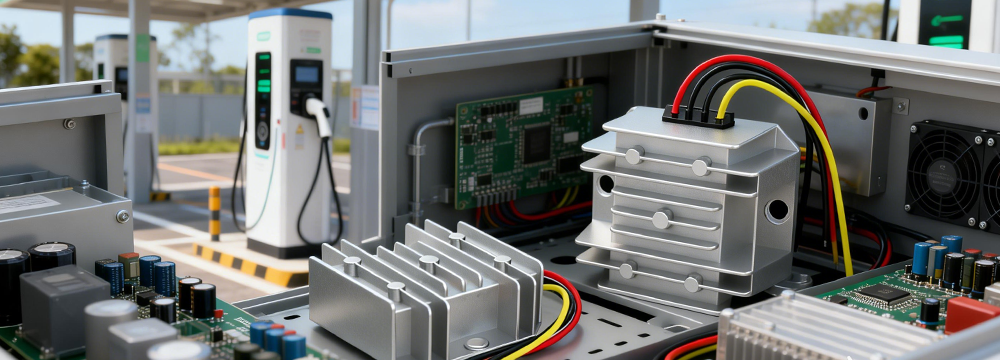
The voltages, between these components are often not the same. For example when you try to charge a 12V lithium battery with a 48V panel it does not work well if you connect them directly. The 12V lithium battery will not get fully charged. It will waste energy. There is also a risk of overcharging the 12V lithium battery. That is when high-efficiency DC-DC converters come in handy. They act as voltage adapters enabling:
Buck conversion: 48V → 12V for battery charging
Boost conversion: Low-voltage photovoltaic power → High-voltage bus for inverter use
Bidirectional conversion: Supporting battery discharge and feedback to the grid (in hybrid systems)
Key role: Bridging the "voltage gap" between different subsystems and ensuring efficient energy flow.
III. Improving overall system efficiency and reliability
The old way of controlling voltage is not very good when you are dealing with a lot of power. This is because a lot of energy is wasted as heat. On the hand modern DC-DC converters are much better. They use technology that switches on and off very quickly like LLC and phase-shifted full-bridge topologies. These converters also use semiconductors made of GaN/SiC. This means they can convert voltage with little loss of energy. Modern DC-DC converters can be 97% to 99% efficient. This is an improvement, over the old way of controlling voltage.
This means
Less energy loss: 2-3 kWh less loss for every 100 kWh of solar power generated (equivalent to powering several more lights or extending the range of an electric vehicle)
Lower heat generation, reducing cooling requirements and extending the lifespan of electronic components
When you are using off-grid or microgrid systems every kilowatt-hour of off-grid or microgrid systems is really important. You want to make the most of the energy from off-grid or microgrid systems. This is why high-efficiency conversion of, off-grid or microgrid systems is so useful. It means you will need solar panels for your off-grid or microgrid systems and smaller batteries for your off-grid or microgrid systems.
Key role: Moving from "usable" to "highly efficient," reducing LCOE (Levelized Cost of Energy).
IV. Supporting intelligent and modular design
Modern solar energy systems are trending towards intelligence and modularity. High-efficiency DC-DC converters typically integrate:
CAN/RS485 communication interfaces for remote monitoring
Multiple protection features against overvoltage, overcurrent, short circuit, and reverse connection
Parallel current sharing function for easy power expansion
For example, in large photovoltaic power plants, each module can be equipped with a miniature DC-DC optimizer (similar to a micro-inverter), enabling module-level MPPT and completely solving the "bottleneck effect" (where shading on one panel reduces the power of the entire string).
Key role: Providing the hardware foundation for intelligent operation and maintenance, fault diagnosis, and system expansion.
More than just "conversion," it's "empowerment"
High-efficiency DC-DC converters have long surpassed simple voltage conversion functions, becoming a core hub in solar energy systems for improving power generation efficiency, ensuring operational safety, and enabling intelligent control. With the advancement of carbon neutrality goals and power electronics technology, their importance will only become more pronounced. In the future, with the widespread adoption of GaN devices, optimization of digital control algorithms, and the growing demand for bidirectional energy flow, DC-DC converters will continue to drive solar power systems towards higher efficiency, lower cost, and greater resilience.
Share our interesting knowledge and stories on social media