When we talk about electronic systems one big problem is making sure the voltage is just right. This is an issue that people who design power management systems have to deal with. The problem is that the voltage we get from our power source is often not the same as what our semiconductor devices need to work. So we need to find a way to change the voltage to match what our devices need. There are a ways to do this but two of the most important ones are the buck converter, which makes the voltage lower and the boost converter, which makes the voltage higher. These two converters are really important. Are used a lot in electronic systems. Voltage regulation is a part of this and the buck and boost converters are essential, for making sure our devices get the right voltage.
A Simple Analogy: A Dam and a Water Pump
Before diving into circuits, let's imagine a water system:
A Buck Converter is like a smart dam. Upstream is high water level (high voltage). It releases water in a controlled manner through its gates to achieve a stable, lower water level (low voltage) downstream. Its core function is step-down.
A Boost Converter is more like a water pump. It draws water from a low-level (low voltage) pool and forcefully "pumps" it out, creating a higher water level (high voltage) at the outlet. Its core function is step-up.
Together, these two converters solve a fundamental conflict in the electronics world: the voltage of a power source often doesn't match the voltage required by the load.

1. The Buck Converter – How to "Step on the Brakes"
(1) Core Task
To reduce an input voltage (e.g., 12V) to a stable, lower output voltage (e.g., 5V or 3.3V).
(2) So What Is The Process Like? It Is Actually Simple. It Works In A Three Step Cycle
Imagine three key actors in the circuit: a switch (S), an inductor (L), a diode (D), and a capacitor (C).
Step A: Switch Closed (Charging Phase)
When the switch is turned on electricity goes from the input source through the inductor to the output. This powers the load. At the time the inductor gets energy. The inductor stores this energy in a field around it. The diode is turned off during this time because it is reverse-biased. The switch being on is what makes the inductor store energy. The load gets power from the input source through the inductor when the switch is, on.
Step B: Switch Open (Discharging Phase)
When the switch turns off the inductor does not like the change in current. The inductor really resists this change. It immediately fights back. Makes a back electromotive force to keep the current flowing. At this moment the inductor is, like a battery. The inductor releases its stored energy through the diode. The diode is now helping the flow easily. This helps to keep powering the load. The inductor is really helping to keep the current flowing in the load.
Step C: Rapid Switching (The Key to Regulation)
We can control the output voltage by switching between two states fast, like thousands or even millions of times per second. The duty cycle, which is the time the switch's on compared to the total time it takes to switch is very important. By changing this duty cycle we can get the output voltage we want from the output voltage. The switch is on for a time, which is called the switch on time and the total time for one switch is called the total switching period. So the duty cycle is the switch, on time divided by the switching period. We use this to control the output voltage.
(3) Typical Applications
Converting USB's 5V to 3.3V for a microcontroller (MCU)
Converting a car's 12V/24V battery voltage to various lower voltages for audio systems, instrumentation, etc.
Any scenario requiring a lower voltage from a higher voltage source.
2. The Boost Converter – How to "Step on the Gas"
(1) Core Task
To increase an input voltage (e.g., 3.7V) to a stable, higher output voltage (e.g., 5V or 12V).
(2) How Does It Work? (Another Three-Step Cycle)
The components are similar, but their configuration is entirely different.
Step A: Switch Closed (Energy Storage Phase)
When the switch is ON, the input source directly charges the inductor. Current rises linearly, and the inductor stores magnetic energy. Crucially, the diode blocks current from flowing to the output. The output capacitor alone supplies power to the load.
Step B: Switch Open (Boost Release Phase)
When the switch turns OFF, the inductor again resists the change in current. The induced EMF across it adds in series with the input source voltage, creating a voltage higher than the input. This forces the diode to conduct, and the combined energy from the source and inductor is delivered to the output and load, while also recharging the output capacitor.
Step C: Rapid Switching (The Key to Boosting)
Again, through high-frequency switching and duty cycle control, the output voltage is elevated. The relationship is:
Vout = Vin / (1 - D) (under ideal conditions)
For example, with a 3V input and a 60% duty cycle, the output is approximately 7.5V. As you can see, a higher duty cycle results in a higher output voltage.
(3) Typical Applications
Driving 5V USB devices from a single lithium battery cell (3.0V-4.2V)
LED drivers, boosting battery voltage to the higher voltage needed to drive multiple series-connected LEDs
Energy harvesting systems like solar panel Maximum Power Point Tracking (MPPT)
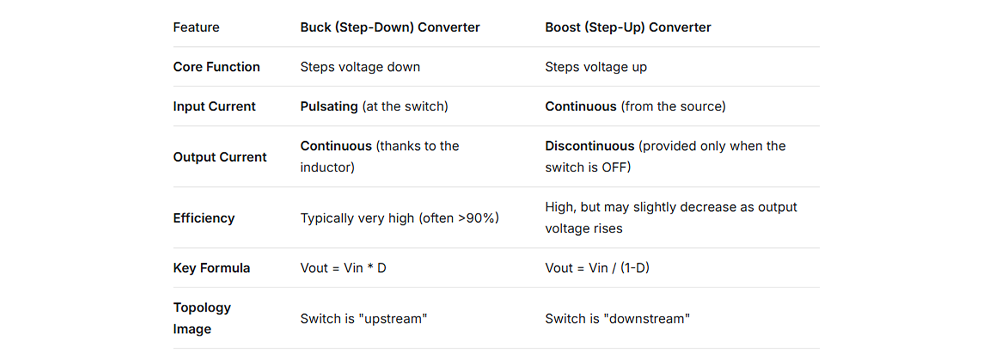
3. A Side-by-Side Comparison of Buck vs. Boost
4. Important Concepts: Ripple and Efficiency
No converter is perfectly smooth:
The Output Voltage Ripple is something that happens because of the way the system switches on and off. This makes the Output Voltage Ripple have ups and downs. We can make the Output Voltage Ripple smaller by making a changes, to the inductor and the output capacitor. The Output Voltage Ripple will be more stable if we get the inductor and output capacitor right.
When we talk about Conversion Efficiency we have to think about the fact that not all of the energy is actually transferred. There are some losses that happen and these losses come from a few main places. For example we have switching losses, which happen when we turn the switch on and off. We also have conduction losses, which are caused by the resistance in the windings of the inductor.. Then there are the losses that come from the diode forward voltage drop. The thing is, people who design DC-DC converters really want to make them work efficiently as possible so they try to make high-efficiency designs. This is a goal for Conversion Efficiency, in DC-DC converter.
Here is a great tip: a lot of designs use something called synchronous rectification technology. This is where they replace the diode with a special kind of MOSFET that has very low resistance. The good thing about this is that it can really cut down on the losses that happen when electricity is flowing through. This means that the efficiency of the design can be really high, above 95%. Synchronous rectification technology is a part of this it really helps to make modern designs work better.
What's Next?
Now that you have learned the basics of Buck and Boost converters you should know that there are complex Buck and Boost converter topologies, in the real world.
Buck-Boost: Can both step voltage up and down.
SEPIC: A non-inverting buck-boost topology.
Ćuk: Another interesting topology with its own characteristics.
These things all start with the ideas of the two topologies that were talked about today. If you understand Buck and Boost you will have the key, to making power supplies that work well. Buck and Boost are important because they help us make power supplies that use energy.
Share our interesting knowledge and stories on social media