
In the era of electronic devices evolving towards thinness, lightness, and integration, AC/DC power supplies, as the core of energy conversion, face an increasingly urgent demand for miniaturization. From portable medical equipment to industrial control modules, from smart home terminals to new energy vehicle accessories, the volume reduction of power supply products is directly related to the flexibility of overall machine design and the expansion of application scenarios. Surface Mount Technology (SMT), with its characteristics of high-density assembly and precise process control, has become a key support for solving the miniaturization challenge of AC/DC power supplies. It promotes the dual breakthrough of "slimming down" and performance upgrading of power supply products without sacrificing conversion efficiency and reliability.
1. SMT High-Density Assembly: Breaking Through Spatial Layout Limitations
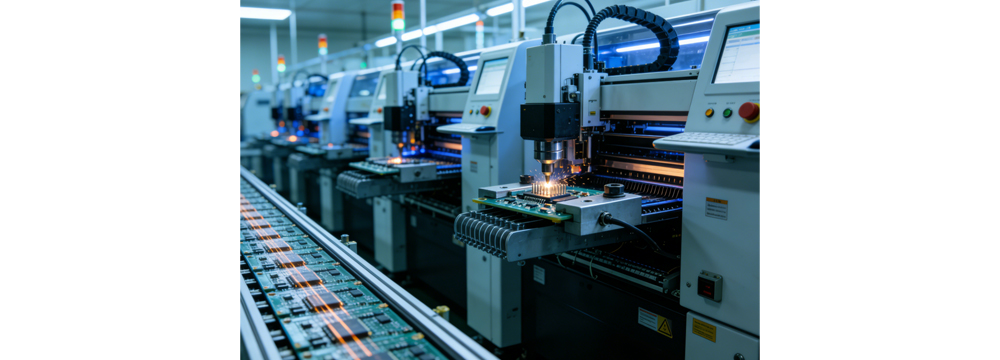
In traditional Through-Hole Technology (THT), components are fixed by inserting pins into the through-holes of the PCB board. The vertical space occupied by the pins and the spacing between through-holes result in a loose internal layout of the power supply, making it difficult to achieve miniaturized design. In contrast, SMT uses leadless or short-lead components that are directly mounted on the surface of the PCB, fundamentally changing the assembly logic.
In AC/DC power supplies, the layout of core components such as transformers, filter capacitors, and power switching tubes is crucial for space occupation. SMT supports double-sided mounting of components, enabling the use of both front and back sides of the PCB board. The area of the circuit board with the same function is reduced by more than 40% compared with THT. For example, high-frequency transformers adopting SMT technology can have a height controlled within 5mm through flat magnetic core design and surface mount structure. Compared with traditional through-hole transformers, their volume is reduced by 30%-50%, and the magnetic coupling efficiency is improved by 10%-15%. At the same time, the pin spacing of SMT components can be reduced to less than 0.3mm. Combined with refined PCB wiring design, more functional modules can be integrated in a limited space, laying a structural foundation for the miniaturization of AC/DC power supplies.
2. Component Miniaturization Adaptation: SMT Drives the Upgrade of Core Components
The miniaturization of AC/DC power supplies not only relies on the optimization of assembly processes but also requires the support of component miniaturization itself. SMT technology and miniaturized components have formed a virtuous cycle of coordinated development. To meet the high-precision mounting requirements of SMT, power supply-specific components are constantly evolving towards miniaturization and integration, further compressing the internal space of the power supply.
In the power conversion link, SMT-compatible surface-mount power MOSFETs adopt leadless packages (such as DFN, QFN). Their package area is reduced by 60% compared with traditional TO packages, and the on-resistance is reduced by 20%-30%, which reduces the heat dissipation space while improving conversion efficiency. In the filtering link, surface-mount multi-layer ceramic capacitors (MLCC) replace traditional through-hole capacitors with their advantages of small size and high capacitance density. Their volume is only 1/5 of that of through-hole capacitors with the same capacitance, and the parasitic inductance is smaller, which helps optimize the electromagnetic compatibility (EMC) performance of the power supply. In addition, the integrated power management chip (PMIC) supported by SMT integrates functions such as PWM controller, drive circuit, and protection circuit into a single chip, replacing the combination of multiple discrete components. This greatly reduces the volume of the power control module and lowers the circuit complexity.
3. Precise Process Control: Ensuring the Reliability of Miniaturized Power Supplies
In the process of AC/DC power supply miniaturization, the increase in component density and the reduction of heat dissipation space may lead to reliability risks. The precise process control capability of SMT effectively resolves this contradiction. SMT uses automated placement machines for component positioning and mounting, with a positioning accuracy of ±0.03mm, ensuring the installation accuracy of components in a small space and avoiding short circuits, poor contact and other problems caused by compact layout.
In the soldering link, the reflow soldering process forms reliable solder joints by melting the solder paste uniformly through precise temperature curve control. Compared with traditional wave soldering, the soldering quality is more stable, and the solder joint defect rate is reduced by more than 80%. For power components in AC/DC power supplies, SMT can be combined with thermal pads and heat dissipation pad designs to quickly conduct the heat generated by the components during operation to the PCB or heat dissipation structure, solving the heat dissipation problem of miniaturized power supplies. For example, surface-mount rectifier bridges are closely combined with the PCB through the bottom heat dissipation pad, and the heat dissipation efficiency is increased by 25% compared with traditional through-hole rectifier bridges, ensuring the long-term stable operation of the power supply under high power density. At the same time, the automated production characteristics of SMT reduce human operation errors, improve the consistency of power supply products, and provide reliable guarantee for the mass production of miniaturized power supplies.
4. Technology Integration and Innovation: Expanding the Application Boundaries of Miniaturized Power Supplies
SMT does not independently promote the miniaturization of AC/DC power supplies, but integrates deeply with technologies such as high frequency and digitalization to form a synergistic innovation effect. High frequency is one of the core paths for power supply miniaturization. By increasing the switching frequency, the volume of magnetic components such as transformers and inductors can be reduced. The high-precision assembly capability of SMT can meet the strict requirements of high-frequency circuits for component parasitic parameters, avoiding the deterioration of frequency characteristics caused by improper layout.
For example, in high-frequency AC/DC power supplies above 600kHz, the combination of SMT-mounted planar transformers and surface-mount high-frequency capacitors can increase the power density of the power supply to more than 10W/cm³, and the volume is reduced by 60% compared with traditional 100kHz power supplies. At the same time, the surface-mount digital control chip supported by SMT realizes the intelligent regulation and fault diagnosis of the power supply, improving the functionality and usability of the product on the basis of miniaturization. In scenarios such as on-board chargers for new energy vehicles and portable energy storage power supplies, the miniaturized AC/DC power supplies empowered by SMT not only meet the strict space requirements of the equipment but also reduce energy consumption through efficient energy conversion, promoting the development of the green electronics industry.
With its high-density assembly, component miniaturization adaptation, precise process control, and multi-technology integration, Surface Mount Technology (SMT) provides comprehensive support for the miniaturization of AC/DC power supplies from multiple dimensions including structural design, core components, reliability guarantee, and application expansion. With the continuous improvement of SMT process accuracy and the emergence of new miniaturized components, AC/DC power supplies will evolve towards smaller size, higher power density, and better performance, injecting continuous power into the innovative development of various electronic devices and releasing value in more niche and professional application scenarios.
Share our interesting knowledge and stories on social media