
An Aircraft Ground Power Unit (GPU) supplies electrical power to an aircraft while its engines are shut down or when onboard power generation is unavailable or unnecessary. It allows ground crews to support aircraft maintenance, pre-flight preparation, avionics checks, and other ground operations without relying on onboard generators for every task.
One important feature of aircraft electrical systems is the use of 400Hz AC power in many applications. Compared with the 50Hz or 60Hz AC power commonly available from utility grids, 400Hz power requires specialized conversion equipment when the available source does not match the aircraft's electrical requirements.
Understanding the working principle of a 400Hz aircraft ground power unit helps airport operators, maintenance organizations, aerospace equipment integrators, and engineering teams evaluate power compatibility, conversion technology, output stability, and operating requirements.
This guide explains how a 400Hz GPU works, what engineers should consider during selection, and how to assess a suitable solution for aircraft ground support.
1. Industry Pain Points: Why Is 400Hz Ground Power Important?
Aircraft ground operations require a dependable electrical source that matches the connected aircraft's specifications. An unsuitable power source can interrupt maintenance procedures, complicate equipment integration, or prevent ground operations from proceeding as planned.
Several challenges deserve attention.
Frequency and Voltage Compatibility
Commercial utility power is typically supplied at 50Hz or 60Hz, while many aircraft electrical systems use 400Hz AC power. The required voltage, phase configuration, frequency tolerance, and connector arrangement depend on the aircraft and its applicable specifications.
A conventional utility supply therefore cannot automatically be connected directly to an aircraft designed for a different electrical interface.
Output Stability Under Changing Loads
Aircraft systems can include avionics, lighting, environmental control equipment, and other electrical loads. The demand placed on a ground power unit may change as equipment is switched on or operating conditions change.
Engineers should assess voltage regulation, frequency regulation, transient response, harmonic distortion, and overload behavior against the requirements of the intended application.
Reliability During Maintenance
A power interruption during ground maintenance or testing can cause delays and require procedures to be repeated. The operational impact depends on the aircraft, the task being performed, and the site's maintenance process.
For this reason, evaluating a GPU involves more than checking its rated power. The unit must also suit the operating environment, duty cycle, maintenance arrangements, and required protection functions.
2. Working Principle: How Does a 400Hz Aircraft Ground Power Unit Work?
A 400Hz aircraft ground power unit converts an available electrical source into an output compatible with the aircraft's ground-power interface.
The conversion method depends on the GPU design. Modern static GPUs commonly use power-electronic conversion, while motor-generator systems use rotating machinery.
Step 1: Input Power
The unit receives electrical power from an available source, such as a facility utility connection or another suitable power source.
The input requirements depend on the GPU model and installation. Engineers should verify the input voltage, frequency, phase configuration, current capacity, and grounding arrangement before installation.
Step 2: Rectification
In a typical static GPU, an AC input is converted into DC through a rectifier stage.
If the input is AC, this stage allows the equipment to establish a DC power path that can be used by the downstream conversion system. The precise topology depends on the design and may include power-factor correction or other input-conditioning functions.
Step 3: DC-Link Energy Processing
The rectified power is supplied to a DC link, which provides an intermediate electrical bus for the inverter stage.
The DC link supports the conversion process and helps the control system manage changes in input and output conditions. Its design influences ripple, transient behavior, protection coordination, and overall conversion performance.
Step 4: Inversion to 400Hz AC
A power-electronic inverter switches the DC-link power to synthesize an AC output at the required frequency.
The control system regulates the output waveform and voltage according to the equipment's design and specified operating limits. In a typical aircraft ground-power application, the target frequency is 400Hz.
Some aircraft interfaces use 115/200V AC, three-phase, 400Hz power. These values are common examples rather than universal requirements; the actual aircraft interface specification must be checked before selecting a GPU.
Step 5: Output Filtering, Monitoring, and Protection
Depending on the design, output filters and control functions help establish the required waveform quality. Monitoring and protective functions may detect conditions such as overload, over-temperature, or abnormal output voltage.
The specific protection features and performance limits must be verified against the selected unit's technical documentation.
Step 6: Delivery to the Aircraft
The converted output is delivered through the appropriate cables and connectors to the aircraft ground-power interface.
Before connection, the operating team should confirm the required voltage, frequency, phase sequence where applicable, connector compatibility, grounding, interlocks, and operating procedures.
The result is a controlled ground power source that can support approved aircraft ground operations without requiring the aircraft to obtain all its electrical power from onboard generation.
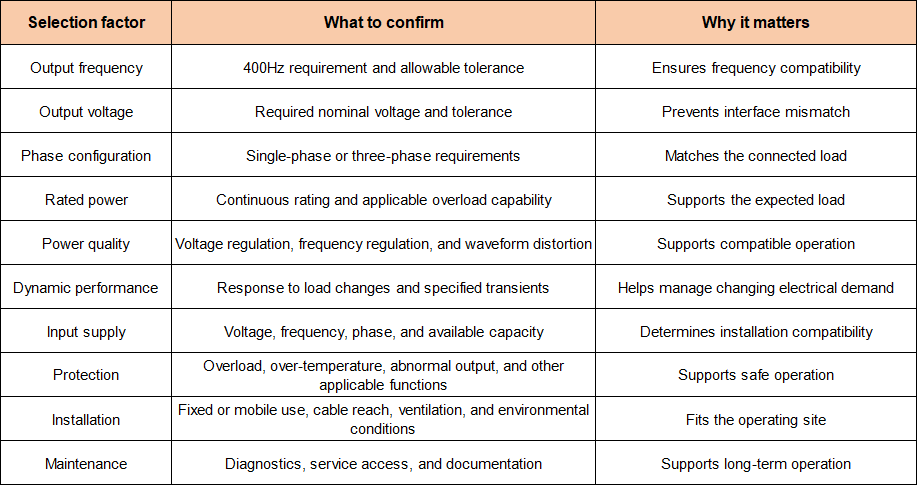
3. Selection Guide: What Should Buyers Compare?
A suitable aircraft ground power unit should be selected based on the aircraft interface and actual operating conditions—not frequency alone.
Static GPU vs. Motor-Generator GPU
| Feature | Static GPU | Motor-Generator GPU |
| Conversion method | Power electronics | Motor-driven generator |
| Moving parts | Generally fewer | Rotating machinery |
| Output control | Electronic regulation | Generator and drive-system characteristics |
| Maintenance considerations | Semiconductor cooling, controls, and electronic components | Bearings, rotating components, drive system, and electrical components |
| Selection priorities | Power quality, efficiency, control, and installation requirements | Mechanical design, serviceability, operating conditions, and maintenance resources |
Neither architecture is automatically the right choice for every installation. The decision should consider the required output, duty cycle, site conditions, maintenance capability, and lifecycle cost.
If you are comparing options, consult the manufacturer's technical documentation and the aircraft's applicable ground-power requirements. An engineering review can help identify missing specifications before a purchase decision is made.
4. Technical Solution: Evaluating a GPU for Aerospace Applications
For aerospace ground-support applications, the engineering process should begin with a clearly defined electrical interface.
A technical review typically covers four areas.
Electrical performance: Confirm output voltage, frequency, phase configuration, rated power, voltage regulation, frequency regulation, waveform quality, and transient requirements.
System integration: Check the input supply, cable and connector requirements, grounding, interlocks, installation footprint, ventilation, and connection procedures.
Testing and documentation: Request the applicable datasheet, operating manual, protection specifications, test documentation, and compliance records. Confirm that the evidence applies to the exact model and configuration under evaluation.
Customization and verification: If the standard configuration does not meet the application requirements, identify the specific electrical, mechanical, environmental, or interface changes needed. Confirm technical feasibility and validation requirements before assuming a customized design is available.
IDEALPLUSING's specific 400Hz GPU models, output ratings, certifications, and test capabilities should be confirmed against current product documentation before being presented as established capabilities.
For technical assistance, prepare the required input supply, output voltage and frequency, power rating, aircraft or equipment interface, installation conditions, and target market. These details give an engineering team a useful starting point for assessing compatibility.
You can also request the relevant technical datasheet or selection documentation to compare candidate configurations. If the application requires a non-standard configuration, submit the requirements for a feasibility review and quotation.
5. Application Example: Aircraft Maintenance in a Hangar
Consider an aircraft maintenance facility that needs external electrical power to support approved maintenance and avionics checks while an aircraft is parked in a hangar.
The engineering team must first establish the aircraft's ground-power interface requirements and determine the expected electrical load during the planned procedures.
The evaluation can then proceed as follows:
1.Confirm the interface: Record the required output voltage, 400Hz frequency, phase configuration, connector, and applicable operating limits.
2.Estimate the load: Identify the equipment expected to operate simultaneously and establish the required continuous power and any specified overload conditions.
3.Check the installation: Review utility input capacity, cable routing, ventilation, working space, and environmental conditions.
4.Validate power quality: Review the manufacturer's specifications and test evidence for voltage regulation, frequency regulation, waveform distortion, and dynamic response.
5.Verify operating readiness: Confirm protection functions, operating procedures, documentation, and maintenance arrangements before deployment.
This workflow helps the facility compare equipment against its real operational needs rather than selecting a unit based only on its 400Hz label.
No measured project results have been supplied for this example. Therefore, no percentage reduction in downtime, energy consumption, or maintenance cost should be claimed. Actual performance improvements must be established through documented site measurements or verified case studies.
A 400Hz aircraft ground power unit converts available electrical power into a controlled output compatible with an aircraft's ground-power interface. In a typical static design, rectification, DC-link processing, inversion, output control, and protection work together to provide the required AC power.
For engineers and buyers, the main task is to verify the complete electrical interface, load profile, power quality, installation conditions, documentation, and maintenance requirements.
A well-defined specification makes supplier comparisons more meaningful and helps identify integration risks before procurement.
If you are planning an aerospace ground-power project, contact the IDEALPLUSING engineering team to discuss your application requirements. Request the relevant technical documentation or submit your target voltage, frequency, power rating, and installation conditions for a preliminary solution review.
FAQ
1. What is a 400Hz aircraft ground power unit?
A 400Hz aircraft ground power unit supplies external electrical power at 400Hz for aircraft systems designed to accept that frequency. It is commonly used during aircraft parking, maintenance, and ground servicing.
2. Why do aircraft use 400Hz power?
Many aircraft electrical systems use 400Hz AC power as part of their electrical architecture. Higher frequency can allow certain transformers and magnetic components to be smaller and lighter for a given design, although the overall system benefits depend on the application and equipment design.
3. How does a static 400Hz aircraft GPU work?
A typical static GPU converts its input power through rectification, a DC link, and an inverter. The inverter generates controlled 400Hz AC power, while regulation, monitoring, and protection functions help maintain the required output conditions.
4. What voltage does a 400Hz aircraft ground power unit provide?
A common aircraft AC ground-power interface uses 115/200V, three-phase, 400Hz power. However, requirements vary by aircraft and application. Always confirm the applicable aircraft documentation before selecting a unit.
5. What is the difference between a static GPU and a motor-generator GPU?
A static GPU uses power electronics to convert and regulate electrical power, whereas a motor-generator GPU uses rotating machinery. Selection depends on output requirements, installation conditions, maintenance resources, and lifecycle considerations.
6. How do I determine the required power rating of an aircraft GPU?
Identify the connected loads, simultaneous operating conditions, continuous power demand, and any specified transient or overload requirements. Then verify the aircraft interface requirements and manufacturer ratings. Do not size the unit based only on nominal voltage.
7. What technical specifications should I check before purchasing a 400Hz GPU?
Review input requirements, output voltage and frequency, phase configuration, rated power, voltage and frequency regulation, waveform distortion, transient performance, protection functions, connectors, environmental limits, and required documentation.
8. Can a 400Hz aircraft ground power unit be customized?
Customization may be possible depending on the manufacturer's capabilities and the application requirements. Confirm the required input/output configuration, power rating, environmental conditions, interfaces, compliance needs, and validation plan with the supplier before proceeding.