Electrical equipment designed for one country may not operate under the same power conditions in another market. Differences in AC voltage, frequency, phase configuration, and power quality can affect equipment performance, compatibility, and safety.
For manufacturers developing products for international markets, testing equipment under different electrical conditions is an important part of product validation.
A Variable Frequency Power Supply provides adjustable AC output voltage and frequency, allowing engineers to reproduce selected electrical operating conditions without depending entirely on the local utility grid.
For example, engineers may need to evaluate equipment under 50Hz and 60Hz operating conditions, adjust output voltage, or verify how a product responds to different input-power requirements.
This article explains how variable frequency power supplies simulate different grid conditions, what technical parameters engineers should consider, and how to select a suitable AC power source for testing and industrial applications.
1. Industry Pain Points
Different Countries Have Different Grid Standards
Electrical grids do not operate under identical conditions worldwide. Common nominal frequencies include 50Hz and 60Hz, while nominal voltage and phase configurations also vary between markets.
Equipment designed for a specific electrical environment may require additional testing before being introduced into another market.
Without an adjustable AC power source, manufacturers may need different utility connections or additional testing arrangements.
Limited Control Over Testing Conditions
Utility power is not always suitable for controlled laboratory experiments.
Engineers may need to change voltage or frequency repeatedly while maintaining consistent test conditions. Relying only on the local grid can limit the flexibility and repeatability of these tests.
Product Compatibility and Validation Risks
Electrical equipment such as motors, household appliances, lighting products, medical equipment, and industrial controllers may respond differently when voltage or frequency changes.
Insufficient testing can result in unexpected operating behavior, additional product modifications, or delays during product validation.
A programmable variable frequency power supply helps engineers establish controlled electrical conditions for evaluating these differences.
2. Working Principle: How Grid Simulation Works
A variable frequency power supply typically converts input electrical power into a controlled AC output.
A simplified conversion process is:
AC Input → Rectification → DC Intermediate Circuit → Inverter → Adjustable AC Output
The inverter generates AC output at the required voltage and frequency through controlled switching.
Depending on the equipment design, the output can be adjusted independently within specified operating limits.
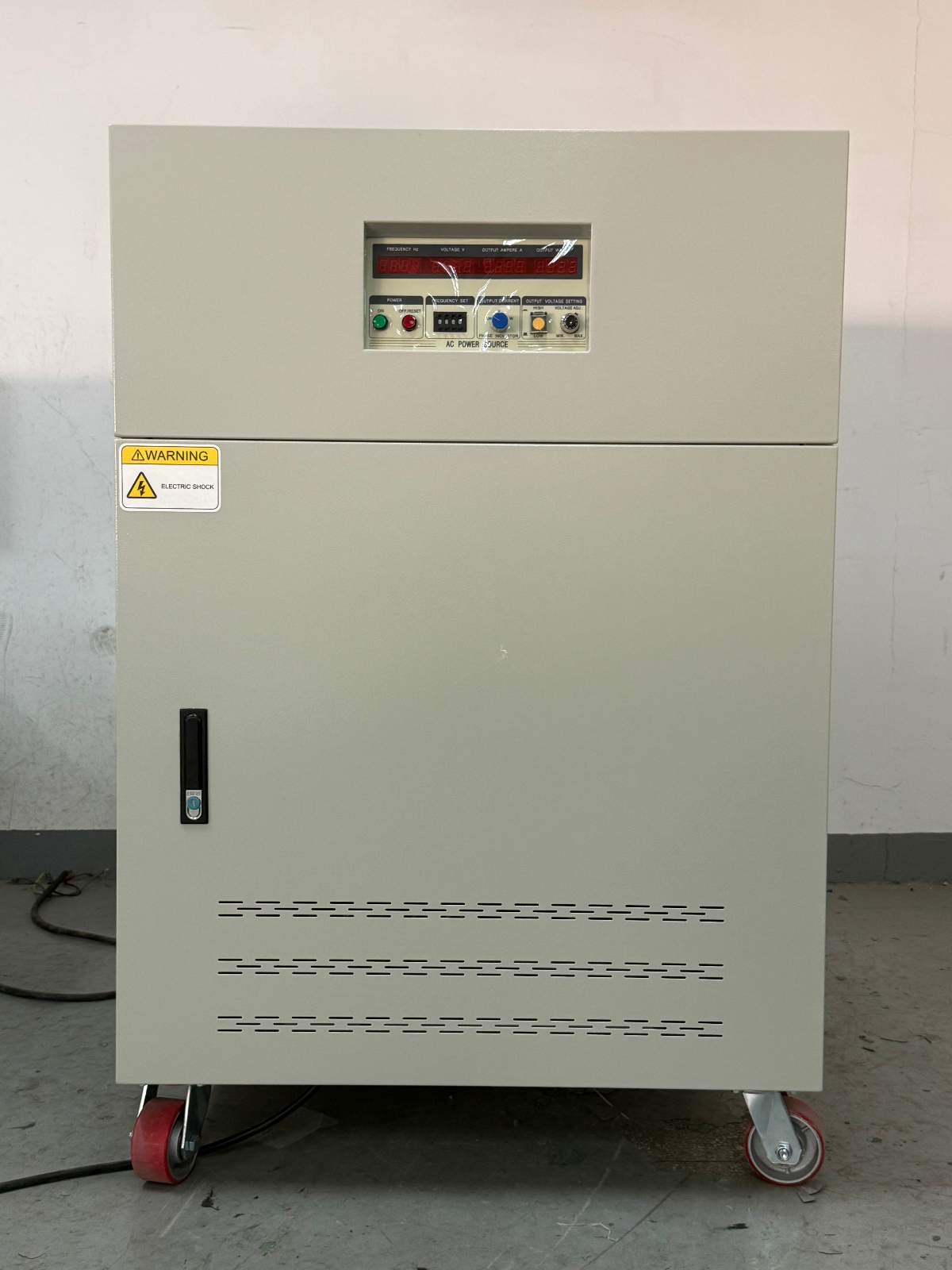
Key Adjustable Parameters
1. Output Frequency
Engineers can configure the output frequency to simulate different nominal grid conditions, such as 50Hz and 60Hz.
2. Output Voltage
Adjustable voltage allows testing under different nominal voltage requirements and selected voltage variation conditions.
3. Phase Configuration
Depending on the model, single-phase or three-phase output configurations may be available.
4. Output Waveform
Waveform quality, including total harmonic distortion (THD), should be considered when testing sensitive electrical equipment.
5. Load Response
The power supply should be evaluated under the expected load conditions to determine whether voltage and frequency remain within the required limits.
These functions allow engineers to establish repeatable test conditions rather than relying exclusively on the characteristics of the local utility grid.
3. Selection Guide: Choosing a Variable Frequency Power Supply
The appropriate power supply depends on the equipment being tested and the electrical conditions that need to be simulated.
Selection Factor | What Engineers Should Check |
Input voltage | Available AC input and input configuration |
Output voltage | Required adjustment range |
Output frequency | Required frequency range, including 50Hz and 60Hz |
Output phase | Single-phase or three-phase requirements |
Rated power | Total connected load and operating power |
Voltage regulation | Output stability under changing loads |
Frequency accuracy | Ability to maintain the specified frequency |
Waveform quality | Output waveform and THD requirements |
Protection | Overvoltage, overcurrent, overload and overtemperature protection, where available |
Control interface | Local operation, remote control or communication requirements |
Different Testing Requirements
Application | Important Testing Conditions |
Household appliances | Voltage and frequency compatibility |
Motors and pumps | Frequency, voltage and starting behavior |
Lighting equipment | Input voltage, frequency and operating stability |
Medical and optical equipment | Electrical compatibility and waveform quality |
Electrical inspection laboratories | Repeatable voltage and frequency conditions |
Industrial controllers | Input-power compatibility and abnormal-condition testing |
One important distinction: a variable frequency power supply used for grid simulation is not the same as a variable frequency drive (VFD).
A programmable AC power supply generates controlled AC output for equipment testing. A VFD primarily controls the speed of an AC motor by adjusting its supplied frequency and voltage.
4. Technical Solution: IDEALPLUSING Variable Frequency Power Supply
At IDEALPLUSING, variable frequency power supply requirements can be discussed according to the customer's application, electrical specifications, and testing environment.
Depending on the project and available configuration, engineering discussions may cover:
·Adjustable AC output voltage and frequency
·Single-phase or three-phase output
·Rated power and load requirements
·Voltage and frequency regulation
·Waveform quality requirements
·Protection functions
·Local and remote control
·Enclosure and installation requirements
Testing and Verification
Before selecting a power supply, buyers should define the electrical conditions that need to be reproduced.
A project-specific verification plan may include:
·Output voltage measurement
·Output frequency measurement
·Waveform inspection
·THD measurement
·Load testing
·Voltage regulation checks
·Protection-function verification
·Continuous operating evaluation, where required
The measurement conditions and acceptance limits should be agreed upon before testing.
If your laboratory or production facility needs to simulate multiple grid conditions, you can contact our engineers with your required voltage, frequency, phase, and power specifications.
You can also request the relevant product datasheet and technical documentation to compare available configurations.
5. Application Case: International Electrical Equipment Testing
Consider an electrical equipment manufacturer preparing products for markets with different nominal grid frequencies.
The engineering team needs to verify whether the equipment can operate under both 50Hz and 60Hz conditions.
A programmable variable frequency power supply can provide a controlled AC source for this evaluation.
A typical testing process may include:
·Define the target market's voltage and frequency requirements.
·Configure the AC power source for the required operating condition.
·Connect the equipment under test.
·Record input voltage, current, power, and operating behavior.
·Repeat the test under another specified frequency condition.
·Compare the results against the product's acceptance criteria.
For example, a manufacturer may establish separate 50Hz and 60Hz test profiles, provided both conditions fall within the power supply's rated output range.
Relevant test records may include voltage, frequency, current, power, temperature, and observed equipment behavior.
Actual compatibility results depend on the equipment design and applicable test requirements. No universal performance improvement should be assumed without measured evidence.
This approach is also useful for electrical inspection laboratories, environmental equipment manufacturers, optical equipment developers, and power engineering research institutions.
A Variable Frequency Power Supply provides engineers with a controlled way to simulate different AC voltage and frequency conditions for electrical testing and product validation.
By adjusting output voltage, frequency, and phase configuration, engineers can evaluate equipment under selected electrical operating conditions without relying entirely on the local utility grid.
When selecting a suitable system, buyers should consider output range, rated power, regulation, waveform quality, load characteristics, protection, and testing requirements.
IDEALPLUSING supports application-based discussions for variable frequency power supply solutions.
If you are planning a new laboratory setup or evaluating electrical equipment for different markets, send us your application, required specifications, quantity range, target delivery market, and certification or testing requirements to discuss a suitable configuration.
FAQ
1. What is a variable frequency power supply?
A variable frequency power supply is an AC power source that allows users to adjust output frequency and, depending on the model, output voltage and phase configuration for electrical testing and other applications.
2. How does a variable frequency power supply simulate different grid conditions?
It converts input power into controlled AC output through rectification, an intermediate DC circuit, and inverter conversion. Engineers can adjust output voltage and frequency to reproduce selected electrical conditions.
3. Can a variable frequency power supply simulate both 50Hz and 60Hz?
Yes, provided the required frequencies are within the equipment's specified output frequency range.
4. What is the difference between a variable frequency power supply and a frequency converter?
A variable frequency power supply provides controlled AC output for applications such as testing and validation. A frequency converter is a broader term for equipment that converts electrical power from one frequency to another.
5. Can a variable frequency power supply simulate different voltage levels?
Many models support adjustable output voltage within a defined range. The available voltage range depends on the equipment configuration.
6. What industries use variable frequency power supplies?
Applications include electrical testing, household appliance testing, environmental equipment, optical and medical equipment development, industrial manufacturing, and power research laboratories.
7. How do I select a variable frequency power supply for laboratory testing?
Consider output voltage, frequency range, phase configuration, rated power, waveform quality, regulation, load characteristics, protection functions, and control requirements.
8. Can a variable frequency power supply be customized?
Depending on project requirements, customization may be discussed for output voltage, frequency range, power rating, phase configuration, control interfaces, enclosure, and other application-specific requirements.