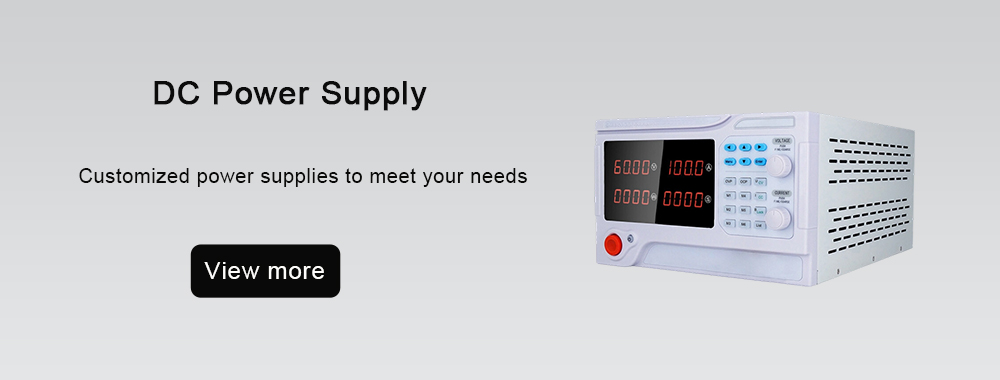
In electronic manufacturing, new energy, scientific research experiments, and industrial automation, programmable power supplies are evolving from auxiliary equipment into core testing and power supply devices. The global market for programmable power supplies maintains steady growth, with continuous iterations in industrial structure, technical routes, and application scenarios, providing solid support for high-end manufacturing and technological innovation. This paper analyzes the market size, industrial changes, and application value, balancing professionalism and readability for technical practitioners and industry decision-makers.
1. Global Market Size and Growth Pattern
The global market for programmable power supplies is expanding steadily, with demand concentrated in high-precision testing, high-power scenarios, and multi-channel cooperative control. Relevant statistics show that the global market size has kept rising in recent years, with a reasonable compound annual growth rate. The Asia-Pacific region leads in growth rate and has become a key engine driving the industry. With a complete electronic industry chain, the expansion of new energy industries, and increased investment in scientific research, China’s share in the global market has risen steadily, offering broad application space for programmable power supplies.
Market growth stems from rigid demands across multiple industries: semiconductor chip testing, new energy vehicle electric drive and battery testing, photovoltaic energy storage system verification, 5G communication equipment debugging, and aerospace device reliability testing all rely on programmable power supplies to provide stable, precise, and programmable power output. Programmable power supplies can flexibly set voltage, current, and output sequences to meet complex working condition simulations, replacing traditional fixed power supplies and improving R&D and production efficiency.

Regionally, North America and Europe maintain stable demand dominated by high-end scientific research and precision manufacturing. Relying on manufacturing upgrading and the outbreak of new energy industries, the Asia-Pacific region has become the main source of incremental growth. The popularization of programmable power supplies standardizes and automates testing processes, reduces manual errors, improves product consistency, and serves as important infrastructure for industrial upgrading.
2. Deep Industrial Changes Driven by Programmable Power Supplies
Programmable power supplies are driving the industry’s shift from hardware standardization to scenario customization. Traditional power supplies have single functions and fixed parameters, hardly adapting to multiple scenarios. Modern programmable power supplies support remote control, sequence output, dynamic waveform simulation, and multi-channel synchronization, suitable for automated production lines and complex laboratory demands. At the hardware level, the application of wide-bandgap devices improves efficiency and power density; at the software level, integration of communication protocols and upper computers enables data recording, abnormal protection, and remote operation and maintenance, connecting data links between equipment and systems.
The industrial landscape is gradually moving from overseas dominance to diversified collaboration. In the early stage, the high-end market was dominated by international brands. In recent years, domestic manufacturers have made continuous breakthroughs in control algorithms, structural design, and reliability, with products covering low-power to high-power series, featuring outstanding cost performance and service capabilities. IDEALPLUSING has accumulated stable solutions in high-power and high-precision programmable power supplies, providing reliable options for industrial testing and new energy scenarios, and steadily promoting domestic substitution.
Application boundaries continue to expand from laboratories to mass production lines and outdoor scenarios. Programmable power supplies are no longer limited to R&D and debugging, but penetrate production line aging, factory inspection, on-site operation and maintenance, etc., playing an irreplaceable role in battery simulation, power grid fluctuation simulation, and motor working condition reproduction. The green trend is obvious: regenerative programmable power supplies can recover energy from loads, reduce energy consumption and heat dissipation costs, conform to the dual-carbon goals, and become an important development direction of the industry.
3. Long-term Value and Development Prospect of Programmable Power Supplies
The core value of programmable power supplies lies in supporting high-end manufacturing and technological innovation with precise, controllable, and stable power output. With higher requirements for accuracy and reliability in semiconductors, new energy, aerospace, and other industries, programmable power supplies will further penetrate more scenarios and become standard configurations. In the future, intelligence, modularization, high efficiency, and domestic substitution will advance in parallel, with faster response, higher integration, and more convenient use.
For enterprises, choosing suitable programmable power supplies can improve testing accuracy, shorten R&D cycles, and reduce production costs. The industry as a whole will develop toward higher stability, stronger compatibility, and better interactive experience, continuously injecting impetus into global industrial upgrading. Although not a popular topic, programmable power supplies are key support behind technology manufacturing, and their market evolution and technological innovation deserve long-term attention.