Introduction
One question appears repeatedly during technical support: "The power supply is rated at 1000W. Our load is only 920W. Why does it still fail after several months? " From a specification standpoint, the selection seems correct. From an engineering standpoint, it is already operating in the danger zone.
During more than twenty years of designing power systems for industrial automation, battery energy storage systems (ESS), laboratory equipment, railway applications, and high-voltage DC power supplies, we have found that over 70% of premature power supply failures are related to insufficient design margin rather than manufacturing defects. The root cause is often simple: The power supply is continuously running too close to its limits.
Failure Case: A 1000W Power Supply That Failed in Eight Months
One customer used a 1000W AC/DC power supply inside a steel electrical cabinet.
System conditions were:
l Continuous load: 930W
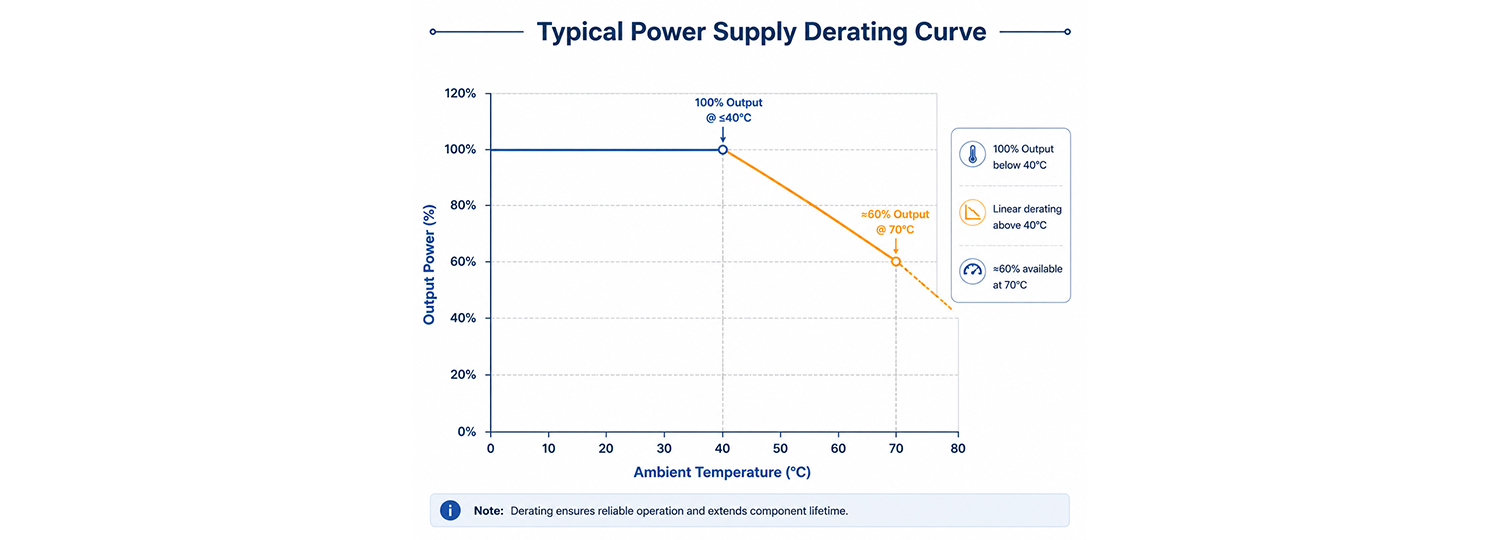
l Ambient temperature: 48°C
l Operation: 24 hours/day
l Cooling: Natural convection
The system passed factory acceptance testing without any alarms.
Eight months later, field failures started appearing.
Inspection revealed:
l Electrolytic capacitors had lost significant capacitance.
l Internal fan bearings showed severe wear.
l MOSFET junction temperatures remained excessively high.
l Output ripple increased by nearly 40%.
Interestingly, none of the components had actually failed due to overload.
Instead, they had simply aged much faster than expected.
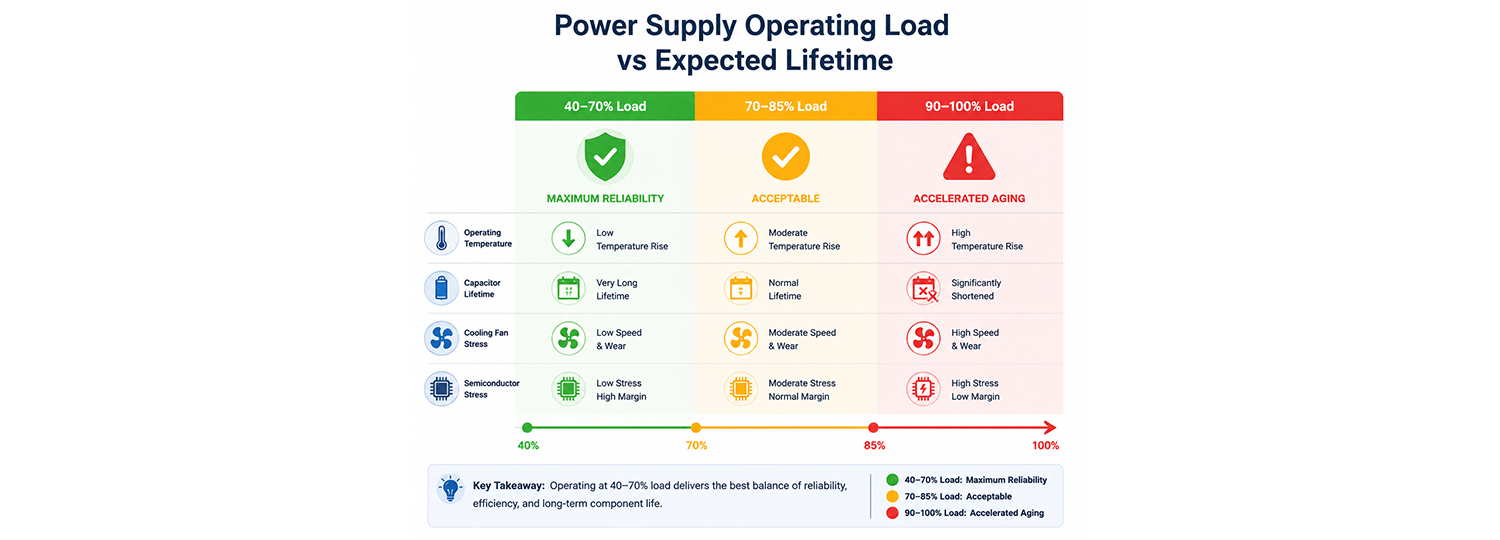
Replacing the power supply with a 1500W model reduced the average operating load to approximately 62%.
The cabinet temperature dropped by nearly 12°C, and no similar failures occurred during the following years.
The lesson was clear:Derating solved a reliability problem that replacing components never could.
Why Engineers Should Care About Derating
Many engineers focus on rated power.
Experienced engineers focus on operating stress.
Every major component inside a switching power supply is affected by thermal stress:
l Electrolytic capacitors dry out faster.
l MOSFET switching losses increase.
l Transformer insulation ages more rapidly.
l Cooling fans wear significantly faster.
l Solder joints experience thermal fatigue.
The power supply may never exceed its rated current.
Yet its service life may be reduced by half.
That is exactly why industrial standards rarely recommend continuous operation at full load.
Practical Derating Recommendations
The appropriate derating depends on the application.
Application | Recommended Continuous Load | Design Recommendation |
Office Equipment | 80–90% | Standard Commercial Design |
Industrial Automation | 70–80% | Recommended |
Energy Storage Systems | 60–75% | Strongly Recommended |
Medical Equipment | 60–70% | High Reliability |
Military & Aerospace | 50–60% | Mission Critical |
Outdoor Equipment (>45°C) | Below 70% | Additional Thermal Margin |
Rule of Thumb
If the equipment will:
l operate continuously,
l experience high ambient temperatures,
l have poor ventilation,
l or remain in service for more than five years,
designing around 60–70% continuous loading usually provides the best balance between cost and reliability.
Derating Is More Than Choosing a Bigger Power Supply
A common misunderstanding is: "I'll simply buy a larger power supply."
That is only part of the solution.
Proper derating also requires considering:
l Cabinet airflow
l Cooling fan redundancy
l Input voltage fluctuations
l Startup surge current
l Future capacity expansion
l Altitude correction
l Dust accumulation
l Seasonal temperature variation
In real projects, reliability comes from system-level design, not oversized hardware alone.
Engineering Checklist Before Finalizing Your Design
Before releasing any design, experienced engineers typically verify:
l Continuous operating load below 80%
l Ambient temperature under worst conditions
l Cooling airflow direction
l Startup current margin
l Future expansion allowance
l Capacitor aging over service life
l Derating curves provided by the manufacturer
Completing this checklist can eliminate many field failures before the product is ever installed.
Need a Reliable Custom Power Solution?
At IDEALPLUSING, we don't simply recommend higher power ratings—we evaluate the complete operating environment.
Our senior power electronics engineers help customers optimize:
l High-voltage programmable DC power supplies
l Bidirectional DC/DC converters
l AC/DC industrial power supplies
l Battery charging systems
l Energy storage power conversion systems (PCS)
l Customized isolated converter topologies
Submit your electrical specifications—including input voltage, output voltage, current, power, isolation requirements, cooling method, communication interface, and application scenario—to the IDEALPLUSING engineering team for a free technical evaluation. A proper derating strategy today can prevent expensive downtime tomorrow.
Conclusion
Power supply derating is one of the simplest yet most overlooked methods of improving system reliability.Field experience consistently shows that premature failures are rarely caused by exceeding a power supply's specifications. More often, they result from operating too close to those limits for too long.A well-designed power system is not one that merely works on the day it is commissioned—it is one that continues to operate reliably after five, ten, or even fifteen years in demanding industrial environments.Designing with adequate margin is not wasted capacity.It is an investment in reliability.