1. Introduction: The Growing Demand for Advanced Battery Testing
The fast expansion of electric transportation and stationary energy storage pushes battery performance verification to the forefront of product development workflows. As the core carrier for energy storage and conversion, rechargeable batteries directly dictate equipment operating efficiency, system safety margins, service longevity and long-run operational stability. Before commercial deployment, battery cells and assemblies must undergo comprehensive validation workflows, covering capacity characterization, cyclic aging profiling, charge-discharge property testing and abnormal condition verification.
Reports published by the International Energy Agency (IEA) reflect continuous market growth for electric vehicles, raising stricter reliability benchmarks for traction batteries. Meanwhile, standards including IEC 62660 establish unified evaluation protocols for traction batteries, specifying methodologies for capacity measurement, power rating assessment and endurance validation.
Traditional battery test setups rely on fixed-output power units paired with manual parameter tuning. When facing high-voltage EV battery packs and large-scale energy storage modules, such hardware reveals obvious limitations: narrow adjustable output ranges, inadequate dynamic responsiveness, and insufficient capability to replicate real-world operational profiles.
Programmable DC power supplies have become core hardware within modern battery test benches. By fine-tuning output voltage, current and power parameters with high precision, these instruments support flexible, stable and fully automated characterization workflows for battery products.
2. Understanding EV and Energy Storage Battery Testing Requirements
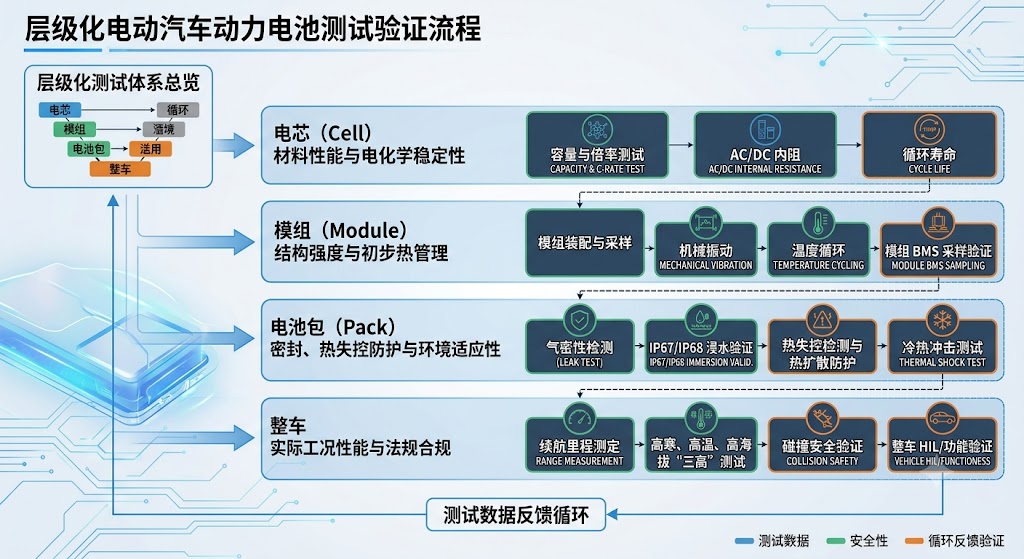
Battery testing aims to quantify cell and pack performance under diversified working scenarios, including energy delivery capability, cyclic stability, built-in protection performance and long-duration operational reliability. Validation of electric vehicle traction batteries adopts a tiered verification framework aligned with the classic V-model development methodology. The evaluation sequence extends from individual cells, battery modules, packs all the way to complete vehicles.
Table 1
Test Tier | Core Verification Goals | Representative Test Items |
Cell Level | Electrochemical stability and raw material characteristics | Capacity testing, rate charge & discharge, cycle aging, AC/DC internal resistance measurement |
Module Level | Mechanical integrity and preliminary thermal management performance | Vibration cycling, temperature swing testing, BMS signal sampling for modules |
Pack Level | Hermetic sealing, thermal runaway suppression and environmental adaptability | IP67/IP68 water immersion, thermal propagation prevention, thermal shock cycles |
Vehicle Level | Real-road performance and regulatory compliance | Driving range calibration, extreme environment testing (frigid, high heat, high altitude), crash safety assessment |
2.1 Standard Testing Workflow for EV Traction Batteries
Routine validation for automotive power batteries consists of four primary test categories:
① Capacity Characterization
This test quantifies the total electrical energy a battery can store and release. Key test parameters include:
l Battery capacity
l Energy output
l Charging and discharging efficiency
Data obtained from capacity testing confirms whether the actual battery performance meets design targets and provides baseline data for subsequent cycle life evaluation.
② Charge and Discharge Cycle Test
Cycle testing evaluates performance changes during long-term battery operation. Key test parameters include:
l Cycle life
l Charging performance
l Degradation rate
During cycle testing, the power supply must continuously execute programmed charge and discharge sequences while maintaining stable and accurate output parameters.
③ Power Performance Test
Under real-world driving conditions, electric vehicles experience acceleration, regenerative braking, and fast charging events, requiring batteries to deliver high transient power output. The test focuses on:
l Peak current capability
l Fast charging performance
The power supply must provide fast dynamic response to simulate changing power demands during real-world vehicle operation.
④ Safety Test
Battery safety testing evaluates the protection capability of batteries under abnormal operating conditions. Key test items include:
l Overvoltage
l Overcurrent
l Abnormal operating conditions
IEC 62660 delivers standardized evaluation references for traction battery safety and performance benchmarking.
3. Challenges of Traditional Battery Testing Methods
As battery system capacity continues to increase, traditional testing approaches face growing challenges in terms of accuracy, flexibility, and automation capability.
Challenge 1: Limited Control Accuracy
Conventional power supplies typically provide fixed output modes, which may introduce limitations when applied to complex battery testing environments.
For example:
l Limited voltage adjustment accuracy
l Slow current control response
l Difficulty in quickly following changing test requirements
For electric vehicle batteries, the battery state of charge (SOC) continuously changes during operation. Therefore, testing equipment needs to simulate different voltage and current conditions accurately. Insufficient output control precision may lead to deviations in test results.
Challenge 2: Difficult to Simulate Real Operating Conditions
Battery operating environments are not always constant in practical applications.
During electric vehicle operation, batteries may experience:
l Rapid acceleration
l Regenerative braking
l Fast charging
Energy storage systems may encounter:
l Peak and off-peak power regulation
l Fluctuations in renewable energy output
l Long-duration charge and discharge operation
Therefore, testing equipment needs to support dynamic voltage and current variations to better reproduce real-world operating conditions.
Challenge 3: High Power Testing Requirements
As battery capacity increases, testing systems need to support higher power output capabilities.
Testing large battery packs and energy storage modules typically requires:
l High voltage output
l High current output
l Long-term stable operation
Conventional laboratory power supplies may not fully meet these requirements, while a High Power DC Power Supply can provide a wider voltage and current adjustment range to support different battery testing applications.
4. How Programmable DC Power Supplies Improve Battery Testing
Digitally controlled programmable DC power supplies lift measurement accuracy, automation maturity and overall throughput for battery validation campaigns.
4.1 Precise Voltage and Current Control
One of the key advantages of a Programmable DC Power Supply is its ability to provide precise voltage and current control during battery testing.
Test engineers can configure the power supply according to specific battery testing requirements:
l Set accurate voltage output
l Control charging current
l Create customized charging profiles
For example, during battery charging tests, a programmable power supply can gradually adjust output parameters according to predefined programs, enabling constant current (CC) charging, constant voltage (CV) charging, and multi-stage charging processes.
This capability makes it an essential component of a Battery Testing Power Supply system.
4.2 Battery Simulation Function
In addition to operating as a power source, a Programmable DC Power Supply can also be used for battery simulation testing.
Through software-based control, the power supply can simulate:
l Different battery voltage levels
l Various battery SOC conditions
l Dynamic load changes
This function is widely applied in:
l EV controller testing
l BMS (Battery Management System) validation
l Automotive electronics testing
With battery simulation capability, engineers do not need to repeatedly connect actual batteries for every test scenario. Instead, the power supply can reproduce different operating conditions, improving testing efficiency and reducing development time.
4.3 Automated Charge and Discharge Cycling
Modern battery testing often requires continuous operation over extended periods.
A Programmable DC Power Supply can be integrated with:
l Software control
l RS485 communication
l RS232 interface
l CAN communication
l SCPI commands
to achieve:
l Automated testing
l Repeatable test procedures
l Test data recording
Through automated control, manual operations can be reduced while improving test consistency and repeatability.
4.4 High Power Capability for EV and ESS Testing
Testing electric vehicle batteries and energy storage systems typically requires higher power levels.
Professional battery testing power supplies can provide:
l 1.5kW–300kW output power range
l High-voltage DC output
l High-current output capability
Suitable for:
l Battery packs
l Energy storage modules
l Charging systems
A high-power Battery Testing Power Supply can support battery development and validation requirements across different system scales.
5. Applications of Programmable DC Power Supplies in Battery Testing
Table 2
Application | Testing Purpose | Power Supply Function |
EV Battery Testing | Battery Pack Performance Validation | Charge and Discharge Simulation |
BMS Testing | Control System Verification | Voltage State Simulation |
Energy Storage System Testing | Cycle Life Validation | Long-Term Stable Operation |
Charging System Testing | Fast Charging Verification | High-Power Output Control |
6. How to Choose a Programmable DC Power Supply for Battery Testing?
Selecting the right Battery Testing Power Supply requires careful consideration of several key factors.
① Output Voltage and Current Range
The first step is to evaluate the power supply output capability.
Key parameters include:
l Voltage range
l Current capability
l Power rating
Different battery systems require different output specifications. For example, low-voltage battery modules and high-voltage EV battery packs may have significantly different testing requirements.
② Control Accuracy
Control accuracy directly affects the reliability of battery testing results.
Key factors to consider include:
l Voltage accuracy
l Current accuracy
l Regulation speed
High-precision control helps ensure more reliable and consistent test data.
③ Communication Interface
Automated battery testing systems typically require remote control capabilities.
Common communication interfaces include:
l RS485
l RS232
l CAN
l SCPI
Through these communication interfaces, the power supply can be integrated into a complete EV Battery Test System.
④ Protection Functions
Safety protection features are also an important factor when selecting a power supply.
l Common protection functions include:
l Over Voltage Protection (OVP)
l Over Current Protection (OCP)
l Over Temperature Protection (OTP)
Comprehensive protection mechanisms help reduce potential risks during the battery testing process.
7. Future Trends: Intelligent Battery Testing Systems
Future battery testing systems are expected to move further toward intelligent and integrated solutions.
① AI-Based Battery Testing
Artificial intelligence technologies can assist in analyzing:
l Battery aging
l Performance degradation
l Failure prediction
Through data analysis, AI-based methods can improve battery testing efficiency and support more effective evaluation processes.
② Higher Voltage Battery Systems
Electric vehicles are moving toward higher voltage platforms, such as 800V EV systems.
Future testing equipment will need to support higher voltage levels to meet the validation requirements of next-generation battery systems.
③ Integrated Test Platforms
Future testing platforms are expected to adopt more integrated solutions.
For example:
l DC Power Supply
l Electronic Load
l Testing Software
By combining these components into a complete testing system, companies can improve R&D efficiency and enhance automation capabilities.
8. Conclusion
The development of electric vehicles and energy storage systems has created higher requirements for battery testing equipment.
Through precise control, high-power output capability, automated communication, and battery simulation functions, a Programmable DC Power Supply provides a more flexible and reliable solution for modern battery testing.
Whether for EV battery pack validation, BMS testing, or Energy Storage Testing, programmable DC power supplies help companies establish more stable and efficient testing processes.
As battery technologies continue to advance, Battery Testing Power Supply solutions will play an increasingly important role in future battery development and production validation.