Selecting a pure sine wave inverter requires more than matching the inverter’s rated power with the load. Different types of electrical equipment place different demands on an inverter, particularly in terms of output waveform quality, startup capability, DC input voltage, conversion efficiency, thermal management, and protection functions.
A model that appears sufficiently powerful on paper may still experience startup failure, unstable output, repeated protection trips, or abnormal equipment operation if its actual operating conditions are not taken into account.
A practical approach is to begin with the load and work through the key electrical parameters one by one. Before selecting an inverter, consider the required power, input and output voltage, operating frequency, startup surge, duty cycle, and installation environment. This helps ensure that the inverter can operate within its intended range rather than simply meeting the nominal load requirement.
1. Why Proper Inverter Selection Matters
An inverter serves as the electrical interface between a DC power source and AC loads. Its performance therefore depends on conditions on both sides of the conversion process.
If the inverter is undersized, the equipment may operate close to the inverter's maximum capacity for extended periods. This can place additional stress on the internal power components and thermal management system. Loads such as motors, pumps, compressors, and fans can create another challenge because their power demand during startup may be considerably higher than their normal operating power.
Oversizing is not always the ideal solution either. A significantly larger inverter can increase equipment cost, physical dimensions, installation requirements, and system complexity. Depending on the design, operating a large inverter at very light loads may also affect overall system efficiency.
For these reasons, inverter selection should focus on matching the electrical requirements of the load with the actual capabilities of the inverter.
2. Step One: Identify Your Load Types
Before selecting an inverter, determine what equipment will be connected to it.
Different loads have different electrical characteristics. For example:
· Resistive loads include heating elements and incandescent lamps. Their starting demand is generally relatively small.
· Inductive loads include motors, pumps, fans, and certain compressors. They can require substantially higher current during startup.
· Capacitive loads may draw a significant inrush current when initially connected.
· Electronic equipment often uses switching power supplies and may be more sensitive to output voltage stability and waveform quality.
If several types of equipment will operate from the same inverter, the selection should be based on the combined operating conditions rather than on only one individual load.
Understanding the load type at the beginning of the selection process can prevent problems later, particularly when the system includes equipment with significant startup requirements.
3. Step Two: Calculate the Continuous Power Requirement
Continuous power is one of the fundamental parameters for inverter selection.
Start by listing the equipment that may operate at the same time and record the rated power of each device. The continuous load can then be estimated by adding these values together.
For example, consider the following loads:
· Computer: 300 W
· Display equipment: 200 W
· Fan: 150 W
· Lighting: 100 W
If all of these loads operate simultaneously, the combined continuous load is: 750 W
The inverter should not normally be selected solely on the basis of an exact power match. Some additional capacity is useful for load fluctuations and changes in operating conditions.
A reasonable power margin can also prevent the inverter from remaining near its maximum output for long periods.
Therefore, a 750 W load does not automatically mean that a 750 W inverter is the best choice.
4. Step Three: Check the Surge Power Requirement
Rated operating power alone is not sufficient for applications involving motors, pumps, compressors, and similar equipment.
During startup, these loads may draw a substantially higher current for a short period. The inverter therefore needs sufficient short-term output capability to handle this transient demand.
For example, a motor may have a normal operating power of 1500 W while requiring considerably more power during startup. If the inverter cannot provide the required surge capacity, the motor may fail to start or the inverter may enter an overload protection state.
For motor-driven applications, pay particular attention to:
· Continuous output power
· Peak output power
· Surge duration
· Overload capability
The relationship between continuous power and surge capability is especially important when multiple loads are switched on within a short period.
5. Step Four: Match the DC Input Voltage
A pure sine wave inverter normally operates from a battery bank, energy storage system, or another DC source. The inverter's DC input range must therefore correspond to the voltage characteristics of the power system.
Common DC input configurations include 12 V, 24 V, and 48 V, with higher-voltage configurations also available for certain applications.
At the same output power, a higher DC input voltage generally means a lower input current. For example, a 48 V system can require considerably less input current than a 12 V system when delivering a similar amount of output power. This can affect cable sizing, wiring losses, connector selection, and overall system layout.
Before selecting an inverter, verify:
· Nominal DC system voltage
· Allowable DC input voltage range
· Maximum input current
· Actual operating range of the battery or DC source
The nominal battery voltage alone should not be used as the only selection criterion. The actual voltage range of the DC source must also remain within the inverter's specified operating range.
6. Step Five: Verify the AC Output Voltage and Frequency
The inverter’s AC output must be compatible with the electrical requirements of the connected equipment. Both voltage and frequency should be checked before the inverter is selected, as these parameters determine whether the supplied AC power is suitable for the intended load.
AC power standards vary between regions, and different types of equipment may also specify different operating requirements. Common inverter output configurations include 120 V, 220 V, and 230 V AC, with output frequencies of 50 Hz or 60 Hz. The appropriate combination depends on the local electrical standard and the specifications of the equipment being powered. For example, 230 V / 50 Hz systems are widely used in many regions, while 120 V / 60 Hz systems are common in North America and several other markets.
A mismatch between the inverter output and the load requirements can result in abnormal equipment operation. Depending on the type of load, an incorrect voltage or frequency may affect performance, increase electrical stress, or prevent the equipment from operating as intended.
Before purchasing an inverter for equipment with defined voltage and frequency requirements, verify the following specifications:
· AC output voltage
· Output frequency
· Output voltage tolerance
· Frequency stability
· Outlet or wiring configuration
For equipment with strict electrical specifications, these parameters should be confirmed against the manufacturer's requirements rather than assumed from the inverter's general product description.
7. Step Six: Evaluate Output Waveform Quality and THD
The output waveform is another specification worth examining when selecting a pure sine wave inverter. A pure sine wave inverter is designed to produce an AC waveform that closely resembles the sinusoidal voltage supplied by a conventional utility grid.
Waveform quality can be particularly relevant for sensitive electronic equipment and systems that rely on switching power supplies, control circuits, or precision measurement. Network equipment, test instruments, industrial controllers, and other electronic loads may respond differently to variations in the quality of the AC supply.
One commonly used parameter for describing waveform quality is Total Harmonic Distortion (THD). THD represents the harmonic components contained in an AC waveform in relation to its fundamental component. A lower THD value generally indicates that the output contains less harmonic distortion and is closer to an ideal sine wave.
For this reason, the term “pure sine wave” should not be the only specification considered. When comparing inverter models, it is useful to check whether the manufacturer provides a specific THD value in the technical specifications. For example, some commercial pure sine wave inverter specifications state THD limits such as less than 3% or less than 5%.
If the inverter is intended to supply equipment with tighter power-quality requirements, a clearly stated THD specification can provide a more useful basis for comparison than the waveform description alone.
When reviewing THD specifications, also pay attention to the conditions under which the value is specified. Measurement results can depend on factors such as load characteristics, output power, input voltage, and test methodology. Therefore, THD should be evaluated together with the inverter's output voltage regulation, frequency stability, efficiency, surge capability, and other relevant specifications rather than treated as an isolated performance indicator.
In practical applications, the goal is not simply to select the inverter with the lowest published THD value. The more important consideration is whether the inverter can provide a stable and suitably clean AC supply under the actual operating conditions of the connected equipment.
8. Step Seven: Consider Efficiency and Thermal Management
The conversion from DC to AC inevitably involves some energy loss. Part of the input energy is converted into heat within the inverter. As a result, conversion efficiency and thermal management become increasingly important as the output power and operating time increase.
For example, when an inverter operates at a relatively high output power for an extended period, its switching devices and other internal components generate more heat. If this heat cannot be removed effectively, the internal temperature may rise and affect operating stability.
Important factors include:
· Conversion efficiency
· Cooling method
· Fan control strategy
· Heat sink design
· Required installation clearance
· Ambient operating temperature
For industrial systems and backup power applications that may run continuously, thermal conditions should be evaluated together with the electrical specifications.
An inverter that performs well electrically but is installed in an unsuitable thermal environment may not deliver the expected long-term performance.
9. Step Eight: Check Protection Functions and Reliability Features
An inverter may encounter changes in input voltage, variations in load demand, and different environmental conditions during operation. Protection functions are therefore an important part of the selection process.
Common protection functions include:
· Input undervoltage protection
· Input overvoltage protection
· Output overload protection
· Short-circuit protection
· Overtemperature protection
· Overcurrent protection
For systems that require extended operation, it can also be useful to check whether the inverter provides status indication, fault indication, communication interfaces, or remote monitoring capabilities.
These functions do not directly increase the rated output power. However, they can provide useful information about operating conditions and make it easier to identify abnormal conditions during system operation.
10. Choosing an Inverter for Different Applications
The priorities for inverter selection vary according to the application.
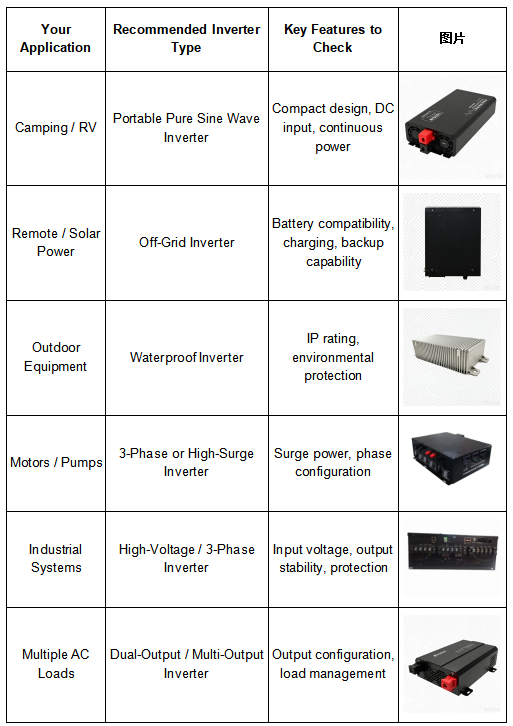
For camping and RV systems, physical size, weight, and DC input voltage may receive greater attention.
Industrial applications, on the other hand, may place greater emphasis on continuous output capability, cooling performance, overload protection, and long-duration operation.
For network equipment and test instruments, output voltage stability and waveform characteristics may become more important selection criteria.
There is therefore no single inverter configuration that is optimal for every application. The appropriate specification depends on the actual electrical characteristics of the equipment being powered.
11. Practical Example: Selecting a 4000 W Inverter
The following example illustrates how the selection process can be applied to a specific load configuration.
Assume that the customer requires:
· DC source: 48 V
· AC output: 230 V
· Total continuous load: 3000 W
· Motor load: 1500 W
· Sensitive electronic equipment: 1000 W
· Lighting: 500 W
Step 1: Confirm the Total Continuous Load
The three categories of loads operate simultaneously:
Total continuous load = 3000 W
The inverter therefore needs a continuous output rating that can cover at least 3000 W under the specified operating conditions.
Step 2: Consider the Startup Surge
The system includes a 1500 W motor.
The motor can require additional power during startup. Therefore, selecting an inverter based only on the 3000 W continuous load would not provide enough information.
If a 3000 W inverter is used, simultaneous operation of the motor, electronic equipment, and lighting may leave insufficient capacity for the motor's startup demand. Depending on the inverter's surge characteristics, this could result in an overload condition or unsuccessful motor startup.
Step 3: Select the Inverter Power Rating
Considering both the continuous load and the motor startup requirement, a suitable choice would be:
4000 W pure sine wave inverter
rather than:
3000 W inverter
The 4000 W class provides additional output capacity for load fluctuations and startup demand while maintaining a reasonable relationship with the calculated continuous load.
The actual surge rating should still be verified against the motor's starting characteristics.
Step 4: Verify the Technical Specifications
Before finalizing the selection, check:
· 48 V DC input
· 230 V AC output
· 50 Hz output frequency
· Pure sine wave output
· Adequate surge capability
· Specified THD
· Conversion efficiency
· Required protection functions
· Suitable cooling design
This approach prevents the selection from being based only on the "4000 W" label. Input voltage, output characteristics, waveform quality, surge capability, thermal performance, and protection functions should all be reviewed as part of the same evaluation.
12. Pure Sine Wave Inverter Selection Checklist
Before placing an order, the following checklist can be used to review the main requirements.
Load
· What is the total continuous load?
· Which devices may operate simultaneously?
· Does the system include a motor, pump, or compressor?
· Is a significant startup surge expected?
Input
· What is the DC input voltage?
· What is the allowable input voltage range?
· What is the maximum DC input current?
Output
· What AC output voltage is required?
· Is 50 Hz or 60 Hz required?
· Is pure sine wave output necessary?
· Is there a specified THD requirement?
Operating Conditions
· What is the required continuous output power?
· What is the required peak or surge power?
· What is the expected conversion efficiency?
· Is the cooling method suitable for the installation environment?
Protection
· Is overload protection provided?
· Is short-circuit protection provided?
· Is overtemperature protection provided?
· Are input overvoltage and undervoltage protections available?
System Integration
· Is a display required?
· Is a communication interface required?
· Is remote monitoring required?
· Will the inverter operate continuously for extended periods?
Based on IDEALPLUSING's existing product power ratings and application scenarios, the following products are available:
Inverter Type | Typical Application | Typical Power Range | Key Selection Factors |
Portable Inverter | Camping, RV, Mobile Equipment | 300W–6000W | Compact design, portability, battery compatibility |
Off-Grid Inverter | Solar Backup, Energy Storage, Remote Power | 1000W–7200W | Battery voltage, charging function, continuous operation |
High-Voltage 3-Phase Inverter | Industrial Equipment, High-Power Systems | Varies by model | High-voltage DC input, 3-phase output, safety |
Waterproof Inverter | Outdoor Equipment, Marine, Harsh Environments | Varies by model | IP rating, moisture resistance, thermal management |
3-Phase Inverter | Industrial Motors, Pumps, Machinery | Varies by model | 3-phase output, surge capability, load characteristics |
Dual-Output / Multi-Output Inverter | Multi-load Systems, Specialized Equipment | Varies by model | Multiple output requirements, load compatibility |
13. Conclusion
Selecting a pure sine wave inverter is essentially a process of matching the inverter to the load, DC power source, and operating environment. Rated power is only one part of this process. DC input voltage, AC output voltage, frequency, surge capability, waveform quality, efficiency, thermal management, and protection functions should also be evaluated.
For conventional low-power loads, the main considerations may be the power rating, input voltage, and output specifications. For motors, pumps, and other loads with high starting current, surge capability deserves particular attention. For network equipment, test instruments, and industrial electronic systems, output stability and waveform quality may become more significant.
A practical selection process should therefore begin with a clear list of the equipment and its electrical requirements. The continuous load, startup demand, DC system voltage, AC output requirements, and operating environment can then be evaluated together.
Rather than selecting an inverter simply because it has a larger power rating, matching the equipment characteristics with the inverter specifications provides a more structured basis for building a stable DC-to-AC power system.