Introduction
Selecting a power supply is rarely just a matter of matching input voltage and output power. In real projects, failures often appear only after the power supply is installed in the complete system.
An engineer may select a 500 W supply for a 400 W load and still experience shutdowns. A converter may pass laboratory testing but fail after installation inside an ESS cabinet. The problem is usually not the rated power—it is the application conditions that were ignored during selection.
After years of working with industrial power electronics and energy-storage systems, I have found seven mistakes that repeatedly appear in field projects.
1. Selecting by Rated Power Only
A 1 kW load does not automatically require a 1 kW power supply. Motors, pumps, relays, capacitors and DC/DC stages can create short-duration startup or transient currents.
A practical approach is to calculate:
Required capacity = steady-state load + peak load + environmental derating
For industrial equipment, leaving 20–30% design margin is often safer than operating continuously near the nameplate rating.
2. Ignoring Input Voltage Transients
Engineers often check the nominal input voltage but ignore the real bus.
In an ESS or industrial DC system, the input may experience battery voltage variation, contactor switching, regeneration, cable drops or transient spikes.
Case: A converter rated for a 48 V system repeatedly restarted. The nominal battery voltage was correct, but the bus briefly dropped below the converter's UVLO threshold during contactor switching.
The solution was not a higher-power converter. The real fix was checking the complete input-voltage waveform and adding the correct input protection and energy storage.
3. Forgetting Thermal Derating
A power supply rated at 500 W at 25°C may not deliver the same continuous power inside a sealed cabinet at 50–60°C.
Before selection, verify ambient temperature, airflow, installation orientation, heat-sink conditions, and continuous versus peak loading.
Practical Reference:
Condition | Recommended Approach |
25°C open environment | Near rated load may be acceptable |
40–50°C cabinet | Apply thermal derating |
50–70°C | Check manufacturer curves carefully |
Poor airflow | Increase thermal margin |
4. Treating Efficiency as the Only Thermal Metric
Two power supplies can both claim 95% efficiency, but their thermal performance may be completely different.
At 1 kW output, 95% efficiency means approximately 52.6 W of heat loss.
That heat must go somewhere.
For cabinet designs, engineers should evaluate losses at the actual operating point, not simply compare the efficiency numbers printed on datasheets.
5. Ignoring EMI and System Interaction
A converter can work perfectly while still causing the entire system to fail EMC testing.
High di/dt loops, poor cable routing, insufficient filtering and common-mode noise can interfere with communication, sensors and BMS circuits.
Do not treat EMI as a problem to solve after PCB design. Consider the power architecture, grounding, filtering and cable layout from the beginning.
6. Choosing the Wrong Isolation Architecture
Not every DC/DC application needs isolation. But when different ground domains, safety requirements, communication interfaces or fault-containment requirements exist, isolation can become critical.
A common project mistake is selecting a non-isolated converter because it is cheaper, then discovering that ground loops or fault propagation require a redesign.
7. Selecting the Product Before Defining the Application
This is perhaps the most expensive mistake.
Engineers sometimes start with:
"Which converter do you have?"
The better question is:
"What are the electrical, thermal, mechanical and protection requirements of the system?"
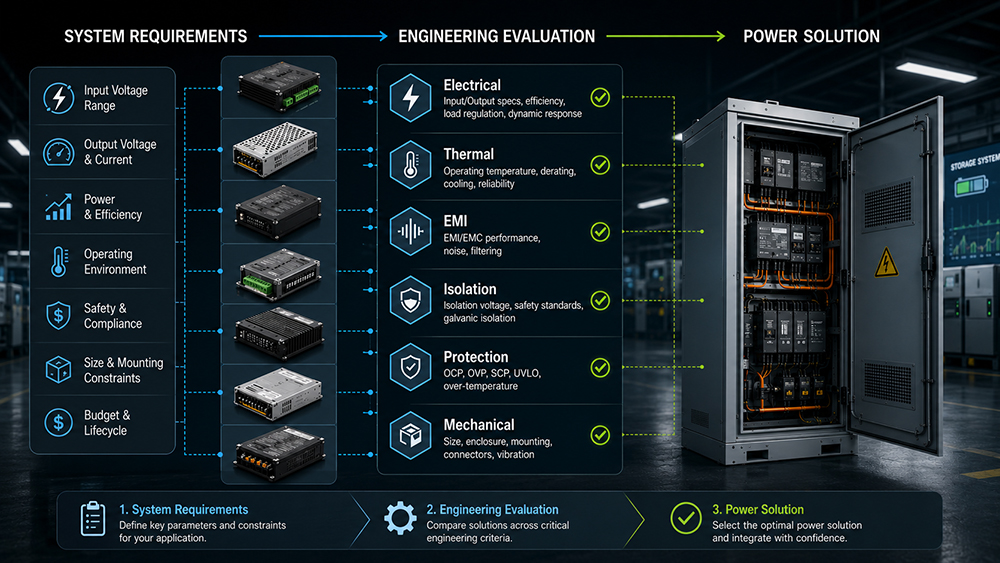
Define input range, output behavior, peak current, isolation, temperature, cooling, EMI, protection and communication requirements first. Then select the topology and product.
Engineering Takeaway
In one industrial DC system, the original converter was repeatedly replaced because engineers believed the problem was insufficient power. After measuring the system, we found that the real issues were startup current, input-bus fluctuation and cabinet temperature.
The final solution used a properly derated converter, controlled startup and improved input protection. The result was more reliable than simply increasing the rated power.
The lesson: power-supply selection should be treated as a system-engineering problem, not a catalog-selection exercise.
Need Help With a Custom Power Architecture?
Need a custom isolated bidirectional topology or a power solution adapted to your actual electrical conditions?
Submit your electrical parameters to the IDEALPLUSING senior engineering team for a free technical evaluation.
From topology selection and thermal design to isolation, protection and system integration, the goal is not simply to select a power supply—but to build a solution that works reliably in the real application.
Conclusion
The best power supply is not necessarily the one with the highest power rating, highest efficiency or lowest price.
It is the one that matches the real electrical, thermal, mechanical, EMI and protection requirements of the system.
Before approving a design, ask seven questions:
Can it handle the peak? Can it survive the input? Can it dissipate the heat? Can it pass EMC? Is the isolation architecture correct? Are the protections appropriate? And is the solution designed for the real application?
Answer these questions early, and many expensive field failures can be prevented before the first prototype is built.