Aerospace power serves as the critical energy backbone for aircraft ground support. Whether for pre-flight startup and post-flight checks on the apron, or in-depth maintenance and component testing inside the hangar, stable and compatible power remains indispensable. Unlike conventional commercial airliners, specialized aircraft — including wide-body jets, military fighters, tethered drones, and carrier-based aircraft — have highly distinctive power demands. Their electrical specifications, voltage levels, frequency standards, and environmental adaptability differ sharply from standard aircraft, making general-purpose aviation power supplies poorly matched. In such cases, customized aviation power solutions become essential.
From the extreme conditions of the open apron to the precise maintenance environment of the hangar, customized aviation power solutions are built around two core concepts: scenario adaptability and aircraft-specific design. By accurately aligning power parameters, operational requirements, and industry standards, these solutions provide end-to-end power support from emergency startup to detailed testing. They effectively resolve the common pain points of universal power supplies — poor compatibility, unstable output, and non-compliance — and safeguard the reliable operation of specialized aircraft.
I. Understanding the Differences: Why General-Purpose Power Supplies Fail Specialized Aircraft
The unique design of specialized aircraft directly defines their one-of-a-kind power requirements — the key reason standard aviation power supplies fall short. Compared with regular aircraft, specialized models impose stricter demands in three major areas:
First, specialized electrical parameters. Military fighters rely on high-precision 28V DC power; wide-body airliners like the Boeing 787 require multi-point 90kVA power output; tethered drones demand high-power-density DC systems.Second, extreme operating environments. The apron exposes equipment to high and low temperatures, salt spray, dust, and vibration, while hangars require precise testing and multi-condition simulation — both placing high demands on durability and versatility.Third, strict industry standards. Compliance with aviation specifications such as MIL‑STD and MH/T is mandatory to ensure power safety and avionics compatibility.
Take the Boeing 787 as an example: this wide-body aircraft uses two front ground power ports and one rear port, each rated at 90 kVA, with a five‑minute peak capacity of up to 112 kVA. Conventional power units cannot meet its multi-port high-power demands or its strict voltage detection timing. Similarly, ground radar and weapon pylon tests for military fighters require high‑precision 28V DC power that can withstand harsh field environments — requirements far beyond the capabilities of off‑the‑shelf power supplies.
II. Apron Scenarios: Customized Adaptation for Extreme Environments and Emergency Missions
As an open‑air operating area, the apron subjects equipment to extreme conditions: high and low temperatures, wind, sand, salt spray, and constant vibration. Meanwhile, apron power for specialized aircraft often supports emergency engine starts and pre‑flight checks, requiring high mobility, strong anti‑interference, and rapid response.
Customized power solutions for apron operations focus on two priorities: environmental resilience and high‑efficiency emergency support, perfectly matching the outdoor power needs of specialized aircraft.
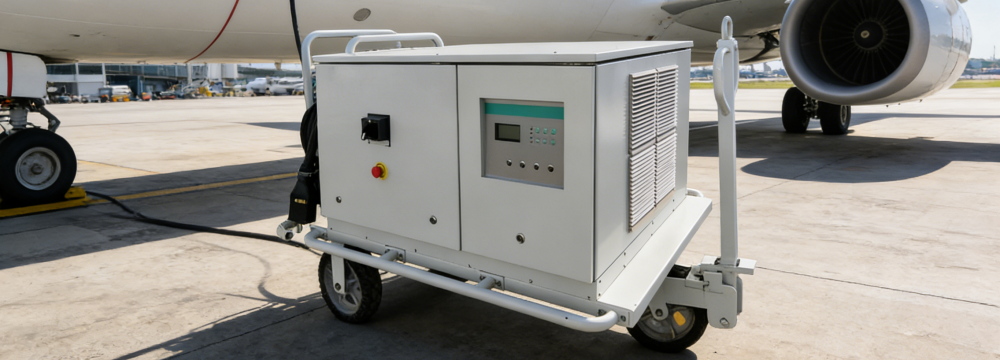
For large specialized aircraft — wide-body airliners and military transport planes — customized mobile diesel or electric GPUs are used. These feature modular designs and flexible power combinations to satisfy multi-port high-power requirements. For example, the customized GPU for the Boeing 787 precisely matches its 90 kVA rating and optimizes the voltage detection sequence, completing voltage identification within 2.5 seconds to avoid power interruptions.
To withstand harsh outdoor conditions, the entire unit uses a sealed IP55 or higher enclosure, protecting against dust, rain, and salt spray. Wide‑temperature internal components enable stable operation from −40°C to +70°C, making them suitable for high‑altitude, frigid, coastal, and island apron environments.
For smaller specialized aircraft such as tethered drones and light military fighters, we provide lightweight, portable power supplies. Compact and easy to deploy, they deliver optimized output accuracy to meet the high power density and stability demands of drones. Our customized 1200W high‑power drone supply, for instance, maintains a steady 12V output and continuous operation from −30°C to 70°C, ideal for emergency rescue and border patrol missions.
These customized power supplies also support ultra‑fast startup — within 30 seconds — to meet urgent startup demands. Multi‑unit parallel operation provides backup power for aircraft with failed APUs, ensuring smooth pre‑flight inspections.
III. Hangar Environments: Customized Upgrades for Precision Maintenance and Testing
As the core hub for maintenance and component testing, hangars demand power supplies that are not only stable but also capable of supporting precise testing, fault diagnosis, and aging experiments. Our customized aviation power solutions focus on precision regulation and functional expansion to fit complex hangar workflows.
For hangar component testing, we offer high‑precision, multi‑waveform static power supplies that can simulate global power standards and output 400Hz AC, 28V DC, and other voltages required for avionics and engine testing. A military fighter‑tailored power supply, for example, can stably output 28V, 115V, and other levels with pure DC or pulse waveforms and total harmonic distortion below 1.5%, ensuring accurate test data and compliance with MIL‑STD‑704.
For wide-body airliner maintenance, we provide multi‑interface programmable power supplies with PLC and PC control, enabling automatic parameter adjustment for avionics, in‑flight entertainment, and other systems, greatly improving maintenance efficiency.
Customized models can also simulate abnormal grid conditions — surges, dips, frequency drift — helping technicians diagnose power faults and detect potential risks in advance.
For long‑duration hangar tasks, dedicated stationary power units use high‑efficiency thermal design, supporting 24/7 continuous operation with MTBF ≥ 10,000 hours. Modular expandability allows flexible power adjustment based on maintenance needs.
IV. The Core of Customization: End-to-End Adaptation Between Standards and Practicality
A truly customized aviation power solution involves far more than simple parameter changes. It requires full‑process management: demand analysis, solution design, component selection, testing, and verification. The core philosophy rests on three principles: tailored to the aircraft, adapted to the scenario, and compliant with standards.
First, we conduct in-depth analysis of the aircraft’s power specifications, environment, and standards, clarifying power capacity, voltage, frequency, IP rating, and other key indicators. Carrier-based aircraft power supplies require salt spray and vibration resistance; drone power supplies must balance lightweight design and high power density.
Second, we optimize topology and control logic, using aviation-grade wide-temperature components to ensure stability and precision. Intelligent thermal management and multi-level protection further enhance reliability.
Finally, strict tests — extreme temperature, salt spray, load transient, and others — are performed in line with MH/T, MIL‑STD, and other standards to fully meet the power and safety requirements of specialized aircraft.
Summary
From apron emergency support to hangar precision maintenance, specialized aircraft have power demands marked by uniqueness, high standards, and strict requirements. General-purpose power supplies cannot provide full compatibility, making customized solutions the optimal answer.
By accurately matching electrical parameters, adapting to apron extremes and hangar precision tasks, and complying with aviation standards, customized power solutions deliver complete support across the entire lifecycle: emergency startup, pre-flight checks, in-depth maintenance, and component testing.
As the aviation industry grows and specialized aircraft become more diverse, customized aviation power solutions are moving toward greater intelligence, efficiency, and light weight. Through continuous technological innovation, they will better serve the unique demands of specialized aircraft, providing safer, more stable power support and improving the quality and efficiency of aviation ground support.
Should you have any inquiries or demands, we welcome you to contact us at any time!
Thank you for your continued support and trust in us.