
In industrial power supply, equipment testing, and specialized electrical applications, the AC variable frequency power supply serves as a professional power supply device designed to enable flexible regulation of voltage and frequency. Although frequently confused with inverters, these two devices possess fundamental differences in terms of design principles, functional characteristics, and application scenarios. An AC variable frequency power supply is not merely a simple energy conversion device; rather, it is a precision power supply system that integrates both power conversion and voltage/frequency stabilization capabilities. It is capable of delivering standard-compliant AC power to a wide variety of loads. IDEALPLUSING’s AC variable frequency power supplies, in particular, have earned industry recognition in specialized fields—such as equipment testing—due to their precise regulation and stable output characteristics.
What is an AC Variable Frequency Power Supply?
An AC variable frequency power supply is a power device capable of precisely regulating the voltage and frequency of an AC power source. Its core function relies on power electronics technology to achieve the conversion and regulation of electrical energy, thereby allowing the parameters of the output AC power to be flexibly configured according to specific requirements. The operational process of an AC variable frequency power supply involves multiple stages, including rectification, inversion, filtering, and voltage stabilization. It first converts the incoming AC power into DC power, then utilizes an inverter circuit to convert the DC power back into AC power. Simultaneously, a dedicated control module precisely regulates the amplitude and frequency of the output voltage. Furthermore, AC variable frequency power supplies effectively suppress harmonics and noise; the resulting AC output waveform closely approximates a pure sine wave, offering high precision in both voltage and frequency stabilization—making them ideally suited to meet the power supply requirements of precision instruments and imported equipment. In industrial production environments, AC variable frequency power supplies are frequently deployed to provide customized AC power to equipment such as CNC machine tools and precision testing instruments, serving as an indispensable power supply safeguard in specialized operational settings.
The Difference Between an AC Variable Frequency Power Supply and an Inverter
Although both the AC variable frequency power supply and the inverter include an inversion link, their design positioning and core structure are completely different. The core design of the AC variable frequency power supply is precise regulation and stable output. It is equipped with a complete set of voltage stabilization, frequency stabilization, filtering and protection circuits inside, which can always keep the output voltage and frequency stable when the input voltage fluctuates and the load changes, and the waveform distortion rate is extremely low. The core design of the inverter is only electric energy form conversion, which mainly realizes the basic conversion from direct current to alternating current. There is no complex regulation and filtering circuit inside, the output AC parameters are easily affected by the input and load, the stability of voltage and frequency is poor, and the waveform is mostly a modified wave or an ordinary sine wave, whose precision is far lower than that of the AC variable frequency power supply. In addition, the AC variable frequency power supply has a higher protection level and better adaptability, and can cope with the complex working conditions of industrial scenarios, while the inverter focuses more on portability and basic conversion with a relatively simple structure.
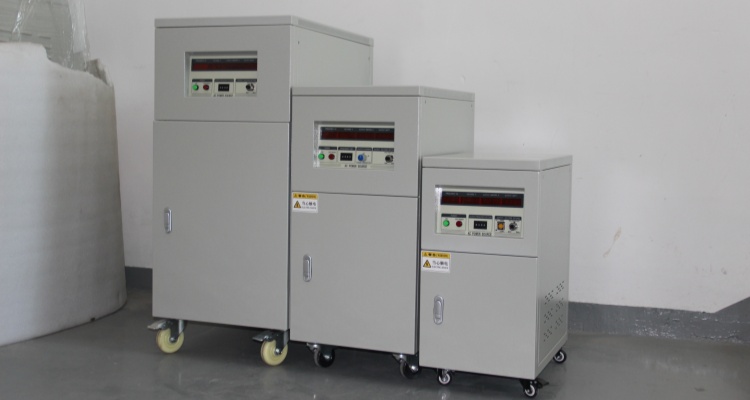
Distinguishing Application Scenarios: AC Variable Frequency Power Supplies vs. Inverters
The functional disparities between these two devices dictate their vastly different application scenarios. AC variable frequency power supplies are primarily designed for professional, high-precision power supply and testing environments. In contexts such as the commissioning of imported equipment, type testing of electrical products, and precision laboratory testing, the equipment under test demands extremely high accuracy regarding power supply voltage and frequency. AC variable frequency power supplies can simulate the grid parameters of various countries and regions, providing the equipment with standardized yet adjustable AC power to ensure the accuracy and reliability of both testing and operation. Conversely, inverters are tailored for civilian and emergency power conversion scenarios—such as RV travel, outdoor camping, and home emergency backup power—where the primary requirement is simply to convert DC power from a battery bank into AC power to satisfy basic electrical needs (e.g., lighting and small appliances) without the need for high-precision parameter regulation. Additionally, AC variable frequency power supplies are compatible with a wide variety of loads—including resistive, inductive, and capacitive types—whereas inverters are typically best suited for resistive loads and may encounter startup failures when attempting to drive inductive loads.
In summary, an AC variable frequency power supply is a professional power supply device that combines both energy conversion and precise regulation capabilities, whereas an inverter serves merely as a basic device for converting electrical energy forms; the two should not be conflated. Recognizing the distinctions between the two allows for the rational selection of equipment based on actual power requirements, thereby preventing issues with electrical safety and equipment operation caused by improper device matching. Furthermore, AC variable-frequency power supplies—distinguished by their precise regulation capabilities—play an indispensable role in a wide range of specialized power supply and testing scenarios.
IDEALPLUISNG Power Expert:
We focus on the research and development, sales and services in the fields of DC-DC power modules, AC-DC rectifier modules, DC-AC inverters, AC power supplies, DC power supplies, LED power supplies, chargers, rectifier systems, etc., providing personalized, efficient, reliable and cost-effective power solutions for all walks of life.
Thank you for considering our services.