
When a civil aircraft remains stationary on the apron, both its main engines and onboard Auxiliary Power Unit (APU) are shut down to cut down noise pollution, exhaust emissions and fuel consumption. At this stage, all electrical loads—including avionics equipment, cabin lighting, air conditioning systems, flight control diagnostics and engine starting circuits—are entirely dependent on a 400Hz Aircraft Ground Power Unit (GPU).Aircraft onboard power systems universally adopt the global aviation standard of 115V/400Hz medium-frequency alternating current, which differs fundamentally from the 50/60Hz frequency of conventional terrestrial mains power. A frequent question arises: how does this dedicated 400Hz power system accomplish power conversion, distribution, protection and safe operation during aircraft ground parking?
I. Fundamental Principles: The Reason for Aircraft Adoption of 400Hz Power
All onboard generators, transformers and electric motors of aircraft are custom-designed for 400Hz medium-frequency operation.In contrast to the 50Hz industrial frequency, 400Hz enables substantial downsizing and weight reduction of airborne electrical components. This effectively decreases aircraft empty weight and reduces fuel burn, forming a mature aviation standard that has been widely implemented for more than a century.
Terrestrial power grids supply 50Hz/220V electricity. Due to complete incompatibility in voltage rating, frequency parameter and power form, ground mains power is unable to directly supply aircraft systems.The primary mission of apron-mounted 400Hz GPUs is to accurately convert airport 50Hz mains power into purified, aircraft-compliant 115V/400Hz medium-frequency AC power, guaranteeing secure, stable and standardized power supply throughout ground operations.
II. GPU Architecture and On-Site Deployment
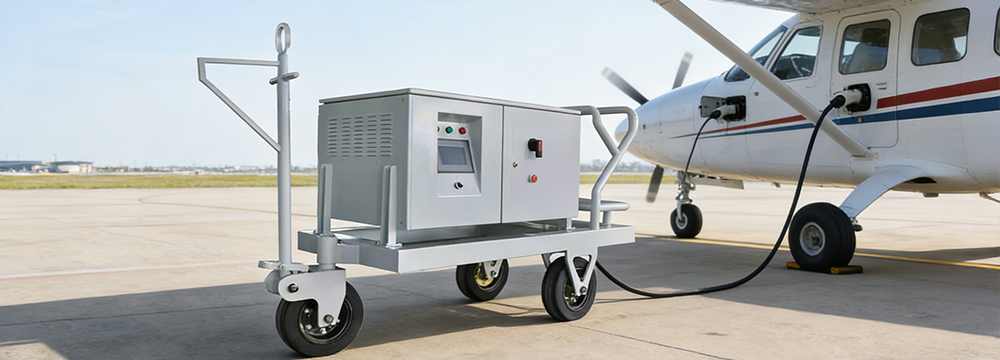
Apron 400Hz ground power units are generally divided into two types: fixed static frequency converters installed on jet bridges, and mobile ground power carts.The on-site power transmission process follows a well-defined chain: Airport Mains Supply → GPU Frequency Conversion Module → Aviation-Grade Power Cable → Aircraft Fuselage Power Connector.
Internally, GPUs adopt an AC-DC-AC double conversion architecture. They first rectify incoming 50Hz mains power into direct current, then generate high-precision three-phase 115V/400Hz medium-frequency power via high-efficiency IGBT inversion, SPWM waveform modulation, as well as isolated filtering processing.Equipped with an integrated independent cooling system, lightning protection, reliable earthing and full aviation-grade safety protections, these units are fully adaptable to the harsh outdoor apron environment with high humidity and drastic temperature variations.
III. Complete Apron Power-Up and Operation Workflow (From Connection to Disconnection)
1. Aircraft Positioning and Secure Connection
Once the aircraft has come to a smooth halt at the jet bridge or parking stand and its brakes have been engaged, ground personnel connect the specialized aviation-grade medium-frequency cable to the power receptacle located on the aircraft's underbelly. This cable is a heavy-duty, aviation-specific line designed to withstand low temperatures and repeated flexing; it features "foolproof" (Poka-Yoke), anti-misinsertion, water-resistant, and dustproof connectors to ensure absolute correctness in wiring polarity and phase alignment, thereby eliminating the risks of reverse power flow or phase-sequence errors.
2. Self-Diagnostics and Soft Start: Shock-Free Power-Up
The GPU first performs a comprehensive internal self-diagnostic check covering voltage, frequency, insulation integrity, and grounding. Once all pre-operation checks are finished, the GPU activates its soft-start function. Rather than outputting full power instantly, it slowly raises voltage and stabilizes frequency to smoothly establish stable 400Hz medium-frequency power.This gentle startup eliminates harmful inrush currents that could damage aircraft avionics, flight control systems and onboard power units, effectively protecting sensitive airborne equipment from initial power shocks.
3. Frequency Conversion and Voltage/Frequency Stabilization: Ensuring Continuous, Dependable Power Supply
During the normal power supply phase, the GPU constantly converts 50Hz grid power into high-precision 115V/400Hz medium-frequency electricity. Its key performance indicators meet strict aviation standards: frequency accuracy within ±0.1Hz, voltage regulation precision within ±1%, and Total Harmonic Distortion (THD) below 1%, producing an output waveform that closely mirrors an ideal sine wave.
Throughout its operation, the power unit conducts real-time monitoring of output voltage, frequency, current, phase, and temperature. Leveraging a digital closed-loop control system, it dynamically adjusts the inverter’s output to sustain a consistent, standard 400Hz power supply—even when faced with fluctuations in the airport’s utility grid or changes in aircraft load demands, such as activating air conditioning, conducting avionics self-tests, or switching on cabin lighting. This ensures the power supply fully complies with the unique requirements of the aircraft’s onboard electrical system.
4. Dynamic Load Adaptation: Meeting All Aircraft Ground Support Requirements
During apron operations, the GPU assumes responsibility for supplying all of the aircraft's electrical power needs. It supplies electricity for avionics self-inspection, navigation & communication devices, cabin lighting, air conditioning, hydraulic system diagnostics, cargo compartment power supply, as well as the pre-power required for engine ignition startup.400Hz ground power units boast fast dynamic response performance. In response to motor startup or abrupt pulse load changes, they can keep voltage and frequency stable within milliseconds. This effectively avoids voltage sags and frequency deviations, guaranteeing stable and reliable operation throughout aircraft ground maintenance and pre-departure inspection procedures.
IV. Multi-Layer Safety Protections: Core Guarantee for Apron Operations
Considering the complex outdoor operating conditions of airport aprons, GPUs are equipped with full aviation-grade protection functions, covering overvoltage, undervoltage, overcurrent, short circuit, phase sequence error, phase loss, overheating, leakage current and reverse power protection.Once any abnormality is detected, the unit will immediately disconnect output power in milliseconds and activate audible and visual alarms at the same time. This design effectively protects both the GPU itself and, more crucially, the high-value, precision avionics systems on the aircraft.In addition, the device is fitted with robust earthing and lightning protection designs, which fully meet airport safety codes for explosion prevention, fire protection and electromagnetic compatibility.
V. Power Disconnection and Shutdown Procedures
Once aircraft maintenance is complete, passengers have boarded, and the aircraft is ready for imminent takeoff, the GPU executes a "soft shutdown" sequence. This involves gradually reducing the output power and slowly lowering the voltage to smoothly disconnect the 400Hz output, followed by the disconnection of the aviation power cable. Direct "hard shutdowns" (abrupt power cuts) are strictly prohibited to prevent voltage spikes that could damage sensitive onboard components. Upon completion of the power-down sequence, the equipment performs a self-diagnostic check and cooling cycle, standing ready for use by the next aircraft.
VI. Operational Value: Noise Reduction, Emission Control, and Apron Environment Optimization
Compared to the use of the aircraft's onboard Auxiliary Power Unit (APU) for power generation, the 400Hz ground power unit offers significantly lower noise levels, zero exhaust emissions, and reduced energy consumption. This substantially improves both the air quality on the apron and the working environment for ground crew personnel, establishing the GPU as a core supporting facility for modern "green airports" and for the civil aviation sector's broader initiatives in energy conservation and emission reduction.
The comprehensive operation of the 400Hz aircraft ground power unit on the apron constitutes a standardized workflow encompassing utility power frequency conversion, secure connection, soft startup, high-precision frequency and voltage-stabilized power supply, dynamic load adaptation, multiple safety protections, and smooth power disconnection. By utilizing medium-frequency conversion technology to bridge the gap between the ground-based utility power grid and the aircraft's onboard 400Hz electrical network, this system serves as an indispensable core safeguard for aircraft ground parking, maintenance, and pre-departure release operations—thereby underpinning the safe, efficient, and sustainable day-to-day operations of civil aviation airports.
Should you have any inquiries or demands, we welcome you to contact us at any time!
Thank you for your continued support and trust in us.