
In precision testing scenarios including R&D, quality inspection and product certification, power quality directly determines the reliability of test data and the safety of equipment. Many users mistakenly assume that stable voltage alone is sufficient, and simply use a conventional regulated power supply in place of a variable frequency power supply. This often leads to waveform distortion, invalid test results, and even equipment damage.
In reality, conventional regulated power supplies can only maintain stable voltage. They are unable to adjust frequency, simulate real operating conditions, or ensure clean output waveforms. A variable frequency power supply, on the other hand, is a true "standard power supply." This is why the industry prioritizes variable frequency power supplies for any precision testing.
I. Standard Regulated Power Supply: Only "Stabilizes Voltage," with Very Limited Functionality
The core function of a standard regulated power supply is only one thing: to transform unstable mains power into a relatively stable voltage output.
Fixed frequency only: 50Hz or 60Hz, not adjustable.
Cannot simulate other national power grids, cannot perform high and low voltage ride-through.
Varied waveform, high harmonics, weak load capacity.
Not programmable, cannot meet standard testing requirements.
It is more suitable for lighting, simple household appliances, ordinary motors, and other equipment that is not sensitive to power supply, but completely unsuitable for precision testing.
II. Variable Frequency Power Supply: A true "standard test power supply," capable of simulating the global power grid
Variable frequency power supplies are not just "voltage stabilizers"; they completely reconstruct voltage, frequency, and waveform, outputting near-ideal AC power.
1. Adjustable frequency, covering global power grid standards.
Variable frequency power supplies can stably output:
400Hz (aviation, military)
50Hz / 60Hz (domestic and international mains power)
Wide frequency range (e.g., 45–500Hz, 10–120Hz). Ordinary voltage stabilizers cannot achieve this. For export, aviation, automotive, and medium-frequency equipment testing, only variable frequency power supplies can be used.
2. Pure waveform, extremely low harmonics, ensuring accurate test data.
The biggest fear in precision testing is an unclean power supply:
Large ripple → Measurement data drift
High harmonics → Interference with sensors, controllers, and instruments
Waveform distortion → Leading to misjudgments and false alarms.
The inverter power supply uses SPWM inverter technology, outputting a pure sine wave with extremely low distortion, making it the standard reference power supply for laboratories, production lines, and certification bodies.
3. Can simulate various power grid anomalies for extreme reliability testing.
True precision testing involves more than just "normal power supply"; it also simulates:
Voltage surges and drops
High and low voltage ride-through
Frequency fluctuations
Power outages, voltage dips, and surges.
Ordinary regulated power supplies will trip or shut down at the slightest fluctuation, while inverter power supplies can actively output abnormal waveforms to complete rigorous reliability verification.
4. Strong load capacity, fast dynamic response, and adaptable to various loads.
Precision testing often involves nonlinear loads:
Switching power supplies, inverters, controllers, medical instruments.
These types of loads can overwhelm ordinary regulated power supplies, causing voltage drops and waveform distortion.
Variable frequency power supplies feature rapid dynamic response and strong shock resistance, maintaining stable output regardless of load fluctuations to ensure test consistency.
5. Support for programmable control and automation, adapting to modern testing systems.
Variable frequency power supplies generally support:
External programmable control
PLC linkage
Computer software control
Automatic testing processes. Ordinary regulated power supplies mostly only offer simple knob adjustments and cannot be integrated into automated testing systems.
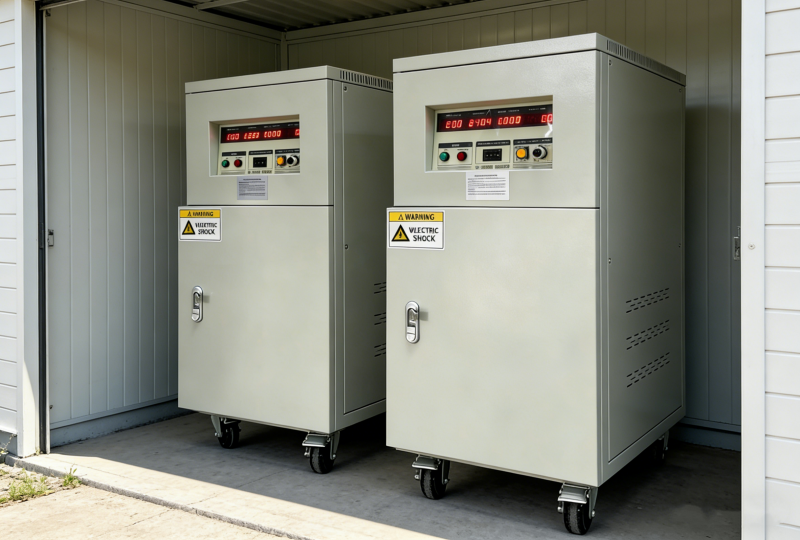
III. Why is a VFD "essential" for precision testing?
In short: Ordinary regulated power supplies can only "provide power," while Variable frequency power supplies provide a "reproducible, controllable, and traceable" standard testing environment.
For R&D: A stable benchmark is needed for reliable data.
For quality inspection: Simulating real-world operating conditions is needed for reliable results.
For certification: Compliance with standard power grids is required to pass tests.
For aging tests: Long-term stable, wide-range output is required. Whenever keywords such as precision, standards, reliability, export, aerospace, medical, or automotive are involved, ordinary regulated power supplies cannot replace Variable frequency power supplies.
Ordinary regulated power supplies are suitable for simple power supply; Variable frequency power supplies are suitable for precision testing.
If you prioritize accurate testing, stable data, standardized processes, and safe equipment, a variable frequency power supply is not "better," but "essential."