
Critical medical devices—including Magnetic Resonance Imaging (MRI) scanners, Electrocardiogram monitors, and life-support ventilators—are the cornerstones of clinical diagnosis, treatment, and research. Their operational precision is directly tied to patient safety and diagnostic reliability; even minor power instability can disrupt medical procedures as an "invisible hazard."
Yet conventional utility grids often have inherent flaws: voltage fluctuations, subtle frequency drifts, and waveform harmonic distortions—like a "turbid stream" with impurities. These issues can cause precision devices to produce errors, disrupt sensitive instruments, or even shut down life-support systems, posing unpredictable risks to medical safety.
As a specialized power conditioning solution, the variable frequency power supply acts as an "energy purifier" through its advanced technical design. These units receive and process raw power from the utility grid; through complex internal digital algorithms and waveform reconstruction, they transform this raw energy into a highly pure and stable power source. This process involves far more than mere voltage and frequency correction; it constructs a "dedicated power network"—featuring a dual layer of physical and logical protection—specifically tailored for sensitive medical equipment, thereby ensuring that these life-sustaining devices operate continuously and without error, around the clock.
"Pure power" intended for the medical sector must undergo a rigorous, three-tiered quality verification process: First, it requires zero-error control over voltage and frequency to ensure an absolutely standard output waveform; second, it demands extremely low harmonic content to completely filter out grid-borne noise; and third, it necessitates comprehensive electromagnetic shielding to eliminate signal interference. Furthermore, such power solutions must strictly adhere to the IEC 60601-1 standard for medical electrical safety, thereby safeguarding both patients and medical personnel right from the initial design phase. Through a comprehensive purification system that integrates power reconstruction, precision voltage regulation, and interference shielding, the variable-frequency power supply precisely eliminates the inherent flaws of utility power. By achieving highly efficient optimization of power quality and ensuring stable output, it serves as the most robust foundation for the reliable operation of sensitive medical equipment.
Clean power for medical applications must meet three core requirements: stable and accurate voltage and frequency, extremely low harmonic distortion, and freedom from electromagnetic interference. It must also fully comply with the IEC 60601‑1 medical electrical safety standard. Variable frequency power supplies achieve this through a complete purification system that integrates power reconstruction, precision regulation and interference shielding.This system addresses the inherent flaws of utility power at the source, ensuring the efficient optimization and stable output of power quality to precisely meet the rigorous power supply demands of sensitive medical equipment.
I. AC-DC-AC Double Conversion Topology: Building a Solid Foundation for Pure Power
The core advantage of a variable frequency power supply lies in its adoption of an AC-DC-AC double conversion topology architecture. This design enables the system to completely isolate itself from the fluctuations inherent in utility power, thereby facilitating the thorough "purification" and reconstruction of electrical energy. The first stage is rectification and filtering. A three-phase fully controlled rectifier converts the input mains AC power into stable direct current. At the same time, a built‑in high‑efficiency power factor correction (PFC) module suppresses noise, transient surges and reactive power loss in the power grid, ensuring steady DC bus voltage. The efficiency of this rectification stage reaches more than 97%.
The second stage is inversion reconstruction. High‑performance SiC MOSFET devices and SPWM (sinusoidal pulse width modulation) technology are used to convert DC power into high‑frequency AC power with adjustable voltage and frequency. With DSP+FPGA digital control chips for precise pulse width adjustment, the output waveform is highly close to an ideal sine wave, guaranteeing fundamental power purity.
Compared with traditional power supplies, this dual‑conversion structure effectively isolates disturbances such as voltage surges, sags and frequency deviations from the mains. It achieves output voltage accuracy of ±0.5% and frequency accuracy of ±0.01 Hz, supports seamless switching between 50 Hz and 60 Hz, and features a response time of less than 10 ms. These capabilities fully satisfy the strict stability requirements of sensitive medical equipment.
II. Multiple Filtering and Harmonic Suppression: Eliminating Power Interference
Harmonic interference poses a major latent threat to the operation of sensitive medical equipment. Unfiltered utility power can exhibit a Total Harmonic Distortion rate of 30% to 50%, potentially leading to internal circuit overheating and signal acquisition distortion within the devices. Through a multi-stage filtering design, this frequency converter establishes a comprehensive harmonic protection system. The output stage employs a third-order LC filter network, combined with a π-type filter circuit, to limit the Total Harmonic Distortion to below 1.8% and suppress high-frequency noise to ≤50 dBμV, thereby completely eliminating characteristic harmonics such as the 5th and 7th orders.
For high-end sensitive equipment, the frequency converter can also integrate an Active Power Filter. The system performs real-time detection of harmonic currents and injects inverse-phase compensation currents to dynamically eliminate broadband harmonics, lowering total harmonic distortion to below 1%.
This effectively prevents harmonic interference from affecting weak-signal acquisition in ECG machines, EEG monitors, and similar equipment, ensuring the accuracy and reliability of diagnostic and therapeutic data.
In addition, copper foil shielding and multi-layer PCB design are adopted to further suppress electromagnetic radiation interference, enabling full compliance with Class B EMC requirements.
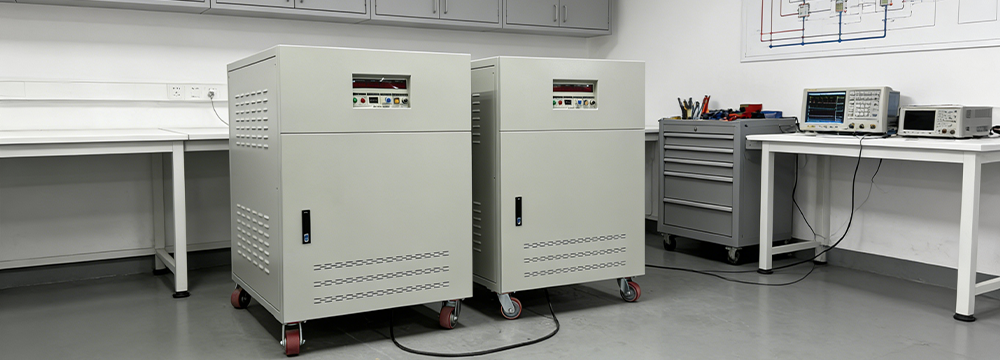
III. Dedicated Medical Safety Design: Ensuring Power Reliability
Sensitive medical equipment—particularly life-support systems—demands exceptionally high levels of power safety and continuity. Specifically optimized for medical environments, this frequency converter features a dual-insulation design. It provides an input-to-output isolation voltage of ≥4000 VAC and limits leakage current from contactable parts to ≤10 μA—figures that far exceed standard medical equipment safety requirements—thereby eliminating leakage current risks and safeguarding the safety of both patients and medical personnel. Furthermore, the system supports N+1 redundant configuration and can be integrated with energy storage UPS modules. In case of mains failure, it achieves seamless power switching within ≤5ms and provides backup power for at least 30 minutes, ensuring uninterrupted operation of critical equipment such as ventilators and extracorporeal circulators.
An integrated dynamic voltage compensation module also stabilizes voltage fluctuations within 0.1 seconds, avoiding equipment restart or data loss caused by sudden load changes and further improving overall power supply reliability.
IV. Customized Adaptability: Tailored for Diverse Medical Scenarios
As different sensitive medical devices have distinct power supply requirements, the variable frequency power supply adopts a modular design. Voltage and frequency ranges can be customized according to specific equipment types, with continuously adjustable output from 0V to 520V.
This design fully meets the special power demands of high‑frequency therapeutic devices (including 110 kHz models) and laser surgical equipment, delivering strong compatibility across various medical applications. For scenarios involving centralized power supply for multiple devices, the system supports multi-unit parallel operation and centralized networking; a single host computer can perform remote monitoring and parameter configuration for multiple power supply units simultaneously, balancing both operational flexibility and management efficiency.
Conclusion: Through power reconstruction, harmonic suppression, and medical-specific safety designs, the variable frequency power supply provides stable, clean, and secure power support for sensitive medical equipment, effectively resolving numerous pain points associated with standard mains power supplies. Amidst the trend toward greater precision and intelligence in medical equipment, the variable frequency power supply serves not merely as a "power guardian" ensuring stable device operation, but also as a catalyst for enhancing diagnostic accuracy and medical safety standards—thereby providing a robust electrical foundation for the high-quality development of the healthcare industry.