
In the fields of electronic device R&D, manufacturing, and testing, a product's ability to adapt to the grid environments of different global regions directly determines its market access and operational reliability. From the domestic 220V/50Hz mains supply to the 110V/60Hz grids of Europe and the Americas—and extending to the unique voltage and frequency standards found in certain other nations—grid parameters vary significantly across different regions. As a critical piece of testing equipment, the variable frequency power supply leverages its flexible power regulation capabilities to perfectly simulate a wide array of global grid environments, providing precise power support for equipment compatibility testing. Today, we will dissect the core principles behind variable frequency power supplies to see how they achieve a "precise replication" of global power grids.
The primary objective of a variable frequency power supply is to convert existing mains power (or alternative input sources) into electrical energy that adheres to the grid standards of a specific target region. At its essence, it reconstructs and regulates electrical energy to simulate critical grid parameters—including voltage, frequency, and waveform—while also being capable of replicating real-world grid anomalies such as fluctuations and harmonic interference. This ensures the testing environment closely mirrors actual operational conditions, delivering reliable and accurate test results.
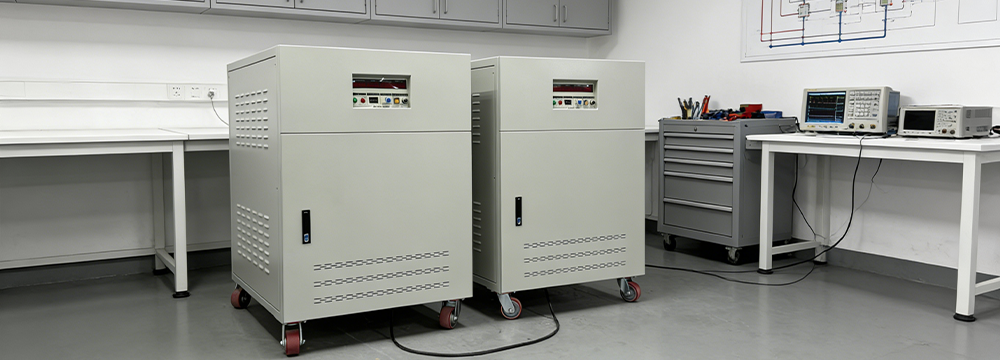
The variable frequency power supply operates on a core principle centered around an "AC-DC-AC dual-conversion topology." When paired with high-precision digital control and advanced waveform optimization technologies, this topology enables comprehensive simulation of global grid environments, meeting the diverse testing needs of equipment across different regions and scenarios.
I. Core Architecture: AC-DC-AC Double Conversion—Achieving Power "Reconstruction"
To simulate the power grids of different regions, one must first break free from the constraints imposed by the parameters of the original mains supply. This necessitates a complete reconstruction of the electrical energy via an AC-DC-AC double-conversion architecture—the very heart of the variable frequency power supply. The first step in the power conversion process is rectification and filtering: the incoming utility AC power (e.g., the standard 220V/50Hz domestic supply) is converted to DC power via a rectifier bridge. Concurrently, a dedicated filtering module eliminates noise and transient voltage spikes from the grid, resulting in a smooth, stable DC bus voltage—laying a solid foundation for the subsequent power conversion process.
The second step is the inversion conversion—a critical stage in simulating different power grids. Utilizing high-performance power semiconductor devices—such as IGBTs and SiC components—in conjunction with SPWM (Sine Wave Pulse Width Modulation) technology, the DC power is inverted back into AC power. At this stage, by precisely regulating pulse width and frequency via digital control chips, the output AC voltage and frequency can be flexibly adjusted. This allows for the output of both the 110V/60Hz standard (common in the Americas and parts of Europe) and the 230V/50Hz standard (common in Europe). Furthermore, it enables continuous adjustment of voltage from 0 to 520V and frequency from 40 to 400Hz, effortlessly covering the grid parameters of the vast majority of countries and regions worldwide.
II. Precise Regulation: Digital Closed-Loop Control—Replicating Grid Nuances
To perfectly simulate global power grids, it is essential not only to match fundamental parameters such as voltage and frequency but also to accurately replicate the grid's authentic characteristics; this relies on precise digital closed-loop control technology. The variable-frequency power supply features built-in dual digital control chips (DSP + FPGA) that sample output data—including voltage, current, and waveforms—in real-time at microsecond-level speeds, comparing and analyzing this data against preset grid parameters.
Should any parameter deviation be detected, the control chips immediately adjust the pulse output of the inverter module to ensure the precision and stability of the output power. Voltage accuracy is maintained within ±0.5%, and frequency accuracy within ±0.01 Hz, fully satisfying the rigorous testing requirements of high-end equipment. Simultaneously, by presetting various waveform parameters, the system can simulate real-world grid scenarios—such as harmonic distortion, voltage fluctuations, and frequency drift. For instance, it can simulate sudden voltage surges and drops typical of certain regional grids, thereby testing the equipment's immunity to interference and rendering the test results significantly more valuable for reference.
III. Key Technologies: Waveform Optimization and Scenario Adaptation—Balancing Precision with Comprehensiveness
In addition to core dual-conversion and digital control mechanisms, the variable-frequency power supply relies on two key technologies to achieve a perfect simulation of global grid environments. The first is Waveform Optimization Technology: utilizing a third-order LC filter network and active filter modules, it refines the square-wave signal generated by the inverter into a waveform closely approximating an ideal sine wave. The Total Harmonic Distortion (THD) is maintained below 1%, thereby accurately replicating the waveform characteristics of a real power grid and preventing waveform distortion from compromising test results.
The second is Scenario Adaptation Functionality: through programmable control, preset templates for grid parameters across various global regions can be configured. The variable-frequency power supplies get rid of the need for people to make the adjustments over and over. This means they can switch to the grid mode they want with one click.
The system also works with units at the same time and can be monitored from a distance. It can be used in different situations like testing in a small lab or checking lots of products on a production line. This makes it meet the needs for testing devices all around the world including things like home appliances, medical equipment and industrial controllers.
The reason variable-frequency power supplies can copy the power grid environments from around the world is that they have special abilities. These abilities are changing power from one type to another. Then back again and controlling it precisely with digital systems.
Variable-frequency power supplies are like a tool that can change power to work with any system. They get rid of the problems caused by power grids in different regions. This gives a base, for testing electronic devices to make sure they work everywhere.
As electronic devices get better and smarter the variable-frequency power supplies will get better too. They will be more accurate and able to work in situations, which will help the electronics industry keep growing. The variable-frequency power supplies will keep playing a role in this growth.