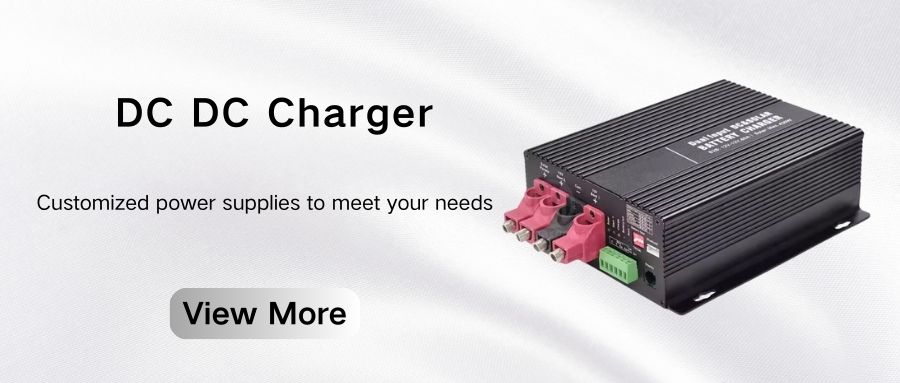
Many friends who work with vehicle electronics, energy storage and mobile power supplies will be confused: Should a DC-DC charger be connected to a battery or a generator? This question seems simple, but it directly affects equipment safety, charging efficiency and battery life. This article explains the connection logic, application scenarios and selection points of DC-DC chargers in plain language to help you avoid misunderstandings and use the equipment correctly.
1. First Understand: The Core Role of a DC-DC Charger
A DC-DC charger is a power conversion device specially designed to convert DC voltage, output stably and charge safely. It does not generate electricity; it only performs conversion, voltage stabilization and control of electric energy. Its input is an unstable DC power supply, and its output is stable DC power suitable for batteries. The core task is to convert "unsuitable" DC power into "safe and usable" charging power, protecting batteries from overvoltage, overcurrent and overheating throughout the process.
A DC-DC charger does not directly drive a generator or replace a generator. It is a safety bridge connecting the DC power terminal and the battery terminal, which is the key basis for judging the connection object.
2. Standard Answer: A DC-DC Charger Mainly Connects to Batteries
The output terminal of a DC-DC charger must be connected to a battery, which is its core working object.
Whether in vehicle dual-battery systems, RV energy storage, engineering machinery backup power supplies or communication base station backup batteries, the output of a DC-DC charger must be accurately connected to the positive and negative poles of the battery, providing constant current, constant voltage, floating charge and other adaptive curves according to battery characteristics to complete safe full charge and extend battery life.
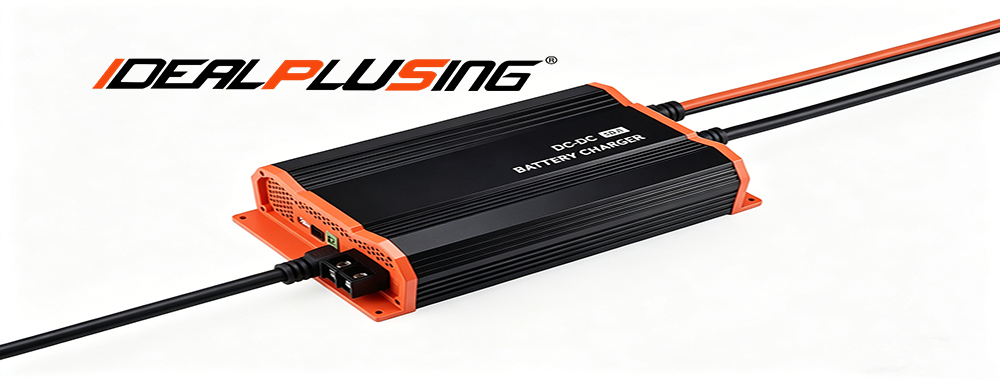
It is not directly connected to the generator body, but connected to the DC bus output by the generator, converting the fluctuating DC power generated by the generator into stable electric energy acceptable to the battery. In short: The generator is the "power supply source", the DC-DC charger is the "charging manager", and the battery is the "charging terminal".
3. Special Scenarios: The Matching Relationship Between DC-DC Chargers and Generators
In vehicles, ships and mobile equipment, generators are important DC sources. At this time, DC-DC chargers will indirectly cooperate with generators:
The engine runs, and the generator outputs unstable DC voltage;
This voltage is input to the input terminal of the DC-DC charger;
The DC-DC charger stabilizes, regulates and limits the voltage, then outputs it to the battery for charging;
When the engine is turned off, the generator stops supplying power, the DC-DC charger stops working, does not consume power reversely, and protects the starter battery.
This design not only uses driving energy to charge auxiliary batteries, but also avoids voltage fluctuations damaging batteries, which is a mature solution for mobile scenarios. It can be seen that the input terminal of a DC-DC charger can be connected to the DC output of a generator, and the output terminal is always connected to a battery. The two are in a relationship of "upstream power supply – intermediate conversion – downstream energy storage".
4. Why Can't Generators Be Directly Connected to Batteries?
Some people skip the DC-DC charger for convenience and directly connect the generator to the battery, which is extremely risky:
The generator output voltage fluctuates with speed, being high at high speeds and low at low speeds, which is easy to overcharge and damage the battery;
Without voltage stabilization and current limiting protection, high-current impact will shorten battery life, and even cause overheating in extreme cases;
Reverse power consumption may occur after parking, leading to power loss of the starter battery and failure to start the vehicle.
The value of a DC-DC charger is to eliminate these risks through stable conversion and intelligent control, making charging safer, more efficient and more durable.
5. Correct Connection and Selection Suggestions
Remember two points for daily use:
DC-DC charger output → battery: This is a fixed rule to ensure charging safety;
DC-DC charger input → generator/photovoltaic/DC bus: Connect to upstream DC power according to the scenario.
When selecting, prioritize voltage matching, efficiency, protection functions and environmental adaptability. Professional brands such as IDEALPLUSING have reliable DC-DC chargers in terms of wide voltage adaptation, multiple protections and stability, suitable for vehicle and industrial scenarios with high reliability requirements.
6. Summary
The output terminal of a DC-DC charger must be connected to a battery, and the input terminal can be connected to generators, photovoltaics or other DC power supplies according to scenarios. It is the safe conversion core connecting upstream DC power supplies and downstream batteries. Distinguishing connection objects can not only exert charging efficiency, but also protect batteries and equipment, extending the overall service life.
Whether it is a vehicle dual-battery system, mobile energy storage or industrial backup power supply, correct use of a DC-DC charger is the basis for stable power supply and safe operation and maintenance.