
In industries with stringent quality requirements—including electronics manufacturing, aerospace, new energy, and medical equipment—product testing has evolved far beyond simple "power-on/off checks". It now involves comprehensive verification of voltage, frequency, waveforms, and dynamic response.
Conventional utility-frequency or standard variable-frequency devices often suffer from slow response, low precision, and subpar waveform quality, which not only slows down testing workflows but also causes data distortion, misjudgments, and missed fault detections.
By contrast, high-frequency variable frequency power supply, as core components of modern testing systems, boast faster dynamic response, higher control precision, and cleaner output waveforms. Their flexible adaptability to simulate complex operating conditions further enhances testing efficiency and accuracy.
The most intuitive advantage of high-frequency variable-frequency power supplies is a dramatic increase in testing response speed. Traditional power-frequency sources, constrained by low-frequency transformers and mechanical regulation mechanisms, exhibit significant lag during voltage transients, sudden load changes, or mode switching; they often require hundreds of milliseconds—or even several seconds—to stabilize. High-frequency variable-frequency power supplies, however, employ high-frequency soft-switching topologies and high-speed DSP digital control. With higher switching frequencies and faster control loops, the voltage and current rise times can be compressed to the millisecond or even microsecond range. In multi-product assembly line testing—where parameters must be switched frequently—and in multi-stage burn-in testing, these power supplies can rapidly synchronize with the testing rhythm, minimize waiting times, and significantly increase the volume of products tested per unit of time, thereby truly achieving cost reduction and efficiency gains.
Furthermore, the high-frequency architecture significantly enhances the output precision and stability of the power supply. Enabled by high-frequency operation are smaller filtering components and enhanced filtering efficiency, both of which contribute to superior steady-state accuracy of output voltage and frequency. Typically, high-frequency variable-frequency power supplies, which boast voltage accuracy within ±0.5%, frequency accuracy within ±0.01 Hz, and a Total Harmonic Distortion (THD) of less than 1%, generate an output waveform that closely resembles an ideal sine wave.
For sensitive devices—such as precision sensors, medical apparatus, and avionics—this power environment with low ripple and low distortion, which effectively prevents interference with test signals, ensures the authenticity and reliability of measurement data. It also eliminates the risk of product misdiagnosis arising from inherent power supply errors, thus enhancing testing accuracy at the source.
Finally, superior capabilities for simulating complex operating conditions are possessed by high-frequency variable-frequency power supplies, making the testing process more comprehensive and more consistent with real-world application scenarios. Rapidly simulatable by these power supplies are grid anomaly scenarios—including voltage dips, surges, frequency deviation, and harmonic injection—which are used to verify a product’s anti-interference performance and structural robustness.
While traditional power supplies, which struggle to generate rapid, repeatable anomalous waveforms, fall short in this regard, high-frequency variable-frequency power supplies, leveraging high-speed digital modulation capabilities, can precisely replicate a wide range of demanding operating conditions. Furthermore, highly consistent across every test iteration are the test conditions, which significantly enhance the repeatability and comparability of test results, thereby endowing greater credibility to R&D validation and quality inspection processes.
In multi-channel and automated testing environments, further boosted by the compact footprint and interconnectivity of high-frequency variable frequency power supply is the overall efficiency. Drastically miniaturized by the adoption of high-frequency technology are magnetic components—such as transformers and inductors—which results in higher power density of the entire unit and substantial savings in cabinet and laboratory space.
Concurrently, these power supplies, which typically support various remote communication protocols, can seamlessly integrate with host computers, PLCs, and MES systems, facilitating automated programming, batch testing, and real-time data uploading and storage. Relieved of repetitive manual adjustments are testers; instead, fully automated test sequences can be executed by invoking pre-configured programs. This approach not only minimizes human operational errors but also ensures the traceability of test data, thereby further guaranteeing accuracy and enhancing overall testing efficiency.
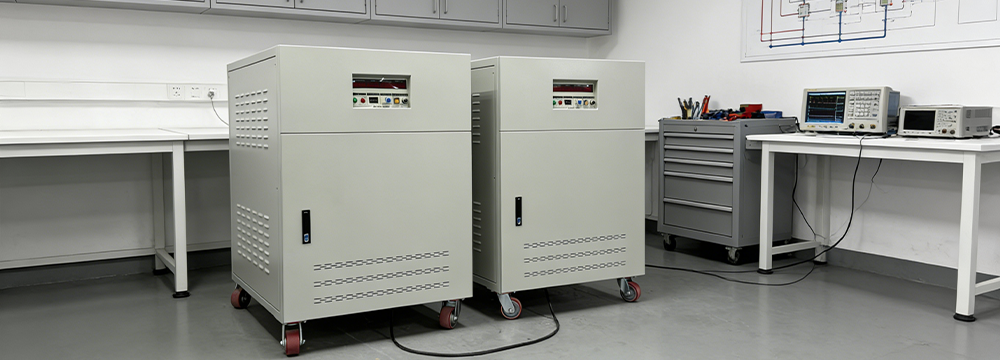
Moreover, distinct advantages in load adaptability and protection response speed are demonstrated by high-frequency variable-frequency power supplies. When faced with impact loads—such as motor startups, capacitor charging, or pulsed loads—rapid output adjustments can be made by these high-frequency units to prevent voltage collapse or overshoot, thus ensuring a continuous and stable testing process.
Within microseconds can anomalies—including overcurrent, overvoltage, short circuits, and overheating—be detected by their high-speed protection circuitry, which swiftly cuts off the output to prevent damage to the Device Under Test (DUT). This capability also avoids test interruptions, thereby enhancing the continuity of long-duration aging and reliability testing.
Moreover, high-frequency variable-frequency power supplies demonstrate distinct advantages regarding load adaptability and protection response speed. When confronted with impact loads—such as motor startups, capacitor charging, or pulsed loads—these high-frequency units can rapidly adjust their output to prevent voltage collapse or overshoot, thereby ensuring a continuous and stable testing process. Their high-speed protection circuitry can detect anomalies—including overcurrent, overvoltage, short circuits, and overheating—within microseconds, swiftly cutting off the output to prevent damage to the Device Under Test (DUT). This capability also prevents test interruptions, thereby enhancing the continuity of long-duration aging and reliability testing.
In summary, by offering faster dynamic response, higher output precision, cleaner waveform quality, more flexible operating condition simulation, and more user-friendly automation integration capabilities, high-frequency variable-frequency power supplies fundamentally resolve the issues of "slowness, imprecision, and instability" inherent in traditional testing methods. In today's environment—characterized by accelerated product iteration cycles and increasingly stringent quality standards—high-frequency variable-frequency power supplies serve not merely as tools for boosting testing efficiency, but as critical equipment for guaranteeing test accuracy, minimizing false-positive rates, and achieving standardized inspection protocols. Selecting the appropriate high-frequency variable-frequency power supply establishes an efficient, precise, and reliable high-speed channel for R&D verification and quality control.