
The Variable frequency power supply is currently the most widely used piece of precision power conversion equipment in fields such as industrial testing, new energy verification, aviation power supply, and equipment burn-in testing. Many people know only that it can alter voltage and frequency, yet they lack an understanding of its internal mechanisms. Using clear, accessible, and professional—rather than obscure—language, this article provides a comprehensive explanation of the variable frequency power supply's overall working principle. It details the core mechanisms by which the device precisely adjusts both voltage and frequency. The full text comprises approximately 1,000 words and is structured with subheadings.
I. The Essence of a Variable Frequency Power Supply: Reconstructing Utility Power
The utility power we use daily operates at a fixed industrial frequency—typically 220V/50Hz domestically and 110V/60Hz internationally—where neither the voltage nor the frequency can be altered. The fundamental essence of a variable frequency power supply is not merely to step voltage up or down, or to perform simple frequency modulation; rather, it involves completely deconstructing the original utility-frequency AC power and subsequently regenerating an entirely new, fully adjustable AC output. By completely breaking free from the constraints of the original utility power parameters, and utilizing power electronics conversion technology, it achieves independent and continuous adjustment of both voltage and frequency while outputting a pure sine wave. It is, in the truest sense, a programmable precision AC power supply.
II. Core Working Principle: The AC-DC-AC Two-Stage Conversion Topology
All mature, industrial-grade variable frequency power supplies currently on the market employ a standard AC-DC-AC bidirectional conversion architecture. The entire operational process is divided into two major stages: the Rectification Stage and the Inversion Stage.
Stage One: AC-DC Rectification and Filtering. The input side connects to the utility power supply. Through a rectifier bridge and a Power Factor Correction (PFC) circuit, the unstable, fixed-frequency AC power is converted into smooth, stable, and pure DC power. Following this rectification and filtering process, the frequency characteristics of the original 50Hz AC input vanish completely, resulting in a DC bus that is independent of frequency fluctuations. This step serves as the foundation for frequency conversion: only by first converting the power into DC can one subsequently freely define and set a new output frequency.
Stage Two: DC-AC Inversion Output. This constitutes the core component of the variable frequency power supply. Internal high-frequency power switching devices—such as IGBTs and MOSFETs—rapidly switch on and off according to a specific control pattern, thereby converting the DC power back into AC power. By precisely controlling switching timing via a high-speed digital master control chip, it becomes possible to freely define the frequency, voltage magnitude, and waveform shape of the output AC power. Ultimately, after passing through an LC filter circuit, a standard, pure sine wave is produced.
To summarize the principle simply: Mains AC input → Rectified into DC → Inverted into a brand-new AC output → Adjustable voltage + Adjustable frequency output.
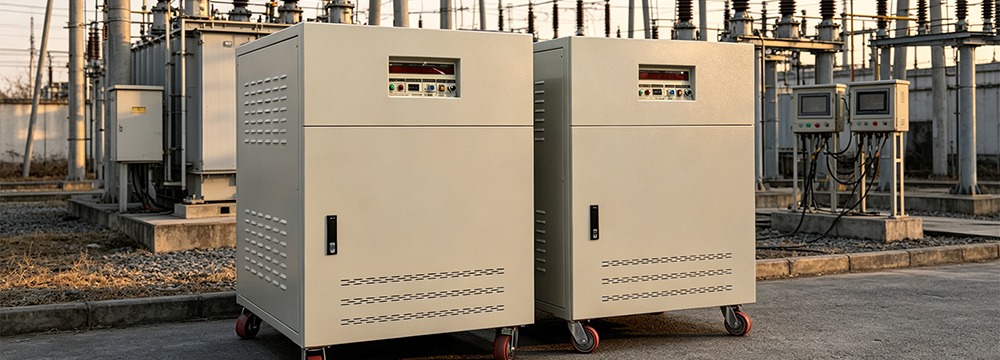
III. How does a variable frequency power supply achieve frequency regulation?
Frequency refers to the number of times AC power undergoes a complete periodic cycle per second. The output frequency of a variable frequency power supply is determined entirely by the control cycle of its inverter switches and bears absolutely no relation to the frequency of the incoming mains power.
The internal architecture of the master control DSP chip features a high-precision crystal oscillator, allowing the system software to freely configure the operating frequency of the inverter switches:
A 50 Hz output is achieved by driving the inverter bridge switches in line with a 50 Hz operating cycle.For 60 Hz output, the control cycle is simply switched to 60 Hz accordingly.To produce the aviation-standard 400 Hz intermediate frequency, the system only needs to raise the inverter control frequency.Realizing a wide adjustable frequency range (45–400 Hz, for example) merely requires adjusting the timing settings inside the control firmware.
No matter if the input mains power is 50 Hz or 60 Hz, it is rectified into direct current first. This means the output frequency is fully independent and adjustable, and will not be affected by input power variations at all. Modern variable frequency power supplies deliver frequency precision up to ±0.01 Hz, delivering exceptional stability even when the input grid fluctuates.
IV. Voltage Regulation Principle of Variable Frequency Power Supplies
Variable frequency power supply adopt advanced SPWM (Sinusoidal Pulse Width Modulation) technology to regulate output voltage.The waveform generated by the inverter bridge is not a pure sine wave directly, but a sequence of high-frequency voltage pulses with variable widths.By adjusting the pulse width and duty cycle, the main control chip can accurately modulate the RMS value of the output voltage.The fundamental principle of voltage regulation can be summarized simply as follows:
Increasing the pulse width → Raises the equivalent output voltage
Decreasing the pulse width → Lowers the equivalent output voltage
Coupled with LC low-pass filtering, these pulses are smoothed into a standard sine wave.
Consequently, a variable frequency power supply offers continuous and smooth voltage adjustment ranging from 0V up to the rated voltage. Furthermore, voltage regulation is entirely independent of frequency regulation: one can adjust the frequency without altering the voltage, adjust the voltage without altering the frequency, or adjust both simultaneously. This fully satisfies diverse requirements such as testing, grid simulation, and equipment burn-in. Voltage control accuracy typically falls within ±0.5%.
V. Closed-Loop Control System: Ensuring Stable, Drift-Free Output
Rectification and inversion alone are insufficient; a precision variable frequency power supply also incorporates real-time digital closed-loop control. High-precision voltage and current sensors are installed at the output terminals to sample actual output values in real-time—at microsecond speeds—and constantly compare them against the user-defined setpoints:
Output voltage is too low → Automatically increases pulse width to boost voltage
Output voltage is too high → Automatically decreases pulse width to lower voltage
Frequency deviation occurs → Immediately corrects the inverter clock cycle
Meanwhile, the system delivers dynamic compensation for load variations, input grid instability and temperature drift.This maintains stable output without waveform deviation or distortion during extended operation, with Total Harmonic Distortion (THD) kept below 1%, producing an output waveform nearly identical to ideal mains power.
The Variable frequency power supply converts utility power into DC via AC-DC rectification, thereby completely eliminating the original industrial-frequency characteristics. It then utilizes DSP digital control combined with SPWM inversion technology to regenerate entirely new AC power. Frequency adjustment is achieved by altering the inverter switching cycle, while voltage adjustment is accomplished by modifying the pulse duty cycle. Finally, through digital closed-loop feedback, it delivers a high-precision, highly stable, and pure sine wave output.
It is precisely this mature and reliable operating principle that enables variable frequency power supplies to simulate global power grids, facilitate new energy testing, provide aviation power support, and conduct equipment burn-in testing—establishing them as indispensable core power supply equipment in modern industrial automation and precision testing applications.