In industrial power supply and electronic equipment power supply scenarios, switching power supply is the core component to ensure stable output. Different output modes correspond to different load characteristics. Choosing the wrong mode will affect equipment life and even cause failures. Many engineers tend to confuse the applicable scenarios of constant voltage, constant current and constant power modes during selection and debugging. Combined with practical applications, this article clearly explains what loads the three modes are used for, helping you achieve accurate matching and stable operation.
Constant Voltage Mode of Switching Power Supply: For Voltage-Sensitive Fixed Loads
Constant voltage mode is the most basic and commonly used output mode of switching power supply. Its core is to keep the output voltage stable, and the current automatically adjusts with the load impedance to meet the rated voltage requirements of the equipment.
This type of load has high requirements for power supply voltage accuracy, and voltage fluctuations will directly lead to abnormal operation. Typical scenarios include industrial control motherboards, communication modules, small controllers, household electronic equipment, laboratory test instruments, etc. These devices have voltage regulator circuits inside, but still rely on external stable voltage input. The constant voltage mode of switching power supply can provide low ripple and high-precision voltage to ensure stable operation of the load.
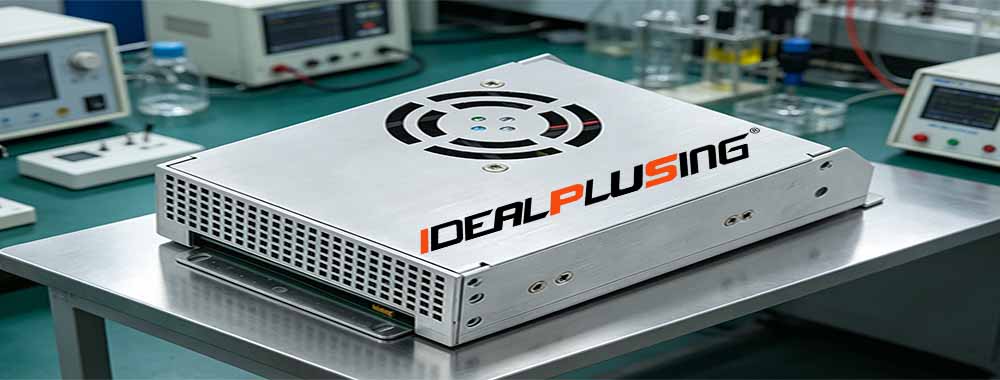
In daily power supply, most fixed-power electronic devices are suitable for constant voltage mode. IDEALPLUSING switching power supply has good stability in constant voltage output, which is suitable for long-term power supply for standard electronic loads.
Constant Current Mode of Switching Power Supply: For Current-Sensitive Variable Loads
In constant current mode, the output current of the switching power supply remains constant, and the voltage automatically adjusts with the change of load impedance, focusing on protecting current-sensitive loads.
The most typical applications are LED lighting drivers, battery charging, laser power supply, some sensor modules, etc. LED beads are extremely sensitive to current fluctuations. Excessive current will easily burn out the beads. Constant current mode can strictly limit the current to ensure uniform brightness and extend service life. Lithium battery charging usually adopts the process of "constant current first and then constant voltage". In the early stage, constant current is used to quickly charge the battery, and in the later stage, constant voltage ensures full charge safety, all of which depend on the constant current control of switching power supply.
In addition, when debugging unknown circuits and testing protection circuits, constant current mode can limit the maximum output current to avoid short-circuit damage to components and improve debugging safety.
Constant Power Mode of Switching Power Supply: For Dynamic Loads with Constant Power
In constant power mode, the switching power supply keeps the output power stable, and the voltage and current automatically adjust in inverse proportion to meet the needs of loads with constant power and dynamic changes of voltage and current.
This type of load is common in industrial motors, spindle drives, some heating equipment and special power supply test scenarios. For example, the spindle of metal processing equipment has changing impedance with speed variation, but needs constant power to maintain cutting force. Some high-power heaters still need stable heating power when resistance fluctuates due to temperature changes. Constant power mode can avoid power fluctuations affecting process effects.
Constant power mode has higher requirements for the control algorithm of switching power supply and needs to respond quickly to load fluctuations. In high-power industrial scenarios, stable constant power output is the key to continuous operation of equipment.
Conclusion
The three modes of switching power supply, namely constant voltage, constant current and constant power, correspond to three types of loads: voltage-sensitive, current-sensitive and constant-power. In practical applications, first clarify the load characteristics, and then match the corresponding output mode, which can not only ensure equipment safety, but also improve system efficiency and service life.