
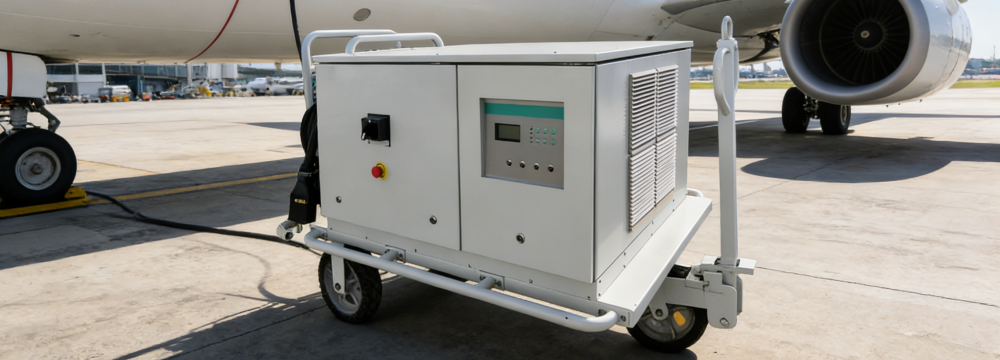
For aircraft maintenance personnel, a 400Hz Ground Power Unit (GPU) is never merely an "optional auxiliary device," but rather a "core support system" that underpins the entire aircraft maintenance process. After an aircraft lands and before it takes off—when its engines are shut down—all avionics diagnostics, system debugging, component repairs, and even cabin support operations rely heavily on a stable supply of 400Hz medium-frequency power. What appears to be a simple power supply device actually directly determines maintenance efficiency and repair quality, and even bears upon flight safety and on-time performance; without it, aircraft maintenance would grind to a halt, making a safe operational release impossible.
Many people wonder: since airports have access to utility mains power and aircraft are equipped with onboard Auxiliary Power Units (APUs), why is a dedicated 400Hz ground power supply absolutely necessary? The answer is simple: standard utility mains operate at 50Hz, while APUs suffer from high fuel consumption and inherent limitations. Not only can a 400Hz ground power unit perfectly meet the specific requirements of an aircraft’s onboard electrical systems, but it also delivers safe, stable, and efficient power support for all maintenance tasks—its significance is evident in every stage of the maintenance process.
I. Replacing APUs: Cutting Maintenance Costs and Mitigating Safety Risks
Not only is an aircraft’s onboard APU capable of supplying ground power, but it also has two critical flaws that render it unsuitable for regular maintenance needs. Excessively high energy consumption is one: running an APU for just one hour uses as much fuel as a small car, and prolonged use drastically drives up an airline’s operational expenses. Equally critical is its high failure risk: as a precision component, the APU is prone to wear and malfunction when subjected to frequent startups. Should it fail, not only are repair costs exorbitant, but the maintenance schedule is also directly delayed.
Resolved are these critical issues by the 400Hz ground power unit. Directly connected to the airport’s utility mains, it outputs the specialized 115V/400Hz medium-frequency power required by the aircraft after frequency conversion—consuming only one-third the energy of an APU. Drastically reduced is the frequency of APU startups by utilizing ground power throughout the entire maintenance period, thereby extending the APU’s service life and lowering both repair and fuel costs. More importantly, exceptional stability is exhibited by ground power units, avoiding the issues of engine flame-outs or power interruptions that can plague APUs, and thus preventing maintenance operations from stalling due to APU malfunctions.
II. Stable Power Supply: Ensuring Precise Avionics System Testing
At the core of aircraft maintenance lies the testing of avionics systems, and extremely stringent requirements are imposed on power supply quality by precision equipment—such as navigation, communication, flight control, and radar systems. Even minute fluctuations in voltage or frequency can lead to distorted test data or even equipment damage. Incompatible with the 400Hz standard required by aircraft onboard systems is conventional utility power, which runs at a commercial frequency of 50Hz, making direct use impossible.
Embedded in the 400Hz ground power unit (GPU) is the key advantage of delivering highly precise, stable intermediate-frequency power. Maintained within ±0.1Hz is frequency stability, restricted to no more than ±0.5% is voltage fluctuation, and provided is a pure, interference-free output waveform. Critical to ensuring accurate, reliable test results—whether conducting avionics self-diagnostics, troubleshooting faults, or calibrating components—is a stable power supply. Eliminated by this stability are misdiagnoses or missed faults caused by power instability, allowing maintenance personnel to pinpoint fault locations precisely and significantly improve maintenance efficiency.
Illustrated by a real-world example is this point: temporarily replaced was a GPU with a standard power source at an airport, leading to errors in avionics testing. Spent by maintenance teams were three precious hours troubleshooting repeatedly before identified was the root cause—a frequency mismatch—ultimately delayed was the aircraft’s departure clearance.
III. Adaptability Across Multiple Scenarios: Supporting the Entire Maintenance Workflow
Encompassed by aircraft maintenance are a wide range of scenarios—from rapid pre-flight checks and in-depth post-flight inspections to component replacement and routine scheduled maintenance. Unmatched by any other power source is the adaptability of the 400Hz ground power unit, which supports every single stage of the maintenance workflow.
Activated rapidly is the GPU during pre-flight maintenance, supplying power to the aircraft’s avionics, hydraulic, and environmental control systems, enabling maintenance personnel to complete self-diagnostics within a short timeframe and ensure the aircraft meets all takeoff standards. Provided by the GPU during post-flight inspections is a continuous, stable power supply, supporting maintenance crews as they conduct comprehensive inspections, repairs, and component replacements on engines, avionics, and airframe structures. Even when an aircraft is parked for extended periods, a continuous, low-power supply can be provided by the GPU to prevent the onboard batteries from discharging and to protect sensitive electronic components from potential damage.
Moreover, available in both fixed and mobile configurations are 400Hz GPUs, offering flexible adaptability—whether for fixed maintenance operations at passenger boarding bridges or mobile troubleshooting at remote parking stands.They effectively meet the diverse requirements of different parking positions and maintenance scenarios, ensuring that maintenance operations remain seamless and uninterrupted. IV. Protecting Onboard Equipment and Mitigating Maintenance Safety Hazards
Aircraft onboard equipment is both precision-engineered and expensive, entailing extremely high maintenance costs; notably, improper power supply stands as one of the primary causes of equipment damage. Conventional power supplies typically lack "soft-start" capabilities and multiple protection features; consequently, the instantaneous current surge upon startup can easily cause dielectric breakdown in avionics modules and damage sensitive electronic components. By comparison, 400Hz aviation ground power units are engineered exclusively for aircraft ground support, featuring native soft-start and linear voltage ramp-up functions. These features reliably suppress inrush currents that could otherwise impair delicate airborne equipment.
Additionally, such units are equipped with comprehensive multi-protection functions, including overvoltage, overcurrent, short-circuit and overheat safeguards. Whenever abnormal operating conditions arise, the GPU immediately shuts down output and activates alarm prompts. This protective design safeguards not only the ground power unit itself but also the aircraft’s high-value onboard systems, avoiding substantial economic losses caused by power anomalies.
Furthermore, airport aprons often present harsh working conditions such as high humidity, salt corrosion and extreme temperature swings. Thanks to their rugged construction and high-grade protection design, 400Hz ground power units maintain steady performance in such demanding environments and greatly reduce potential safety risks during maintenance work.
Conclusion
In aircraft ground maintenance scenarios, the 400Hz ground power unit is never merely a simple power supply device; it stands as an essential foundation for operational safety, work efficiency and cost management.
Replacing onboard APU operation, it cuts fuel consumption and lowers mechanical wear and failure risks. It delivers clean, stable power to guarantee precise diagnostic testing, accommodates complex on-site working conditions to support full maintenance procedures, and shields airborne equipment to minimize hidden safety dangers.
Should a high-performance, dependable 400Hz ground power unit be unavailable, aircraft maintenance would suffer from sluggish efficiency and heightened operational risks. These hazards further jeopardize flight safety and on-time departure performance.
Beyond doubt, the 400Hz GPU stands as an irreplaceable core facility for aircraft ground maintenance, whose indispensable practical value speaks for itself.
Should you have any inquiries or demands, we welcome you to contact us at any time!
Thank you for your continued support and trust in us.