
In factory manufacturing and equipment maintenance, core power sources are none other than electric motors — ranging from small auxiliary units such as fans and water pumps, all the way to large-scale plant machinery including machine tools and production line drive motors. Directly determined by their running efficiency and operational performance are production throughput, energy expenditure, and overall service life of mechanical assets.
Bound to fixed-frequency power supplies are conventional motor control systems, confining motors to run merely at their rated rotational speed. Not only does this mode give rise to massive energy wastage, but it also fails to accommodate fluctuating load demands; frequent issues such as overloading, mechanical vibration and excessive operating noise inevitably follow.
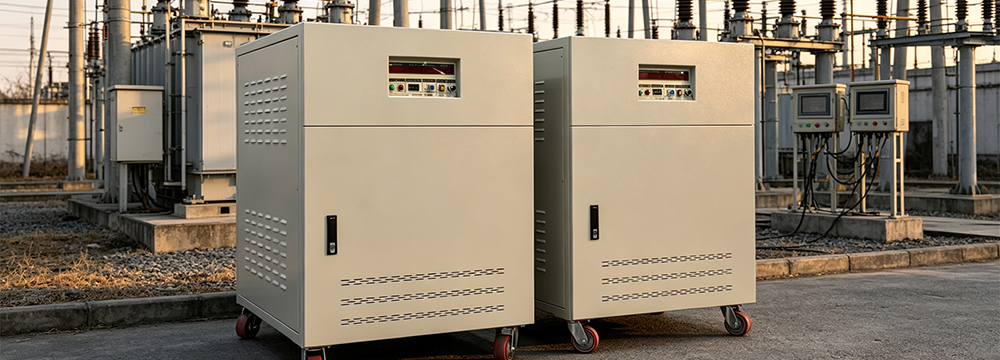
Gone are the inherent drawbacks of conventional motor control, fundamentally reshaped by the emergence of variable frequency power supplies. More than mere frequency adjustment do these units accomplish; through precise modulation of output voltage and frequency, perfect matching is realized between motor speed and actual load conditions. Substantially elevated is motor operating efficiency, and fully optimized is its overall performance — rendering variable frequency power supplies an indispensable cornerstone within modern motor control architectures.
From real-world frontline operational experience shall we analyze in depth how such equipment delivers simultaneous improvements in motor efficiency and operational performance.
I. On-Demand Speed Regulation: Cutting Motor Power Consumption from the Source
Forced to run at rated speed by conventional fixed-frequency power systems are motors, irrespective of real-time load magnitude. Take industrial centrifugal fans as a typical example: for most of their service cycle, full-load operation is not required at all, yet persistently does the motor maintain high-speed rotation. Load regulation is typically achieved only through the manipulation of valves or dampers, resulting in the sheer waste of vast amounts of electrical energy—a primary reason why energy consumption in factory motor systems remains persistently high.
The core advantage of Variable frequency power supply lies in their capacity for "on-demand speed adjustment." By modulating the output frequency, these devices alter the motor's rotational speed to ensure a precise match with the actual load requirements. When the load is light, the frequency is lowered to slow down the motor, thereby reducing energy consumption; conversely, when the load is heavy, the frequency is increased to accelerate the motor and ensure that production demands are met. In practical applications, the adoption of variable frequency control for motors driving fans, pumps, and similar equipment can reduce energy consumption by 20% to 50%. This energy-saving effect is particularly pronounced in motors that frequently operate under low-load conditions.
Crucially, Variable frequency power supplies eliminate the wasteful inefficiency often described as "using a sledgehammer to crack a nut"—that is, oversizing a motor relative to its actual workload. For example, a single 15kW motor, when paired with variable frequency speed control, can adapt to a diverse range of load scenarios without the need for motor replacement. This approach not only saves on capital investment in equipment but also significantly reduces operational energy losses.
II. Soft Start for Motor Protection: Extending Motor Lifespan
When a motor is started directly (direct-on-line), it generates an inrush current 3 to 5 times its rated current. This instantaneous surge can severely damage motor components such as windings and bearings. Over time, this makes the motor prone to issues such as overheating, excessive wear, and burnout—problems that not only increase maintenance costs but also disrupt production continuity. This represents the most significant performance shortcoming inherent in traditional motor control systems.
Variable frequency power supplies feature a "soft start" function. Instead of instantly outputting full voltage and frequency upon startup, they gradually ramp up both parameters, allowing the motor speed to increase incrementally. This ensures that the starting current remains within 1.2 times the rated current, thereby completely eliminating the damaging startup surge. Furthermore, Variable Frequency Power Supplies units enable a "soft stop" capability, preventing the mechanical shock associated with abrupt motor shutdowns and safeguarding both the motor and its transmission components.
Field operational data indicates that motors controlled by Variable Frequency Power Supplies units experience a reduction of over 60% in the probability of winding damage and bearing wear. Consequently, their operational lifespan is extended by a factor of 2 to 3, leading to a drastic reduction in equipment maintenance frequency and downtime, and indirectly boosting overall production efficiency.
III. Precise Speed Control: Optimizing Motor Performance
Many production environments demand extremely high precision regarding motor speed—such as in machine tool operations, conveyor belt systems, and precision instrument drives—where even a minute deviation in speed can compromise product quality or production efficiency. Lacking either speed regulation capability or sufficient tuning precision are traditional fixed-frequency power supplies, falling short of the stringent criteria required by high-precision manufacturing.
Through digital control technology do variable frequency power supplies achieve stepless speed regulation, with control accuracy reaching as high as ±0.1%. Fully matched thereby are the customized speed needs across diverse production scenarios. In machine tool processing, for example, fine tuning of motor rotational speed can be carried out according to workpiece materials and machining standards; greatly improved in turn are machining precision and surface finishing quality. Likewise, on conveyor belt systems, freely adjustable is the running speed in line with material throughput, effectively avoiding material accumulation or overly fast conveying speed.
Also suppressed by variable frequency power supplies is harmonic interference during motor operation, lowering mechanical vibration and operational noise for far smoother running performance. In field practice, by as much as 10–15 decibels can motor noise be reduced under variable frequency control, alongside a marked drop in vibration magnitude. Not only does this upgrade the workshop working environment, but it also lowers the risk of equipment damage induced by long-term vibration.
IV. Adapting to Complex Load Conditions and Improving Motor Compatibility
Faced with intricate load variations in industrial production are numerous motors—including frequent load swings, transient overloads, and extended low-speed running—scenarios ill-suited to conventional power supply designs. All too often do such limitations trigger overload tripping or speed instability, disrupting normal production workflows.
Strong load adaptability do variable frequency power supplies inherently possess. In real time can they track motor load changes, dynamically calibrating output voltage and frequency to sustain steady motor operation amid fluctuating working conditions. For cranes, compressors and other equipment subject to drastic load shifts, swift response is delivered by Variable Frequency Power Supplies to avert motor overload effectively. Moreover, during low-speed motor operation, automatically elevated is the output voltage to compensate for torque deficiency, guaranteeing stable low-speed running and stalling-free performance.
Multiple control modes are also supported by Variable Frequency Power Supplies, covering constant voltage, constant current and constant torque operation. Freely switchable are these modes according to motor categories—such as asynchronous and synchronous units—and actual load demands. Further optimized by this flexibility is overall motor performance, with applicability extended to a broader range of complex industrial scenarios.
Far more than a mere speed-regulating device is the variable frequency power supply in the field of motor control. Through on-demand speed tuning is energy conservation realized; via soft-start functions is motor protection reinforced; with precise speed calibration is operational performance optimized; and by accommodating complex loads is system stability elevated—together bringing simultaneous gains in operational efficiency and overall performance.
For industrial enterprises, multiple benefits are unlocked by adopting Variable Frequency Power Supplies for motor regulation: not only are power consumption and operating expenses cut down and equipment service life prolonged, but production efficiency and finished product quality are also substantially enhanced. It stands as a pivotal strategy in modern industrial production for achieving cost reduction, efficiency gains, and optimized operations and maintenance; indeed, it represents the prevailing trend in modern motor control technology.