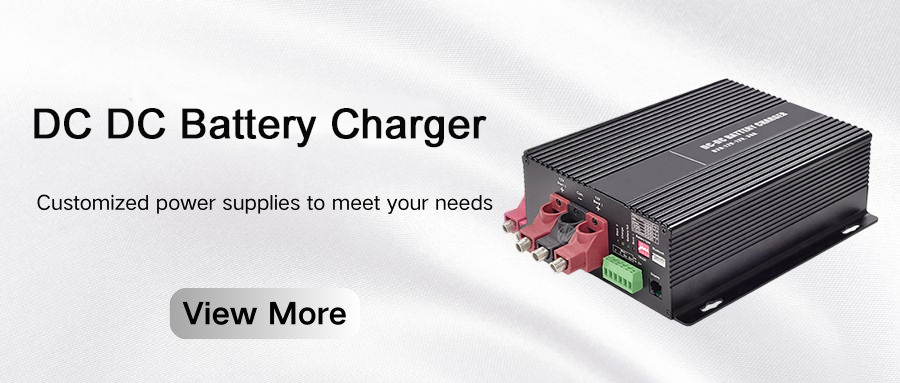
In off-grid photovoltaic systems, vehicle backup power supplies and power supply links of industrial automation equipment, the DC-DC battery charger plays a core role in voltage conversion and safe power replenishment. Many purchasers and engineering personnel only focus on the matching of voltage and current values, but ignore the differences in charging logic of battery chemical systems, and match DC-DC battery chargers at will. This extensive selection method may cause accelerated cell aging, abnormal heating during charging, and even shorten the service cycle of the entire energy storage equipment.
Batteries of different materials vary greatly in cut-off voltage, current bearing capacity and charging stage division. Only selecting a DC-DC battery charger accurately matching battery properties can ensure a stable and controllable charging process. Many enterprises focusing on power supply R&D in the industry, such as IDEALPLUSING, also fine-tune the built-in control logic of DC-DC battery chargers according to the characteristics of different batteries to adapt to diverse on-site working conditions.
Selection Tips of DC-DC Battery Charger for Lead-Acid Batteries
Lead-acid batteries are long-term used in communication base stations, marine backup power supplies and outdoor energy storage equipment. Their chemical reaction rhythm is gentle and they are not suitable for high-current fast charging. The DC-DC battery charger suitable for such batteries must be equipped with a complete three-stage charging structure, including trickle pre-activation, constant current energy replenishment and constant voltage floating charging process.
When selecting a DC-DC battery charger, focus on the voltage regulation accuracy of the equipment. Excessively high voltage will corrode the internal plates of the battery, while low voltage cannot complete full charging. The charging current is recommended to be controlled within 0.1 to 0.2C of the battery capacity. Excessive current will cause the loss of internal electrolyte of the battery, while excessively low current will greatly extend the charging time. For working conditions with alternating high and low outdoor temperatures, it is recommended to select an industrial wide-temperature DC-DC battery charger to ensure stable output under temperature difference environments.
Selection Tips of DC-DC Battery Charger for Ternary Lithium Batteries
With high energy density, ternary lithium batteries are widely used in drones, mobile energy storage devices and intelligent inspection equipment. However, their own voltage tolerance range is narrow, which imposes very strict requirements on the regulation accuracy of DC-DC battery chargers. Such batteries must not be matched with simple DC-DC battery chargers without precise voltage regulation; only models with built-in high-precision constant current and constant voltage regulation can be selected.
In daily use, the charging rate can be relaxed to 0.3 to 0.8C to improve charging efficiency within the safety bottom line. During selection, it is necessary to confirm that the DC-DC battery charger integrates overvoltage, overcurrent and over-temperature protection mechanisms to avoid potential safety hazards caused by high-voltage overcharging. For multi-string combined ternary battery packs, it is also necessary to equip a DC-DC battery charger supporting cell balancing function to balance the charging progress of each cell.
Selection Tips of DC-DC Battery Charger for Lithium Iron Phosphate Batteries
With excellent thermal stability and long cycle life, lithium iron phosphate batteries have become the mainstream choice for RV power supply and photovoltaic energy storage power stations. Its full-charge cut-off parameters are significantly different from those of ternary lithium batteries, and ordinary universal DC-DC battery chargers cannot be used interchangeably.
The DC-DC battery charger suitable for lithium iron phosphate needs dedicated voltage parameter calibration and can withstand higher charging rates, realizing 1C fast charging in industrial scenarios. Facing complex environments such as photovoltaic fluctuation and unstable vehicle voltage, priority should be given to isolated DC-DC battery chargers, which can isolate circuit interference and protect the stable operation of batteries and rear-end loads. High-quality DC-DC battery chargers also have a low-voltage wake-up function, which can perform gentle recovery charging for deeply depleted batteries.
Core Guidelines for General Selection and Avoiding Pitfalls
No matter what type of battery it is matched with, basic practical guidelines should be followed when purchasing a DC-DC battery charger. First, check the input voltage range of the DC-DC battery charger, and give priority to wide-voltage models to adapt to more complex power supply sites. Secondly, there is no need to blindly pursue ultra-high power; reasonable power redundancy is sufficient. Long-term light load or full-load operation will reduce the service life of both DC-DC battery chargers and batteries.
Finally, prioritize DC-DC battery chargers with comprehensive protection. Protection designs such as reverse connection, short circuit and over temperature can effectively reduce the probability of equipment failure and battery damage. Based on the accurate selection of battery types, the DC-DC battery charger can work stably for a long time and extend the service life of the entire power supply system.